

“I go in search of myself. It is in this search that my essence lies. The path I walk in the course of my search belongs to poetry.” These are words Pramil wrote in one of his reflections.
The journey along the path of the arts is a journey towards essence. That is both the nature and the purpose of art. This foundation, shared by all the traditional Indian arts, was consciously set aside in the Tamil land in the modern age, as the modernist outlook and aesthetic entered the art of the novel.
Pramil’s was one of the strongest critical voices raised against this exclusion. He brought a range of spiritual thinkers, from Jiddu Krishnamurti to Yogi Ramsuratkumar, into the conversation within a serious Tamil literary milieu dominated by modernism. In the milieu in which he spoke, none of the modernist figures of the day had any interest in the streams of Indian metaphysical thought. Nor did they possess a deep philosophical grounding in, or understanding of, modernism. This is why Tamil produced only works of limited scope, informed by a modernist outlook and aesthetic but lacking the philosophical depth of modernism and existentialism. Khasakkin Ithikasam, available in Tamil in Yuma Vasuki’s translation, is a modernist novel of the first order. Its author, O. V. Vijayan, was deeply steeped in modernist philosophies. A comparison with Khasakkin Ithikasam reveals what is missing in Tamil modernist writing.
At the same time, there are modernist works that have found the metaphysical quest impossible to evade. Ashokamitran’s story Payanam, for instance. One could describe it as an existential critique of the Indian yogic tradition, the relationship between guru and disciple, and that way of life. Beyond these, Ashokamitran also wrote works of fiction such as Manasarovar, whose essence is the metaphysical quest. Along these lines, one could draw up a short list of fewer than ten works, including A. Madhavan’s Krishnapparunthu and, within a realist aesthetic, Jayakanthan’s Oru Manithan Oru Veedu Oru Ulagam.
Within this current, a highly significant work of fiction concerned with the quest for truth appeared outside the sphere of serious literature, in popular writing. It was serialised over a year in 1995 in the weekly Tamilarasi, edited by M. Natarajan. The work was called Thiruppoonthuruthi. Its author was Balakumaran. Through a protagonist named Mani, and against a particular backdrop, the story described the meditative and spiritual experiences Balakumaran had attained through Yogi Ramsuratkumar. If one sets aside the story’s popular elements and considers only the protagonist’s experiences, the work gave expression to a variety of distinctive inner experiences that serious literature had not so much as touched until then. Since this work moved through emotional realms with which readers could not connect, no general readers, including Balakumaran’s own readership, read it.
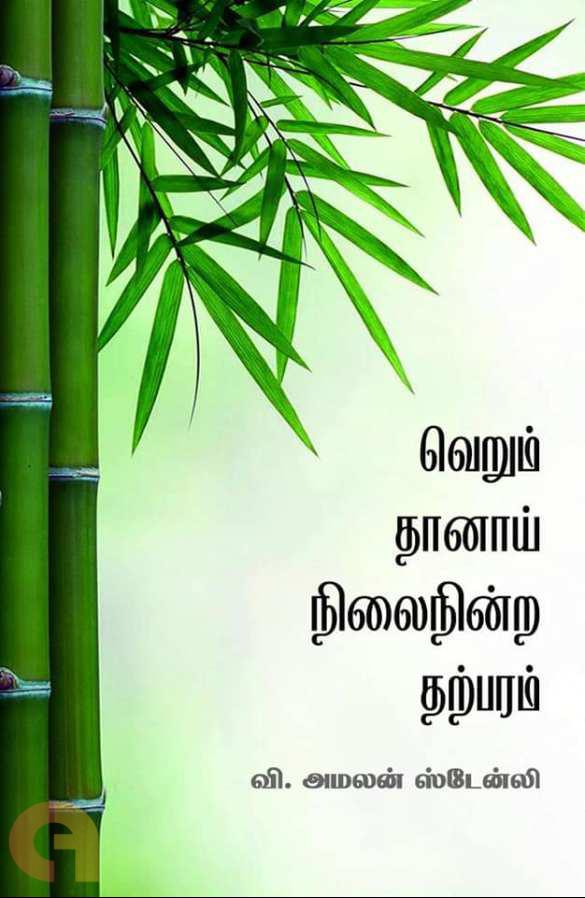
The serious literary circles of the day observed a taboo against popular literature, refusing to share so much as food or water with it; nor were they troubled by any grand anguish such as a metaphysical quest. Thiruppoonthuruthi therefore never came to their notice either. One could say that Jeyamohan’s Vishnupuram, which subsequently arrived with a challenge, was the first Tamil novel to confront fully the demands of fiction devoted to a metaphysical quest. Through later works such as Yuvan Chandrasekar’s Kullachithan Sarithiram, this field has been expanding little by little, in all its varied shades. V. Amalan Stanley’s Verum Thaanaai Nilainindra Tharparam, published by Tamilini, is a highly significant addition to this expanding field.
*
Not only between you and me,
but between myself and me.
These are the closing lines of V. Amalan Stanley’s poem titled Thooram. The ‘self’ that stands at such a distance from itself—there begins the primal, inexhaustible question of the quest for truth: ‘Who am I?’ The question that came to Ramana, who lived 2,500 years after the Buddha. In the sequence ‘I am hungry’, ‘I eat’, who is the I that feels ‘I am hungry’? Who is the I that ‘judges’ that ‘I eat’? The I is the starting point of wisdom. Between the Buddha’s question and Ramana’s lies a cultural burden of 2,500 years. In this year, 2020, what further weight bears down upon this fundamental question, ‘Who am I?’ This is what Verum Thaanaai Nilainindra Tharparam investigates.
Cast as something resembling the autobiographical account of Gerald, known as Jerry, and told from his perspective, this work spans the half-century from 1970 to 2020. It centres on what Jerry gains and loses, from his premature birth at eight months, the youngest of seven children born to a Christian mother and a Hindu father, until his daughter enters Class Twelve.
Jerry begins his story with what he has lost. The death of his elder sister Shantha, who raised him like a mother, and was more than a mother to him. It is this that gives a face to the questions that had been gathering formlessly within him until then. Where does he arrive, seething and seething through a question that has acquired substance? The first death Jerry hears of is that of his elder brother Kenny. It is Kenny’s death that makes Jerry the family’s darling. Later, among the hundreds of pieces of information that reach him from the outside world, comes the tenth anniversary of the lives lost when an entire train was submerged in the Rameswaram cyclone. After that, from the dog he raised to his childhood friends, his grandmother, his father and mother, the massacres of Eelam Tamils—how many, how many deaths.
The madman called Adi Up; Mallika, the policeman-uncle’s wife, reduced to a bundle of ashes; Bharath, who played cricket with him, dying of a blow to the head during a game; the brother of his first love, Devi, drinking poison with his lover and dying; his colleague Ram throwing himself before a train with his lover; Rowther dying after giving life to his son. Besides these, a rooster, a sparrow, a snake. His laboratory mice, butterflies—death after death. Jerry is someone who expresses even his anger by drawing a picture of his own grave. It is all this that shapes Jerry’s inner world and, after Shantha’s death, sharpens and evolves into a question directed towards essence.
The other force that shapes Jerry’s inner world as profoundly as death is lust. His father is portrayed as a man who has relationships with other women even while married to his mother, whom he had married for love. In Jerry’s childhood (there are images here of a sparrow, maddened by desire, striking a ceiling fan and dying, and a dog, unable to bear its lust, giving chase, being bitten, and suffering in pain), a blind man sexually abuses him. Jayanthi’s lust-laden embrace, the womaniser Jerome—images of the turmoil of desire keep recurring throughout Jerry’s life.
There are also illicit relationships born of such desire. The unfulfilled relationship between Devaraj and Vijaya, the story of Charles, born out of wedlock, the degraded lives of the sisters Kasthuri and Gomathi, Niyas’s relationships with women, Ram’s relationship with an older woman, Selvam and Kalpana’s affair—a succession of transgressive desires.
Each life carries a weight multiplied hundreds of times over. Especially the story of the sisters Kasthuri and Gomathi. As Kasthuri takes her younger sister, made pregnant by her husband, to the hospital, her husband Eswaran sits at the street corner, simply watching, utterly unperturbed. This portrayal is one of the novel’s high points. There are women of many different dispositions: Parvathi, who, unlike Kasthuri, severs the relationship and moves on at the very first affair; Jennifer, who wastes her life as a perpetual virgin after Sridhar leaves her. There is a similar variety among the men. Beyond them, from Pattabhi and Amali, the couple who ‘elope’ in old age, to schoolteachers, Professor Anil Agarwal during Jerry’s higher studies, the mentally ill, people of variant sexualities, dogs, cats, and other living creatures, an entire world unfolds around Jerry. Within this world, Jerry evolves in many forms: a premature baby, a middling student, a boy surrounded by friends, a mother’s boy, one whose heart melts for Jesus, one who feels no great sorrow on the day his mother dies, an aspiring priest who fails, a communist, a mediocre musician, an unsuccessful lover, a father who recoils helplessly in disgust when his daughter is picked up, fondled, and kissed by her leprosy-afflicted grandfather, and wrecks his family life; a servant of society struggling to create ecological awareness in his land; a meditator.
Behind every death, behind every transgressive relationship, a life of unbearable sorrow is depicted. Through all these lives, the novel unfolds, interweaving the social and political shifts in Tamil society from 1970 to the present: the railway colony in Chennai’s Perambur, the distinctions among the Christians there, Mettu Street in Ayanavaram, the lives of its Anglo-Indians, the differences between them and the Anglo-Indians of Pallavaram, their gradual dwindling and disappearance, the unemployment Chennai witnessed, the proliferation of bachelor living, and many other changes.
Another principal element, rendered through hundreds of delicate images and shaping Jerry’s inner world, is bibhatsa, revulsion. Shantha squeezes breast milk into Jerry’s eye. From there, Jerry arrives at Shantha lying dead, her belly swollen, her body stiffened on blocks of ice, lice crawling over her face. In his childhood, golden butterflies rise and take flight before his eyes, as though in a dream. Later, they are pinned down for his experiments. A scavenger woman with a mutilated nose carries away their loads of excrement. When Appachi bends down, her uterus bulges and hangs between her legs like an egg; goats are slaughtered at the Ayyanar temple; a garden lizard is cut open in the laboratory; mice carry growing tumours around as though these were their bodies; blood is drawn through a hole made in the spine; his mother develops cancer in her genitals; his father dies, his belly torn open by a vehicle running over him; his friend dies clasping his lover, their bodies shattered by a train; the state in which their bodies lie in the mortuary; legs afflicted with elephantiasis; rows of bodies turned inside out, flesh and blood and stench. Beyond all this is the ecological devastation Jerry encounters in his postgraduate studies in toxicology.
Alongside this, beginning with the first comics he reads and growing from there to Osho, JK, and Ramana, his reading too shapes his inner world. Through his experiences and his reading of literature, he becomes a poet himself and forms friendships with people such as Yuma Vasuki. So do figures he encounters during his higher studies: Dr Jeevanandam of Erode, Vandana Shiva, and Krishnammal Jagannathan. Through all this, through the questions that gather within him, Jerry arrives at the Bodhi Zendo centre in Kodaikanal, and at the inward experiences and clarity he gains there.
Through Jerry’s perspective, through half a century of Chennai’s growth and decay, through political, social, cultural, and spiritual changes (the centre called Bodhi Zendo was established by a Catholic priest), through countless characters and moments in their lives, and through Jerry’s life intertwined with theirs, this work unfolds to give the reader the expansive feeling of having come to know hundreds of lives. It has two powerful features.
First, it sees the whole of the living world as one, and depicts ecological degradation penetrating that unity like a cancerous tumour and growing within it. Second, Jerry’s meditative experiences.
The weakness of this work lies in the construction of its form. There is no artistic reason within the novel—such as a different perception—for the narrative to shift from Jerry’s point of view to Xavier’s. One is obliged to see the shift to Xavier’s perspective as a deliberate act of craftsmanship, undertaken to ensure that a narrative proceeding from Jerry’s point of view does not move too far towards Jerry’s ‘first-person’ position. Even without that device, the novel’s overall emotional tenor remains finely balanced, without being made to ‘stick out’ by the narrator’s point of view.
Two elements make this a distinctive novel in Tamil. First, beyond the modernist works filled with the existential lamentations of an individual abandoned by all the forces that made him, beyond the fictions that babble about life along postmodern theoretical lines and belong in the green bin at the street corner, there is the truth this novel speaks, here and now. The sweet truth that all living beings are one.
Second, the outlook on life that this novel constructs. Buddhism says that suffering has three levels. The first arises from the self. It arises because the self presents itself as something that exists. The second arises from the body. It arises from the conditions of birth, hunger, desire, illness, old age, and death. The third arises from life, from the social environment, from cultural movements. None of these three exists in a state of completeness. That is why it is impermanent. That is why it keeps changing. That is why it is without essence. To remain unaware of this condition is suffering.
There is suffering. There is an end to suffering. There is also a path to the end of suffering.
This is what the novel conveys through its depiction of the life of a moth that adapts by changing colour to suit its surroundings.
There is a Buddhist parable about the pleasure a human being experiences. A man falls into a pit; on the branch from which he hangs is a snake. Below him is a flood, and in it, crocodiles. Death above and below. At that moment, a drop of honey from a hive on the branch falls upon his tongue. In those circumstances, the taste of honey makes the man forget his predicament. Amid the work’s many portrayals of life, there are honeyed moments—Basha’s pranks, the lovely Tamil Rowther speaks—that may be compared to this parable.
Drawing upon all the fields into which the modern metaphysical quest is spreading—meditation, genetics, neuroscience, ecology, the web of life—this work discusses suffering and offers the hope that there is an end to it. The life it portrays has just one taste. The taste of suffering.
*
Book: Verum Thaanaai Nilainindra Tharparam, published by Tamilini, price Rs.550