

1
Two things have played a major role in the development of human culture. The first is agriculture. The second is the rise of the age of machines and factories, made possible by subterranean oil. Social anthropological thinkers say that these two inescapable developments have also left humanity permanently mired in predicaments from which there is no return.
Agriculture came into practice as long as 6,000 years ago. From the day it began, ‘written’ human history also began, according to the rules of surplus valuation. Daniel E. Lieberman, who wrote Manitha Udalin Kathai, observes that humanity acquired ailments ranging from incurable asthma to numerous enduring genetic diseases at the dawn of agricultural culture, when humans began living alongside livestock carrying microbes alien to the human body, and their bodies were thrust into a different dietary regime.
Unlike other creatures, a human child needs at least fifteen years after birth to adapt to social life. Throughout these years, the child remains dependent on the care of other human beings. Agriculture became a sustained activity because, in this respect, an agricultural life offered greater advantages than a hunting life. The human body had developed on a diet obtained through hunting, at the exceedingly slow pace of evolution. Agricultural culture abruptly interrupted this process with an excess of nourishment; the adaptations that followed, Lieberman says, left the human body with many of the chronic diseases that persist to this day.
The flowering of the Renaissance was also a time when the indiscriminate application of science and technology surged. It was Francis Bacon who provided a powerful philosophical foundation for the idea that analysing, conquering and exploiting nature was the right—and indeed the duty—of human intelligence. Its surplus consequences, which continue today in the destruction of the Arctic’s polar reaches, reached their height during the two world wars. There is also an important perspective here that sees agriculture as the foundation of both world wars. The history of how every nation that entered the wars drained its farmers to the last drop remains, even today, inadequately documented. In this age of polar destruction, disruptions to seasonal cycles caused by global warming, and dwindling groundwater—an age scholars regard as the beginning of the sixth great extinction—the world’s human population has now reached eight billion. Another anthropological reckoning tells us that unless two billion people remain permanently shackled to agriculture and other forms of food production, daily food for eight billion people is simply impossible.
2
The reality of the world today is that agriculture, mechanical power and the use of subterranean elements cannot operate without affecting the environment. In Britain, which had grown fat by draining the whole world, the first voice raised against this destruction belonged to a poet. William Wordsworth fought against the intrusion of a railway into his native landscape. This voice, carried forward by America’s Emerson, came to reverberate across the world only after Rachel Carson’s Mouna Vasantham. In India, one of the most powerful voices raised against environmental destruction was Gandhi’s. In literature, from Bibhutibhushan Bandyopadhyay’s Vanavasi in Bengal then to Jeyamohan’s Kaadu in the Tamil landscape today, there is a powerful continuity of writing about deforestation and environmental destruction.
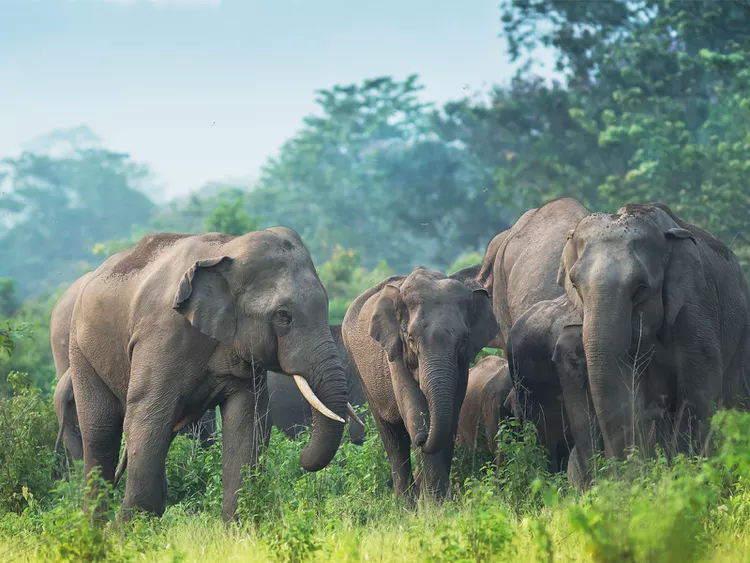
Environmental destruction poses its first threat to the principal large animal of a given landscape. If polar bears face that threat at the poles, in India the foremost creatures confronting it are elephants. To survive, they must walk an average of twenty-five kilometres a day and eat up to a hundred kilograms of food. Their digestive systems function in a distinctive way: whatever they eat is only half digested, so they must remain perpetually hungry, perpetually eating. They have no sweat glands. Their need for water is therefore considerable too. India once possessed the forests and seasonal conditions in which elephants, with all these needs, could thrive.
From the seals of the Indus Valley to the clearing of Assam’s forests to establish tea plantations, the story of Indian history’s unfolding through elephants is recounted at length in Thomas Trautmann’s Yaanaigalum Arasargalum, translated by Theodore Baskaran, and the researcher Raman Sukumaran’s Endrendrum Yaanaigal, published by Tamilini. These books also describe the condition of those that remain today, after their abandonment following Independence, the shrinking of their habitats, and deaths through hunting, railway collisions and the torment of human–animal conflict. In this long succession comes Su. Venugopal’s novel Valasai. Through the perspective of a farmer named Sukumaran, with the present unfolding in action and the past in memory, it recounts four days of anguished conflict between the lives of the forest and the lives of the fields, in a village bordering the forests of the Western Ghats in present-day Coimbatore.
3
There is a reply Jayakanthan once gave to a question about writing for popular magazines: “Which magazine I write for, or whether I write on a palmyra frond, does not matter. The one writing it is ‘I’. That alone matters here.” Su. Venugopal entered the world of serious literature with much the same disposition. His first novel, Nunvelik Kiraganangal, was published by a literary group once active in my district of Cuddalore. Merely because the novel had won first prize in Kumudam’s novel competition, the serious literary world of the time hesitated to read or publish it. Since then, through works such as Koonthappanai, Nilam Enum Nallaal, Balconigal and Aattam, Su. Venugopal has established himself as a writer who cannot be disregarded in the field of serious literature. His Valasai, too, is a novel that won first prize in a literary competition.
The foremost beauty of this novel, which moves between the lives of farming communities and tribal communities, and between tribal life and the lives of forest creatures, lies in the three-dimensional world it creates through a language alive with poetic flashes such as ‘the night in which light sleeps’. This begins with the very first image, as Sukumaran steps into his sorghum field to irrigate it at night. The way the ears of grain stand, their sheen, the pallor of their leaf-arms for want of water, the heat rising from the field: from here to the final page, the world unfolds at every joint, giving the reader an experience akin to encountering it directly through the senses.
Chellapandiyan, Kathiresan, Kaaliyannan, Uncle Pavunu—all the people of the surrounding lands are related to the narrator in one way or another. It is an immense joint family. It was Grandfather Maasaiyya who nurtured both these relationships and their farming life. Whatever happens on their lands becomes a joy or sorrow shared by all.
More than power shortages and other such difficulties, the greatest problem in their farming life is the invasion of wild boar. Next come the elephants, whose shrinking forest habitats drive them into the fields in search of food. Against this background, the past unfolds through the narrator’s memories: the evil deep within the human heart that emerges through Geetha’s illicit relationship; a picture extending from the thieves in Ammachi’s story, who submit to a deity’s authority, to land and society falling into the hands of the great thieves who submit to nothing—the thieves of government, officialdom and corporate power; and the antagonisms arising from caste hierarchies among farming communities. These densely rendered portrayals of individual depths and social decline are presented in a measure suited to the novel’s terrain. If Grandfather Maasaiyya of the farming community stands on the highest rung of the evolutionary ladder by which forests are destroyed and turned into fields, Saamana Muthuvar stands on the lowest rung of tribal life’s decline, as people lose their forests and become the dispossessed, refugees in their own country.
Beginning in the time of Saamana Muthuvar’s grandfather, they gradually lose their habitat and their hunting-and-gathering life, move into agricultural wage labour, and then leave even that, dwindling and disappearing. Their lack of literacy; cultivated foods, including coconuts, that the Muthuvar community had never known in its forest life, whose flavours slowly draw them out of the forest and into the life of the fields; their gradual loss of forest and communal life from the age of the zamindars to the age of Jaggi—at the centre of these two lives, woven together as warp and weft, emerges the picture of the decline of forest creatures.
Alongside these, one of the novel’s important arcs concerns Sukumaran, who enters the forest as a sick child, passes the remainder of his boyhood amid rare experiences, and returns to farming life with the health the forest has given him. These are vividly living pictures: a home in the Muthuvar settlement; the rituals surrounding a girl’s coming of age in their community; their dancing, singing and music; their healing practices; the feast of thorny yam relished by the community’s ancient patriarch; the feast of mountain honey gathered and celebrated by the tribal boys together; their deities and the clans of forest creatures.
Sukumaran climbs a hill with Kunthaali to see their deity, and the image of the tusker they see from there is among the most intense of the novel’s many powerful elephant portraits. An elephant distraught, not knowing its calf is dead; a calf in anguish, not knowing its mother is dead; a tusker fighting a bloody battle to establish its alpha-male dominance; that same elephant yielding to a younger tusker the very female for whom it fought; elephants guarding their calves and tending their families; elephants parched with thirst in the summer’s desert-like forest, and revelling in the drenching forests of the monsoon; an elephant lifting a child that crosses its path as gently as a flower, setting it aside and moving on; an elephant wedging its own decayed tusk into a cleft in a rock, breaking it off and casting it away; an elephant, in passing, rescuing a cow heavy with calf from the jaws of a tiger; a kumki elephant going in alone to beat back and scatter an entire herd—through these many distinctive portrayals, the novel performs the magic of making us become the elephant, that great creature, and feel its nature and its social life from within.
4
Explosives concealed in tubers to catch wild boar; firecrackers that go off automatically once every hour; barriers built from drums pierced with holes in which a boar’s tusks will catch; blankets woven from creepers and pulled over sleepers to keep elephants from scenting them; remedies made with elephant dung; the digging of trenches to prevent elephants from entering the fields—the novel moves through a wealth of such fine detail, which reaches its height in the descriptions of how elephants eat. These passages describe how elephants dig up and tear out each kind of tree, plant, fruit and tender shoot in the forest to feed on it. When they descend on the fields, our hearts tremble for the ripened crop as though a child we had raised were caught beneath an elephant’s feet.
This story, set amid the confrontation between a herd of elephants and a community of humans, reaches its climax in the actions of Saleem, the kumki elephant brought in to drive away the herd that has entered the fields. It is a singular portrayal, combining credibility and emotional intensity in a way Tamil literature has not seen before. The novel moves between the dreamlike forest life Sukumaran experienced among the Muthuvar community in childhood and his farming life as a young man, in a reality filled with daily struggles. Then, one early morning, in a state of bewilderment in which he cannot tell whether he is asleep or awake, Saamana Muthuvar’s call leads him out of this reality into another, into the elephants’ social life in the forest, and the novel takes on an entirely different colour. The whole depiction of elephant society that unfolds there spontaneously raises a critique of the nature of human society. The novel’s emotional life unfolds around this powerful centre.
This rich novel has two strengths. The first is outward-looking: through its portrayal of Kunthaali, who has become Christina, it asks what spirituality we lose, and what spirituality we gain. The second is inward-looking: the expansiveness of heart Sukumaran acquires by living with the elephant family led by Ponni, in both the parched landscape and the landscape of torrential rain. It is an expansiveness that moves him to embrace everyone, including the younger sister with whom he quarrelled and whom he drove away, long since buried in his forgetfulness. This is the truth he brings back from the forest, from those great creatures, the elephants, into his village and his social life.
The novel’s weakness is that, in this balance with humans on one side and elephants on the other, the needle leans too far towards the elephants. The lives of the fields cannot live in any way other than this. Nor can the lives of the forest live otherwise. What a terrain it is, then, when two inescapable ‘rights’ must stand opposed to each other. By leaning so heavily towards the elephants, the novel sidesteps a challenge that would unsettle any writer and moves on. As a result, it proceeds towards a state of ‘saying everything’, leaving no space at all for the reader.
5
This is one of the beautiful poems in the expanse of Sangam literature.
The soft-headed calf of the great, thick-kneed cow elephant
ran round and round with the short-wristed children
born to a hill woman in a hamlet rich in toddy.
Sweet in those earlier days, but later,
when it grazed upon their millet field,
their laughter and play turned to enmity.
When they are young, the cow elephant watches her calves run and play with the hill woman’s children. Time passes, and when the grown elephants see those same children, now grown themselves, they go to play as before. But things are different now. Between the two stands a field cleared from the forest. Fearing damage to their crops, the people beat the elephants away. How can the elephants know that ownership of land has undone the state of ‘we’ and brought into being the division of ‘us’ and ‘you’?
Beyond the strengths and weakness mentioned above, what distinguishes this novel is that it presents, with artistic intensity, a fundamental problem concerning the web of life and the environment—a problem that has persisted from the Sangam age to the present—entwined with the complexities of our own time, against a background lit by the enduring flame of compassion. In this respect, this novel too stands among the most important works in Su. Venugopal’s literary world.