

In the town of Lashnik, near Lublin, lived a married couple, Chaim Noson and Teibele. They had no surviving children. Barrenness was not the reason. Teibele had borne her husband a son and two daughters. All three had been lost: one to whooping cough, one to a malignant fever, and one to diphtheria. After that, Teibele’s womb closed its eyes. Prayers, charms, herbal brews—nothing did any good. Grief drove Chaim Noson away from worldly life. He withdrew from his wife. He gave up meat. Even at night he would not come home, but slept on a bench in the prayer house. Teibele owned a dry-goods shop her parents had given her. She sat there all day long. To her right lay a measuring rod, to her left a pair of scissors, and before her a Yiddish edition of the women’s prayer book. Chaim Noson was tall and thin, with dark eyes and a short beard. Even in happier times he had been ill-tempered. Teibele was small, with a ruddy complexion, blue eyes, and a round face. Despite the terrible sorrows God had inflicted upon her, she was quick to laugh, and her dimples were lovely. Though she had no one else to cook for, not a day passed without her tending the stove or setting up three stones for a hearth and making herself some porridge or gruel. She did all kinds of sewing: stockings, underclothes, floral embroidery on white linen. It was not in her nature to bewail her fate or wallow in sorrow.
One day Chaim Noson packed his prayer shawl, the leather pouch containing his sacred scrolls, a single change of underwear, and some bread, and left home. When a neighbour asked where he was going, he replied, ‘Wherever my eyes lead me.’
Teibele learned of her husband’s departure too late to catch up with him. He had already crossed to the other bank. Word reached her that he had hired an ox cart to take him to Lublin. Teibele sent a messenger to bring him back. But neither her husband nor the messenger ever returned. At thirty-three, Teibele became an abandoned wife.
After searching for some time, she understood that there was nothing left to hope for. God had taken her husband just as He had taken her children. She could never remarry. She would have to live alone. Apart from her house, her shop, and her possessions, she had nothing of her own. The townspeople pitied her, for she was quiet, kind-hearted, and honest in her dealings. Many asked why such cruelties should befall her. God’s reckonings are hidden from humankind.
Many of the married women in town were Teibele’s childhood friends. Busy all day with their pots and pans, they would sit down in the evening for a chat. In summer they sat on the bench outside the house, gossiping and exchanging stories.
One dark, moonless summer evening, Teibele sat on the bench with her friends and told them a story she had read in a book bought from a peddler. It was about a young Jewish woman. A demon gave her pleasure. The two lived as husband and wife. Teibele told the story at length. The women huddled close together, clasped hands, spat to ward off evil spirits, and laughed fearfully.
One of them asked, ‘Why didn’t she show the demon an amulet and drive him away?’
‘Not every demon is afraid of amulets,’ Teibele replied.
‘Why didn’t she go to a holy rabbi?’
‘The demon had warned her that he would strangle her if she revealed the secret.’
‘Oh, may God protect us! Whoever heard of such a thing!’ one woman cried in alarm.
‘Now I’m afraid to go home,’ said another.
‘I’ll go with you,’ a third reassured her.
As they talked, Alchonon, the teacher’s assistant, happened to pass by. His ambition was to become a wedding jester. A widower for five years, he was known as a buffoon, a prankster, and something of a madman. His shoes were so worn and tattered that no one heard his footsteps. He stopped to eavesdrop as Teibele told her story. The thick darkness and the women’s absorption in the tale concealed his presence. Alchonon was a troublemaker. He had any number of tricks up his sleeve. Suddenly a mischievous plan took shape in his mind.
After all the women had gone, Alchonon remained hidden in Teibele’s yard. From behind a tree, he peered through the window. When he saw Teibele put out the candle and go to bed, he slipped into the house. Teibele had not bolted the door. Theft was unheard of in that town. Standing in the entrance hall, he took off his loose robe. He loosened his clothing and removed his shirt. Then he took off his trousers and stood naked as the day he was born. He tiptoed to Teibele’s bed. She had begun to fall asleep when she saw a figure moving before her in the darkness. She was afraid to make a sound.
Trembling, she asked in a faint voice, ‘Who is it?’
Alchonon answered in a voice that cut through the air. ‘Don’t scream, Teibele. If you scream, I’ll kill you. I am the demon Armisa, king of darkness, of hail and thunder, and of wild beasts. The spirit who loved a Jewish woman, whose story you told tonight—that was I. You told the tale with such fervour that you roused me in the netherworld. Ever since I heard it, I have burned with desire for your body. Do not try to resist me. If I choose, I can drag those who oppose me beyond the darkness of this earth’s mountains to the summit of Mount Seir and satisfy my desire. No human foot has ever trodden there. Even beasts fear to approach it. The ground is iron and the sky copper. I will roll your body in thorns and fire, grind it to dust where scorpions and giant scorpions dwell, destroy it for ever, and dissolve it in the abyss. But if you yield to my desire, I will not let a hair fall from your head. At every step I will grant you success and joy.’
On hearing this, Teibele lay motionless, as though she had fainted. Her pounding heart seemed about to stop. She thought death was near. After a few moments, she summoned a little courage and murmured, ‘What do you want of me? I’m a married woman!’
‘Your husband is dead. I followed his funeral procession myself.’ The teacher’s assistant raised his voice. ‘I cannot go to the rabbi and testify that you are free to remarry. Rabbis do not believe us. Besides, I dare not cross the threshold of a rabbi’s room. I fear the sacred scrolls. But I am not lying. Your husband died of a pestilence. Worms have eaten the nostrils of his corpse. Even if he were alive, there would be nothing to prevent you from lying with me. The laws of the Shulchan Aruch do not apply to us.’
Armisa persisted, now sweet-talking, now threatening. He invoked the names of angels and devils and recited a catalogue of fearsome beasts and ghouls. He solemnly declared that Asmodeus, king of the demons, was his uncle’s cousin. Lilith, queen of the evil powers, had danced for him on one leg and performed all manner of tricks for his amusement. The demoness Shibta, who stole infants from women, had baked poppy-seed cakes for him in the ovens of hell, rendered the fat of sorcerers and dogs, and spread it over them. With bawdy tales and proverbs, he went on talking at length until Teibele was persuaded to smile. Armisa swore that he had loved her for a long time. He described the dresses and outer garments she had worn the previous year and the year before that. He recounted the secret thoughts that had arisen in her mind while she kneaded dough, prepared the Sabbath meal, washed herself in the bathtub, or went to the privy. He reminded her how she had woken one morning to find black-and-blue marks on her breast and had thought a demon had pinched her. In truth, he said, they were the marks of kisses from Armisa’s lips.
Before long the demon was sitting on Teibele’s bed and had obtained her consent. He said he would visit her twice a week, on Wednesday and Saturday nights. Those were the two nights on which evil powers were free to roam the earth. He warned that she would be severely punished if she told anyone what had happened to her, or so much as hinted at it. He threatened to tear out her hair, gouge out her eyes, and bite her navel. He would cast her into the terrible solitude of hell, where dung was bread and blood was served at table. There the howling of Zalmaweth could be heard night and day. He made Teibele swear upon her mother’s remains to keep the secret all her life. Teibele could see no way of escape. She placed her hand on his thigh and swore. She did everything the demon told her.
Being a demon and not a man, Armisa gave her a long, lustful kiss before departing. When she kissed him in return, her tears wet the demon’s beard. Evil spirit though he was, the demon treated her tenderly.
After Armisa had gone, Teibele fell back upon her pillow and wept until dawn.
Armisa never failed to come on Wednesday and Saturday nights. Teibele was afraid she might give birth to a little devil with horns and a tail. Armisa promised to protect her from such disgrace. When she asked whether she should continue her ritual bathing during her days of impurity, he told her that the laws of menstruation did not apply to a woman who coupled with a supernatural creature that knew no purity.
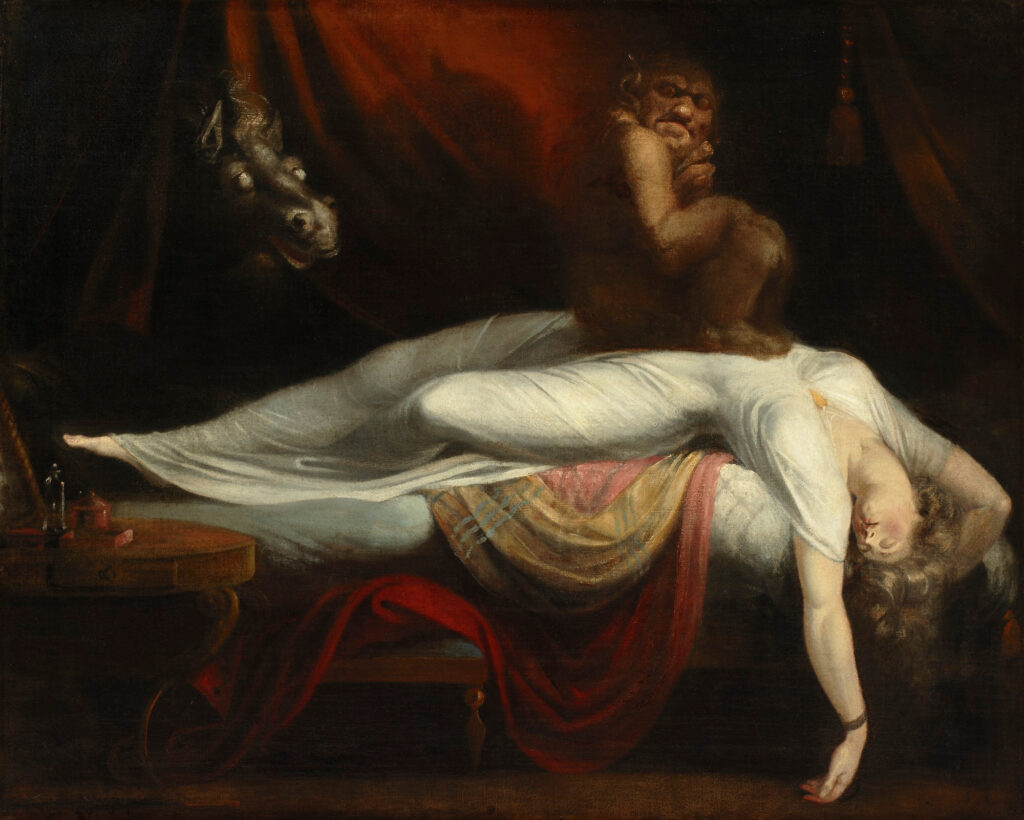
There is a saying: may God protect us from whatever we grow accustomed to. So it was with Teibele. At first she feared that her nocturnal visitor might harm her. She was afraid he might cover her with boils, make her hair grow in matted locks, force her to bark like a dog and drink urine, or degrade her in other ways. But Armisa neither whipped her nor pinched her nor spat upon her. Instead he caressed her, whispered tender words into her ear, told jokes, and sang sweetly. Sometimes he made her laugh with demonic games and nonsense. He folded her earlobe and left love bites on her shoulder. In the morning she would find the marks of his teeth on her skin. He said that if she let her hair grow long, he would braid it for her. He taught her spells and incantations. He described flying about with his nocturnal companions over desolate lands teeming with frogs, the salt marshes of Sodom, and the refuse of the frozen sea. He did not conceal the fact that he had other wives. But they were all demonesses. Teibele was his only human wife. When she asked their names, he promptly listed them: Nama, Meglath, Af, Sultha, Lucha, Nafka, and Cheima. Seven in all.
Nama was dark and fierce-tempered. When she quarrelled with him, she spat venom, breathed fire, and sent smoke pouring from her nostrils.
Meglath had a face like a leech. Anyone she touched with her tongue was marked for ever.
Af loved ornaments of silver, emeralds, and diamonds. She braided coils of gold into her hair. She wore bells and bangles about her ankles. When she danced, the bells rang throughout the desert.
Sultha had the form of a cat. When she spoke, she could only mew. Her eyes were green as gooseberries. While coupling, she chewed a bear’s liver.
Lucha was the enemy of brides and bridegrooms. She stole the virility of newly married men. If a bride came alone at night to receive the seven blessings, and Sultha approached her dancing, the woman would lose her power of speech or be seized with convulsions.
Nafka was a wanton. She was always deceiving him and coupling with other demons. He had not yet driven her away only because her impudent, filthy talk delighted him.
Cheima, to live up to her name, ought to have been crueller than Nama. In truth she was quite the opposite. She was a modest demoness. She performed many good deeds, kneading dough for sick housewives and taking bread to the homes of the poor.
Thus Armisa described his wives. He told Teibele how happily he lived with them, how they hid on rooftops and played all kinds of hide-and-seek. A woman grows jealous when she learns that her husband is involved with other women. But how could a human woman be jealous of demonesses? Here it was otherwise. Armisa’s stories excited Teibele. She asked him many questions. Sometimes he told her secrets that should never be revealed to mortals. He spoke of God, jinn, celestial musicians, the palaces of heaven, and the seven paradises. He told her how the dark angels of hell tortured male and female sinners in cauldrons of oil, how they roasted them in pans over coals, made them lie in pits of snow and on beds of nails, and beat them with metal rods heated in the fire.
The greatest of all the torments of hell, Armisa said, was tickling. A little devil named Lekish lived there. Once, when he tickled the soles and armpits of a prostitute, her laughter echoed as far as the island of Madagascar.
In this way Armisa entertained Teibele all night long. When he was away, she began to long for him. The summer nights seemed far too short.
Armisa would leave as soon as the crow cawed. Even the winter nights were not long enough for her. She loved Armisa. Though she knew it was wrong for a woman to love a demon, she yearned for his coming night and day.
Since Alchonon had lived without a wife for so many years, the matchmakers tried to arrange another marriage for him. All the women they proposed were from humble households, widows, or divorcees. Those were the only women a teacher’s assistant could expect on his wages. Besides, Alchonon had the distinction of being known as a good-for-nothing madman. He rejected the women on one pretext or another. One was too ugly, another had too sharp a tongue, and a third looked like a streetwalker. The matchmakers marvelled that a teacher’s assistant earning nine groschen a week could afford to be so choosy. How long could a man live alone? But no one could be forced into marriage.
Alchonon often wandered aimlessly about the town. He was tall and lean, with a mop of red hair and a crumpled shirt. His Adam’s apple bobbed up and down continually. He was waiting for Reb Zekhili, the wedding jester, to die. Only then, he reckoned, could he take over the job. But Reb Zekhili was in no hurry to die. As lively as he had been in his youth, he poured forth an inexhaustible stream of jokes and rhyming quips. When Alchonon tried to become a teacher of beginners himself, no one would trust him with a child. Morning and evening he escorted the little boys to the cheder. During the day he sat in the courtyard of Reb Ichili, the teacher, sharpening wooden pointers. Or he cut out paper decorations for the synagogue’s annual celebration of Pentecost, or made clay figures. Several times a day he came to the well near Teibele’s shop to drink, wetting his red beard, or to fill a barrel. Each time he would glance quickly at Teibele and turn away. She sometimes pitied him, wondering why the man had to do so much work all by himself. And each time Alchonon said inwardly, ‘Teibele, you sinner! If only you knew the truth!’
Alchonon lived in a storeroom at the back of an old widow’s house. Deaf and half-blind, the old woman often scolded him for not going to the prayer house like other Jews. After taking the boys home, he would hurry back, say his evening prayers, and go to bed. Sometimes the old woman sensed that he rose at midnight and went somewhere. When she asked where he roamed at night, Alchonon denied doing any such thing and said she must have dreamed it. Sitting on the bench with the gossiping women in the evening, mending a stocking, the old woman started a rumour that Alchonon turned into a half-beast at midnight. Someone said that he coupled with a demoness called a succubus. How else could a man live alone for so long without a wife? None of the wealthy would entrust their children to him. Now he took only the children of the poor to the cheder. He seldom had a decent meal. Often he subsisted on dried nuts and seeds.
Alchonon grew thinner and thinner. But his feet remained as nimble as ever. Watching him glide through the streets on his long, skinny legs, one might have thought he was dancing on stilts. He was often thirsty and would come to the well. Sometimes he drew water for a merchant’s or a peasant’s horse. One day Teibele saw from a distance that his coat was in tatters. She called him into her shop. He started, and his face went pale.
‘Your coat is torn,’ Teibele said. ‘If you like, I can give you a few cubits of cloth. You can pay me back a little at a time, five coins a week.’
‘No.’
‘Why not?’ Teibele asked in surprise. ‘Even if you’re late paying, I won’t embarrass you by asking for it in front of your rabbi. Pay me when you can.’
‘No.’ Afraid she might recognize his voice, he hurried away.
It had been easy to visit Teibele at midnight in summer. He could slip in through the backyard and walk naked, holding his robe behind him. In winter it was difficult to dress and undress in Teibele’s entrance hall. Nights after a fresh snowfall were the worst. He worried that Teibele or her neighbours might notice his footprints. He caught cold and coughed. One night he sat on Teibele’s bed with his teeth chattering. His body took a long time to warm up. Fearing that she might discover his deception, he invented explanations and fresh excuses. But Teibele never suspected him or scrutinized him. She had always believed that demons had human habits and frailties. Armisa sweated. He sneezed, hiccupped, and yawned. Sometimes his breath smelled of onions, sometimes of garlic. His body, like her husband’s, was bony and covered with hair, with an Adam’s apple and a navel. Sometimes Armisa was in a playful mood. At other times he sighed. His feet were not like a goose’s but like a man’s, with toenails and blisters. Once, when Teibele asked him about them, he explained, ‘Any one of us who couples with a human woman takes on the appearance of a human man. Otherwise she would die of fright.’
Teibele had grown thoroughly accustomed to him. She loved him. His supernatural antics no longer frightened her as they once had. She noticed contradictions in his endless stories. Like all liars, he had lapses of memory. Earlier he had told her that demons were immortal. But one night he asked, ‘What will you do if I die?’
‘But demons never die.’
‘True. But sometimes they fall into the deepest abyss, from which there is no return.’
That winter an epidemic swept through the town. Foul air rose from the river, the forest, and the marshes. Not only children but grown men and women shivered with fever and chills. It rained. Hail fell. Floodwaters broke the dam. A gale tore off one arm of the windmill. One Wednesday night, when Armisa came to Teibele’s bed, she felt that his body was burning hot. His feet, though, were cold as ice. He trembled and groaned. He tried to amuse her with stories of the demonesses. He told her how they seduced young men, how they played and took their pleasure with other demons. They leapt into the ritual baths and splashed the water about. They tied a tiny queen of lust, invisible to the eye, into the beards of old men. Though the men burned with desire, they lacked the strength to possess her. Teibele had never seen him in such a pitiful state. Her heart was troubled. ‘Shall I give you raspberries mixed with milk?’ she asked.
‘Remedies like that are no use to our kind,’ Armisa replied. ‘What do you do when you fall ill?’
‘We itch and scratch.’
After that he said little. When he kissed Teibele, his breath smelled sour. Usually he stayed with her until the crow called, but that night he left very early. Teibele lay quietly, listening to his movements in the entrance hall. He had told her that he could pass through the window and fly away even when it was shut. But that night she heard the door open. She knew it was a sin to pray for evil creatures, that one ought to curse them and blot out their memory. Yet that night she prayed to God for Armisa.
In her anguish she cried, ‘There are so many demons. Let this one live among them too.’
The following Saturday night, Teibele waited for Armisa until dawn. He never came. In her mind she summoned him with the incantations he had taught her. But the entrance hall remained silent. She lay as though benumbed. Armisa had once boasted that he had danced for Tubal-Cain and Enoch, sat in Noah’s ark, licked the salt from the nose of Lot’s wife, and tugged at Ahasuerus’s beard. He had prophesied that a hundred years hence she would be born a princess, and that with the help of his servants Shittim and Tachkim he would abduct her and carry her away to the palace of Basemath, Esau’s wife. But now he lay ill somewhere, a demon with no one to help him, an orphan without father or mother or an honest wife to tend him. She remembered how unevenly he had breathed the last time he lay beside her. His breath had whistled through his nostrils. From Sunday to Wednesday, Teibele passed her days as though in a dream. She could find no rest until the clock struck midnight on Wednesday. Still Armisa did not appear. Teibele turned her face to the wall.
The day began as dark as evening. Snow poured from the gloomy sky like a cloud of dust. Smoke could not rise from the chimneys. It spread like tattered cloth over the rooftops. Ravens cawed fiercely. Dogs barked. After her sorrowful night, Teibele had no heart to go to the shop. Nevertheless, she dressed and set out. She saw four pallbearers carrying a bier. The blue feet of the corpse protruded from the snow-covered shroud. Only a single religious official followed the body. When Teibele asked who had died, he replied, ‘Alchonon, the teacher’s assistant.’
A strange impulse came over Teibele to follow the funeral procession of Alchonon, who had lived without obligations, alone, and had died alone. Who would come to the shop today? What did business matter to her? Teibele had lost everything. At least she could perform a good deed. She followed along the long road to the cemetery. She stood waiting while the gravedigger cleared away the snow and dug into the frozen earth. They wrapped Alchonon, the teacher’s assistant, in a shroud and a loose robe. They placed shards over his eyes. Between his fingers they put a sprig of myrtle. The belief was that the dead man could use it to dig his way out of the grave and meet the Redeemer when he came. They filled the grave and recited the Kaddish. Teibele broke down and wept. This Alchonon, too, had lived alone, as she did. Like her, he had no children. Alchonon, the teacher’s assistant, had danced his last dance. From Armisa’s stories, Teibele knew that the dead did not go straight to heaven. Every sin brought forth a demon. After a man’s death, those demons roamed about as his children. They would return to claim their share. Calling the dead man father, they would chase him through a savage wilderness, hounding and tossing him about until his punishment was complete. Only then would he be sent to suffer the torments of hell.
From that day on, Teibele lived alone. Twice abandoned—by an ascetic and by a demon. She grew old quickly. Nothing of her past remained with her except a secret that could never be told, and would never be believed if it were. There are secrets the heart cannot tell even to the lips. Their burden must be borne to the grave. Rows of oleanders murmur them. Crows caw them aloud. Gravestones speak of them silently in the language of stones. One day the dead will awaken. But the Lord knows all their secrets. They will remain with Him until the Day of Judgment, when every generation has lived out its days.
*
English original: Teibele and her demon by Isaac Bashevis Singer, The Collected Stories: A Library of America Boxed Set, November 2015 Edition.