

The close of a dark, soundless day of the year; clouds crept along the edge of heaven. After riding all day through a town with little life or beauty, I found this house of Usher only at dusk.
I cannot say exactly what it was like. But at the very first sight it filled my soul with sorrow. The scene unfolds before my eyes: the house, the land around it, the chill walls of the building, the vacant, eye-shaped windows, a few lifeless trees. I look at the house with my utterly sorrowing soul, feeling severed from all earthly ties. I do not know how to lighten the burden of my chilled and sickened heart. Why does the sight of that house of Usher frighten me so? What makes me so afraid, I ask myself. I cannot discover the answer.
I halted my horse beside the dark pool behind the house, frozen in silence. In its waters I saw the reflection of the lifeless trees, the vacant, eye-shaped windows, and the house. I thought of the many weeks I would have to spend in this house filled with sorrow and darkness. Its master was Roderick Usher. We had been friends since we were boys. Yet many years had passed since we had seen one another. A letter had come to me from him. It stipulated that my reply must be a visit. He had written of his illness, his troubled mind, and his wish to see me, his one true friend. The manner in which he expressed himself, and the life in his words, left me unable to refuse.
Even when we were together as boys, I had known little about my friend. All I knew was that his family had a fine appreciation of the arts, and that they were also renowned for helping the poor. I knew, too, that it was not a large family with many branches. The family name had always passed from father to son. Whenever people spoke of the house of Usher, they meant both the family and the house together.
Now I look again at the image of the house in the lake. A strange idea begins to grow in my mind—so strange that the weight of the feelings it imposes upon me is almost unbearable. I firmly believed that the air moving through that house and over the land around it was different. It was not air that came from heaven. It rose from the dead, decaying trees, the grey walls, and the silent lake. I could see that this heavy, slow-moving grey air was unhealthy, diseased. Bracing my soul against what might have been a dream, I looked more closely at the building, and what struck me was its age. Though none of its walls had yet fallen, the stones alone appeared to be crumbling. A careful eye could not fail to notice a fissure on the front of the building, beginning at the top of the wall and running all the way down before disappearing into the black waters of the lake.
2
Roderick Usher, whom I had known as a boy, was now in ill health and had asked me to visit and help him. When I arrived, that great, ancient stone house and the lake before it seemed strange and frightening. Indeed, Usher himself appeared much the same. He looked less like an ordinary human being than a spirit risen from a burial ground. He said, “I shall surely die” of his illness, and named that illness “fear.” “My fear is not of what is happening now, but of what is to come. I do not fear pain, only its consequences—only fear itself. I feel that the time will soon come when, in the final battle with that terrible enemy called fear, I shall lose my life, my mind, my soul, all at once,” he said.
Through words that were neither coherent nor certain, yet full of meaning, I slowly came to understand another strange truth about Usher’s state of mind. He was greatly afraid of the house in which he lived. For many years he had never gone outside it. He felt that the house, its grey walls, the silence surrounding it, and that motionless lake had, for years, exercised a powerful hold over his soul.
He said that the chief cause of the great sorrow surrounding him—a cause not readily apparent—was the death drawing near his sister, who was dear and close to him, and who had been ill for many years and his sole companion. She was the only other surviving member of the family. I can never forget the grief that came over me when he said, “When she dies.” “When she dies, I alone shall remain, the last of this ancient family, the last of this house of Usher,” he said.
While he was speaking, his sister, who was called Madeline, passed across the far corner of the room. At first I sat without noticing her. Then I looked at her with great wonder and fear. Yet I could not fully account for those feelings. My eyes followed her. When she reached the door, closed it, and went away, my eyes turned to her brother’s face. But he held his face in his hands. All I could see then were his tears flowing between his slender fingers, whiter than ever before.
Madeline’s illness was beyond the physicians’ power to cure. She cared about nothing. Day by day her body grew thinner and weaker. She often sank into a sleep resembling death. Until then she had not been compelled to take to her bed. But Usher told me that night that the power of the one seeking to destroy her had been especially strong on the evening I entered the house.
For many days afterwards, neither of us spoke her name. During this time I devoted myself to trying to rescue my friend from his sorrow and despair. We painted together; sometimes we immersed ourselves in the music he played as though in a dream. In this way a warm and affectionate friendship began to grow between us. I then understood clearly the futility of trying to bring happiness to a mind that poured forth nothing but darkness and spread endless sorrow over everything in the world.
I shall always remember the hours I spent with Usher. But any attempt to describe the true nature of the things we did together would end in failure. A strange light lay over everything in that house; I did not know why. But the pictures he painted made me tremble. To speak of them lies beyond the power of written words. If a man could paint a thought, that man could only be Roderick Usher. Fear and wonder burst from those paintings.
I think I might speak of one of those pictures, though I can do so only in feeble words. It showed the interior of a vault where the dead might be laid, its low walls white and bare. It seemed to me to lie deep beneath the earth. There were no doors or windows, no light or fire, in the picture. Yet a river of light flowed through it with a dreadful radiance and filled it.
I have already spoken of the sickness of Usher’s senses, which turned every kind of music he heard into an intensification of his pain. There were very few notes he could hear with pleasure. Perhaps this was why the music he played differed from all other music. But I cannot explain its profound beauty. What I can readily recall is a phrase from one of his songs: “The Haunted Palace.” I thought, too, that this was the first time I had seen that he himself knew his mind was weakening. The song told of “a king who lived in a great house, a palace, and how everything in that green valley was light and colour and beauty, and even the air was fragrant.” There were two radiant windows in the palace. The people who lived in the happy valley heard the music coming through them and saw spirits moving about the king with smiles. The palace door was made of costly red and white materials. The sole task of certain spirits entering through it was to sing, in their sweet voices, of the king’s wisdom.
But a great change came. The song continued. Now, however, those entering the valley see a red light through the windows. That light dances to discordant music. Through the doors appears a river of colourless, terrible spirits. They stream out, never smiling gently, but always grinning.
Our conversation about this song brought another strange idea into Usher’s mind. He believed that plants could feel and think. He believed that not only plants but stones and water, too, possessed this power. He believed that the grey stones of his house, the plants growing over those little stones, and the dying trees all held sway over him and had brought him to his present condition.
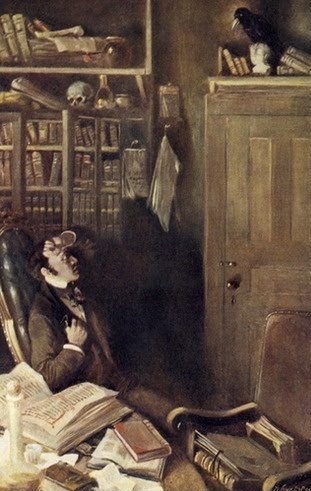
It also seemed certain to me that all the books he had been reading for so long must have shared the feverish nature of a sick man. Usher had read some of them for hours on end. His mind took its keenest delight in reading a very old book about a forgotten church, entitled Irandhavargalin Meedhana Paarvai.
One evening he told me, “Madeline is no longer alive,” and said that he intended to keep her body for a time in one of the vaults within the walls of the building. He said he had decided to do this not only because of the nature of her illness and the strange, curious questions the physicians might ask, but also because the burial ground where all the other members of his family lay was far from the house. I found these reasons acceptable.
Together we carried her body to the resting chamber of the house and placed it in a vault that was very small and dark. It must have witnessed strange and bloody scenes in the past. It lay deep within the building. I myself had slept there before. Its door was made of heavy iron and gave out a very loud sound whenever it was opened or closed. As we placed Madeline’s body in that dreadful chamber, I noticed for the first time the striking resemblance between brother and sister. Usher said that they were twins, born on the same day, and that this was why they shared such a deep understanding and so powerful a bond. We looked at her face one last time. I was filled with wonder. Madeline lay there as though asleep rather than dead. Even after death she looked gentle and serene. Only the stones around us were cold.
3
I visited my friend Roderick Usher in his old stone house—his mansion—where death seemed to hang in the air. I saw how fear weighed upon his mind and heart. We placed the body of his only sister, Madeline, in a cold, dark, and frightening vault. When I looked at her face, I saw a very strong resemblance between them. “Of course! For we were born on the same day; the bond between us is very firm,” Usher said. Fear and wonder surrounded our hearts, and we could not look at her for long. There was a smile upon her lips that might linger a little longer. We closed the iron door and returned to rooms steeped in a sorrow greater than that of the vault.
A change now came over my friend’s sick mind. With quick, hurried steps he went from room to room. His face grew paler and more dreadful than before. The light in his eyes was gone. The tremor in his voice revealed an immense fear. At times he sat for hours staring into emptiness, as though listening to some sound I could not hear. I felt certain that his condition was slowly beginning to take hold of me. I felt his feverish thoughts settling into my own mind.
On the seventh or eighth night after we had placed Madeline in the vault, I felt the full force of these feelings as I went to bed. The hours passed; sleep would not come. My mind struggled against its weakening. I wanted to believe that I felt this way because of the sorrowful room and the dark wall pictures rising in the wind and stirring against the walls. But my efforts were in vain. An uncontrollable trembling filled my body. A causeless fear seized my heart. Without knowing it, I sat up, staring into the darkness of my room, to listen to a few faint sounds that had fallen quiet during the storm. A terrible feeling settled heavily upon me. I dressed and began to walk anxiously about the room.
I had been walking for only a short while when soft footsteps approached my room. I knew they were Usher’s. A moment later I saw him, his face pale as usual. There was a wild laughter in his eyes. Yet his company made me glad. “Have you not seen it?” he asked. He quickly led me to a window and opened it. A storm.
The force of the wind rushing in almost lifted us both off our feet. It was certainly a beautiful, storm-filled night. But it was wild and strange. The clouds hung low, seeming to press down upon the house; instead of moving away, they flew against one another from every direction and returned again. Their dense mass cut off the light of the moon and stars. Yet we could see them. For we saw that they were lit by the air rising from the dark lake and the stones of the house.
“You must not look at this! You shall not!” I said to Usher, leading him to a chair. “This sight that astonishes you has been seen in many other places. The lake is surely the cause. Let us close this window; the air is damp. Here is one of your favourite stories. I shall read it. Listen to me. Together we shall live through this fearful night.”
The old book I had chosen was written by a fool for fools to read. It was not, in truth, a favourite of Usher’s. But it was the one most readily to hand. He seemed to listen quietly as I read. I now reached a passage in which a strong man, who had drunk heavily, begins to break down a door. The sound of the dry wood splintering could be heard throughout the forest around him.
Suddenly I stopped reading, for I began to hear sounds from distant parts of the house just like those in the story I was reading. It was my fascination with those sounds that made me notice them; the gathering storm did not frighten me.
I continue reading the story. Now the man enters through the broken door. A strange and terrible beast appears, as is usual in old tales of this kind. He strikes it. It falls with so loud a shriek that he covers his ears with his hands. Here I stopped reading once more.
There was no doubt. This time I had certainly heard, some distance away, something like the beast’s cry, just as it had happened in the story. I restrained myself so that my friend should see nothing of what I felt. I could not say for certain whether he had heard the sound. But I noticed a change in him. He had now slowly shifted his chair so that I could not see him clearly. I saw his lips moving as though he were speaking to himself. Then his head sank forward. But I knew he was not asleep, for his eyes were open. Besides, he was rocking his body from side to side.
I began reading the story again. Now, as it was written in the tale, a heavy piece of iron fell upon a stone floor with the ringing sound of a bell. At the very instant these words left my lips, I heard, distinctly though from some distance away, a loud sound like the ringing of a bell. It sounded as though a piece of iron had really fallen upon the floor, or an iron door had just closed. I lost all control of myself and sprang from my chair. Usher remained seated, rocking from side to side. His eyes turned towards the floor. I hurried to his chair and laid my hand on his shoulder, and felt that his whole body was trembling. A sickly smile touched his lips. In a very low, rapid, faltering voice, he spoke as though unaware that I was there.
“Yes! I heard it. For many minutes, many hours, many days, I have heard it. But I dared not speak of it. We have put her living self into the vault. Did I not tell you how keen my senses are? I heard her movements many days ago. But I had not the courage to speak of them. And now this story you have been reading—but those sounds are hers. Where shall I run? She is coming to ask why I put her there so soon. I hear his footsteps on the stairs. I hear the loud beating of her heart.” As he said this, he sprang up and cried as though surrendering his soul: “Even now she stands at the door.”
The great door to which he pointed now slowly opened. Perhaps it was only the work of the wind. But no. A figure stood outside that door. The grey clothes upon that tall figure were Madeline’s. Blood could be seen upon her white dress. Every part of that figure showed the desperate effort she had made to escape. She stood trembling by the door for a few moments, then, with a faint cry, fell painfully upon her brother. Already dead herself, she dragged him down with her to the floor.
In the end he was killed by his own fear. I began to run from that room, from that house. As I crossed the bridge, the storm surrounded me in its full strength. Suddenly a great light moved over the ground at my feet. I turned to see where it came from, for behind me there was only the great house and its darkness. It was the light of the full moon—a moon reddened with blood. The moon was now shining through the fissure I had seen in the front wall when I first looked upon the mansion. I watched that small crack widen and spread. A powerful wind rushed towards me. The full face of the moon appeared. I saw the great walls break and fall. I heard the long shriek of the storm. The deep, black lake gathered what remained of the house of Usher into its darkness and closed over it.
*
English original: The Fall of the House of Usher by Edgar Allan Poe, The Fall of the House of Usher and Other Writings, Published by Penguin Classics, March 2003 Edition.