
Chapter 20
As the car approached the gate, the man came running, as though he had been waiting for it. The guard who had opened the gate hurriedly caught hold of him and pulled him back. “How many times have I told you? Here you are again. Go on, get over there.” Adjusting his cap, he shut the gate. In the mirror, Durga could see the man pointing inside and arguing again.
“Find out who that is,” Durga told Nani as she got out.
“Someone looking for a break in films. What’s new about that? Doesn’t it happen every day? You go on. We’ll see to it.” Nani went up the steps, idly twirling the key between his fingers.
Durga stood looking towards the gate. She beckoned to the guard. He came running.
“Who is he? What does he want?”
“That man’s been coming here for two days, making a nuisance of himself, madam. Says he’s a friend of Rao sir’s. I couldn’t believe him. That’s why I chased him away.”
Durga felt a sudden desire to see the man. “How old would he be?”
“Over fifty. A dirty dhoti. An old shirt. He must have found out that Rao sir is here.”
“Go and bring him in.”
The guard ran off. He opened the gate and peered out. A few minutes later, the man came in. He walked bent over, almost hunchbacked. But there was no weariness in him. With his grey hair and beard, a tattered bag slung over his shoulder, he came running, holding up the hem of his dhoti with one hand. The guard hurried after him. “Wait. Take it slowly. Madam’s asked you to come in.”
Durga waited in the hall. Though she had been with Rao sir all these years, everything she knew about him came only from what she had seen for herself. He had never spoken of who or what he had been before, and Durga had never asked. She waited now, thinking this might be a chance to learn something.
“My respects, madam.” The Telugu startled her for a moment. She brought her palms together.
“Please sit down.”
“I’m Balayya. Vengi’s friend.”
The guard, who had been waiting for her permission, withdrew at her nod. At the name Vengi, Durga looked intently at the man for a moment. A servant came and stood respectfully beside her.
“What would you like to drink?”
“I’ll drink whatever you give me. Whatever you like.” His Tamil now was flawless.
“You drink coffee, don’t you?”
When he nodded, the servant disappeared inside.
“I can see you’re confused, madam. He started in Telugu. Now he’s speaking Tamil. He calls Rao sir Vengidu. You’re wondering whether to trust him. Am I right?”
Durga said nothing.
“Fair enough. Your Gurkha hasn’t let me anywhere near the place for two days. Can’t blame him either. How many people turn up every day saying things like this? It must be a nuisance for you too. But I’m not like that. My only fault is being dirty and ragged like this. Otherwise, you can believe what I tell you. I’ve known for a while that you’ve taken Vengidu in and are looking after him. What am I saying? Doesn’t the whole world know? But I didn’t come to see him. When he was well, I’d meet him now and then. He’d give me money too. There was no fixed time or place. Whenever the thought struck us. Once or twice he took me to Tirupati. It was some time before I heard what had happened to him. I didn’t believe it when I first heard. I was certain nothing like this could happen to him. So I didn’t take it seriously. Only when I heard it again, once or twice, and read about it, did I know it was true. I couldn’t bear it.”
He did not look at her face as he spoke. He spoke looking at the vase on the round table. His eyes wandered. His fingers wrote in the air. Words poured out of him, as though he would speak whether she listened or not.
When the steaming coffee arrived, he eagerly picked it up and drank. He did not wait for it to cool. Setting the cup down, he looked up hesitantly. “If you don’t mind, could I have another cup?”
He finished the second cup too. “May I see Vengidu?”
“Of course. How do you know him?”
Balayya’s eyes widened. “How could you ask me that? Vengidu and I were at college together. Didn’t he tell you? But how could he have? Why would he tell you about me?”
“He went to college? Where?”
“So you don’t know anything at all. Well, well.”
Durga spread her hands wearily. “You tell me.”
“One moment. May I have some betel? You don’t mind, do you?” From his bag he took a smaller, even dirtier bag and pulled out two wilted betel leaves. He added areca nut and slaked lime, folded them and put them in his mouth.
“Vengidu goes to Tirupati every month. Did you know that?”
“Yes.”
“Why?”
“He loves the Lord.”
“That’s true. But another important reason is that it’s his hometown.”
Durga sat up. Such a reason had never occurred to her.
“His hometown is Chandragiri, near Tirupati. There’s an old fort there, isn’t there? That’s the place. His father had a shop there. An elder brother and two elder sisters. I got to know him when he finished school and joined college in Tirupati. I’m from Chittoor. He used to cycle in from his village. Neither of us was much good at studies. But we were both mad about films. Somehow we’d scrape together the money and go to the cinema.”
By then his mouth had filled with betel juice. He rose, asked where the toilet was and went off. He returned wiping his mouth. “I shouldn’t have had the betel. Can’t say what I want to.”
Durga waited to hear what he would say next.
“His sisters got married when he was in his second and third years at college. His father set up a bangle shop for the elder one and a flower shop for the younger. He got his elder brother a job with the temple administration. That was as much as he could manage. Vengidu was the youngest. So no one bothered about him then. When he finished college, he left for Madras.
“I’d come here before him, you see. The two of us roamed around Kodambakkam. Those were the days when Telugu people held sway in cinema. For six months, nothing happened. At least I went home now and then. Vengidu never even thought about it. Then, on the recommendation of someone important in the Tirupati temple trust, we joined the director Avula Rajeswara Rao as assistant directors. Both the films he made after we joined were hits. So he kept us with him. We thought he’d somehow get us a film to direct. After that, he kept getting films. One would be a hit, the next two would do moderately well. But he’d made a name for himself as a big director. We’d been with him for two years and nothing had changed for us. I lost hope. I left and went to another director. After a year there, things weren’t working out, so I joined someone else. In four years I worked for six directors. Nothing came together. But Vengidu stayed loyal to Raja Rao for five years. Whether there was a film or not, he clung to him as his only hope. He’d see to things around the house as well. If there was no shooting, he ate at that house. He never even thought of leaving.
“For those who make it big, the desire to produce their own film is often their undoing. It was the same with Raja Rao. He made grand plans. Borrowed a lot of money. When the film was three-quarters finished, he had a small argument with the hero. It ended in a fight over who was the bigger man. The hero showed him. He couldn’t finish the film. Everyone who’d lent him money began pressing him. Interest on interest, and more interest on top of that—it mounted at a dizzying rate. There was nothing he could do. It came to the point where he had to give up everything: the bungalow, the car, the jewellery.
“The biggest loans had come from men from the south. The days of the Seths were over; these fellows had just moved in. They had political influence, hired muscle, police support—everything. You couldn’t touch them. You either paid up or did what they told you. They’d be at your door at daybreak. They’d use filthy language in front of the women and children. Turn the hall itself into a latrine. There were people who killed themselves out of humiliation.
“Even that was nothing. If they knew the money wasn’t coming, they’d abduct actresses, the girls in the house. Keep them for a month or two, make money off them, then send them back. There are plenty of stories we’ve heard. Plenty more that never reached anyone’s ears.
“Raja Rao’s misfortune was that he had a beautiful daughter. College-going age. They carried her off. We knew it was them. But there was no getting near them. ‘Bring the money, then talk’—that was their only answer. No one knew where they were keeping her or what they were doing to her. Even then, our Vengidu stayed with the director. There was no salary. Still, he didn’t leave.
“He fell at the moneylenders’ feet, wept and pleaded. Ran here and there. No one came to help. A month went by. In the end, when they realised there was no money to be had, they brought the girl back themselves. Apparently they’d kept her in a bungalow in some grove near Theni. They brought her back in the dead of night. Vengidu was there that day. He couldn’t bear to look at the girl. She stared as though she’d seen a ghost. Lay there utterly limp. Her mother and Vengidu took her to hospital, got medicines and brought her home.
“They were living in a rented house in Perambur then. Everyone went to sleep, exhausted. Unable to bear the grief and shame, her mother hanged herself. The director couldn’t take the sight of it. He’d already had an angioplasty. A heart attack. He died too. The girl was in a daze, unable to understand what was happening. Only the director’s mother was left to look after her. Just think what it must have been like.
“They came back after burying them both, and the landlord told them to vacate immediately. Grandmother and granddaughter stood there, not knowing where to go or what to do. He was from Kakinada. A long way away. Once they knew he was ruined, none of his relatives came anywhere near him. Then Vengidu found a house and settled the two of them there. Bought them what they needed for their meals. Meanwhile, a producer who understood Vengidu’s character and knew his abilities took him on as a manager. He’d come here wanting to direct films. Fate made him a production manager. But he didn’t lose heart. He did the work he was given sincerely.
“He put the girl back in college, hoping it would bring a change in her state of mind. However much you try to keep such things quiet, they get out easily enough. The girl came under pressure everywhere. Where she lived, at college, everywhere. He didn’t give up either. Moved her to a house in another neighbourhood. Paid the fees all over again and put her in another college.
“The old woman didn’t last long. She closed her eyes. What could be done now? What was he to do with a girl left all alone? That was when he made that decision. Pity or compassion… God alone knows. Only Mother Padmavati knows what was in his mind. He asked the girl if she agreed. She said nothing. What other way was there? He took four or five close friends with him to Tirupati. At Mother Padmavati’s temple in Tiruchanur, he tied the thali around her neck. I was there too.
“But there’s one thing. He’s told me this. No, I was the one who asked him one day when I was drunk: ‘She’s your wife now. Did you ask her what happened that month?’ He didn’t get angry. Didn’t fly into a rage. By rights he should have hit me. But he said, ‘What am I going to do with that knowledge? I don’t need to know.’
“That’s the kind of man he is! Someone who wouldn’t wish the slightest harm on anyone. His brother and sisters are still in Tirupati. He keeps doing whatever he can for them. People say the Lord will look after you. We think that’s why he goes to see Him every month. But he’s beyond all that.
“If this can happen even to him, it must indeed be the age of Kali. I stayed away because I couldn’t bear to see him in such a state. But two weeks ago, another friend of ours died—he’d been an assistant director with us, and had gone to ruin just like me. Vengidu knew him too. When he fell ill and was in hospital, I thought the same way and didn’t go to see him. In the end, one day he closed his eyes. Now, even if I want to, I can’t see him. I felt terrible. I thought I mustn’t keep putting off seeing Vengidu. So I came looking for him.”
She had listened, staring at the floor. She made no attempt to wipe away the tears that welled up and streamed down. All the dots she had placed here and there had joined up; the kolam was complete. She could not bear it. How wrong she had been to think that no one else could have known the misery of standing helpless in the middle of the street in the rain, holding Shravya, with nowhere to turn. Beside her all along had been a man who had taken on a burden even more unbearable, and lived without letting any of it show. My sorrow was one that fell to me. One caused by Prithvi. But the sorrow he took upon himself belonged to someone else. It had nothing whatever to do with him. Was this magnanimity? Sacrifice? No. It was something beyond all those things. It had no name. If one had to name it, perhaps the only fitting words would be ‘Rao sir’.
“I’ve poured out everything that was on my mind. May I see him?” Balayya took out his betel leaves.
“One moment. Have another coffee, then you can have your betel.”
His face brightened as he nodded.
“You haven’t told me anything about yourself. What do you do?”
He spread his hands. Shook his head. Pursed his lips. “Nothing came of it. All those years wasted. You know what happens to people who come here pinning their hopes on cinema. A few come to their senses and get out. Plenty of people like us keep waiting here—if not today, then tomorrow; if not tomorrow, then another day. Every one of them knows nothing is certain. Yet he believes something is bound to happen for him alone. However many times he fails, he won’t stop. All it takes is a phone call the next moment, and he’ll forget everything and run off to tell his story. I kept running like that too. When I look back, I’ve done nothing worthwhile to speak of. And I’ve grown old. I don’t have the heart to go back home either. What would I do there? What else was there to do? I did whatever work I could get. Nothing in particular. One meal was enough; I’d do anything. I’m at a wedding hall in Valasaravakkam now. You could call me the manager, if you like. There’s a place to stay and food for certain. That suited me, so I stayed on. I’ll just have to see out the rest of my days there.”
He ate the bonda with relish. He finished his coffee while it was still hot, and rose contentedly.
“Keep this.” She folded some five-hundred-rupee notes and held them out.
“What for, madam? You have a generous heart. Just like him. May you be well.” He took them eagerly and stowed them safely in his bag.
“He’s in the outhouse. Come, let’s go.” The light at the entrance was on. As they walked along the garden path, the balcony lights came on too. She could see Teja opening the door.
Chapter 25
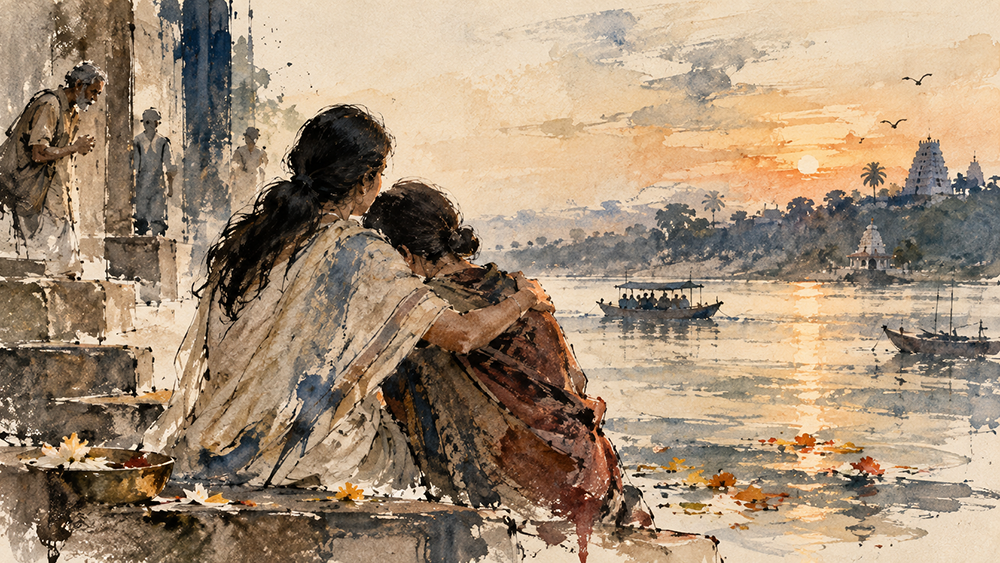
The Godavari flowed, touching its banks. Brown waters rolled and curled, swelling and surging. Wet footprints marked the sun-baked steps. Crows hopped and fluttered, their eyes on the rice-ball offerings. Shenbagalakshmi had drawn her sari over her head. Roopa and Ramya sat beside her, watching the priest’s rituals attentively. Fallen chrysanthemum petals floated on the water.
Durga waited in the shade of the peepal tree on the bank. The ashes of the man called Venkateswara Rao, who had walked about in flesh and bone, with life and feeling, had mingled with the Godavari. The body consumed by fire had now dissolved in water too. It had been offered back into the lap of the river where he had taken birth.
When the three of them came up after the rites, they were exhausted. The priest brought his palms together in farewell and walked away with Nani. Teja stood by the car, looking at the flowing river.
At the thought that it was all over, Durga’s chest ached. Reality scorched her with the ferocity of the blazing sun. While Roopa and Ramya stood hesitating, Shenbagalakshmi came towards her. Durga rose. How long had it been since she had seen her this close? This was not the face she had seen the day she was driven out of the house. She had grown terribly frail. She must still be angry with me. Even when she was brought from Chennai in another car, she had kept her distance, as though she did not wish to meet me face to face. Now she is coming straight towards me. What should I do?
Standing beside her, Shenbagalakshmi looked at the river, rippling and glinting in the sun. Tears gathered in her eyes. She wrinkled her nose and sniffed. Suppressing her agitation, Durga waited.
“He went without looking upon my face, right up to his last breath. At least you gave me the blessing of immersing his ashes, my dear…” Sobs surged up before she could finish.
Durga longed to draw close and put an arm around her shoulders. She was afraid. Shenbaga was utterly broken.
“I don’t know what sin I committed. He didn’t like me. And after you came, he stopped even speaking to me. I kept blaming you, but I never tried to understand him.” Holding back her grief, she spoke very slowly.
She had to speak now. There would be no other chance. If she could not speak on this occasion, she would never be able to. This was not to console her. It was for Rao sir. For the peace of his soul.
“Akka… I’ve never told you this all these years. You didn’t like me. So I kept out of everything, not wanting to hurt you. You know very well. If not for sir, I wouldn’t be here. When we arrived in Madras with a baby in my arms, we knew no one. All we had was sir’s number. I don’t know what made him do it. He brought us straight home. I never imagined that man would abandon me and his own daughter like that. It was a terrible shock to sir too. But if he hadn’t been there then, I don’t know what would have become of me. I had no other way at the time. I could understand that you didn’t like us staying in your house. Anyone would have felt the same. They’ll put up with you for ten days. For a month. Beyond that, it becomes awkward for anyone. You were struggling with two daughters of your own. In a way, it was a good thing you drove me out. I couldn’t die then. I couldn’t bear to leave the child in my arms an orphan. Nor did I have the courage to kill her and then die myself. Sir decided to take me to Mala’s house on the spur of the moment. That decision is what has given me the life I have now. It troubles me to keep calling him sir with every other word. By rights, I ought to call him Nanna. I don’t know my own father’s face. Rao sir is everything to me…” She wiped her tears. She felt drained, as though she had said a great deal. Had I said what I came to say?
Shenbaga sat with her head bowed. Seeing that she was crying, Durga gently laid a hand on her shoulder. Her body shook.
“I’ve caused you a great deal of pain. I’m doing what I can to make amends. And I will go on doing it. Whatever Rao sir would have wanted to do if he were here, I’ll do. You must be strong. I’m doing all this as Rao sir’s daughter, not as your rival, as you imagine. Please understand just that.”
Shenbaga broke down. Roopa and Ramya sobbed. Uncontrollable grief had engulfed them. When Roopa drew her against her shoulder, the weeping grew more intense.
Durga raised her eyes to the Godavari, which flowed on, dissolving everything.
0
Far away, across the sea-like expanse of river, the Veerabhadraswamy temple stood on a small hill with its white towers. A temple on a little island in the middle of the river. The double-decker boat approached the shore of Pattiseema with its passengers. Countless small boats lined the bank. In the mild sunlight, the Godavari moved unhurriedly. People dipped beneath the waist-deep water and rose again. On the shore, wet, coloured clothes stirred in the breeze.
“Is this all the water there is?” Ramya sat eagerly at the tip of the boat.
“You can’t come here like this during the rains. The water spills over the banks. That’s when the Godavari is truly beautiful to see.” Stringing flowers, Shenbaga looked at the temple tower on the hill.
“Have you been here with Nanna?” Roopa gathered up her hair and fastened it with a clip.
“He brought me here once. There was some shooting in Rajahmundry. I remember it vaguely.”
As her fingers picked up the flowers and threaded them together, Shenbaga’s gaze touched the flowing water. That day slowly brightened in her memory. ‘It was a small boat. There weren’t many people. He sat at the edge. I was beside him. I was in no state then to look at anything or enjoy it. Whatever I saw frightened me. Whoever I saw filled me with fear. At seventeen, when I should have been celebrating and savouring the sweetness of life and the exuberance of youth, fate brought me impenetrable darkness, pain and cruel torment. Even when Appa’s fame and influence collapsed and he struggled under crushing debts, he managed somehow. My brother was shrewd. The very opposite of Appa in his ways. He had foreseen the ups and downs of the film world. As soon as he finished his studies, he chose his own path, broke away and went to Srikakulam… As though he had known Appa would come to this, he cut himself off from all of us. Appa’s debts swallowed everything we had. Left us with nothing. The creditors poured out abuse too foul to listen to. Many nights I saw Amma and Avva lying awake, shedding tears. One evening, when I came home from college, they were washing the house with phenyl, lamenting and weeping. I could understand the situation. But I could not see what we were going to do. Yet I never imagined that it would come to claim me too.
A man came looking for me during a break between classes. He said Appa had had a heart attack. In an agitated voice, he said he’d been admitted to some hospital. Without stopping to think, I got into the car with him. On the way, he spoke of Appa with respect, saying all sorts of things. He talked as though he knew him well. He took advantage of my distress and anxiety. As if to calm me, he gave me a soft drink. I drank it. Not even all of it. Just a little. After that, I saw nothing.
When I next opened my eyes, my body already hurt. Some enormous weight had descended upon me. A weight I could not push away. It was frenzied. I was bleeding. The pain was so great I could not walk. All I could see were coconut fronds through the bathroom window. A doctor came to see me. He treated me. A few days later, he too invaded me. There was no hunger. Only fear, all the time. Disgust, nausea, vomiting. Diarrhoea too.
Always a daze, with no sense of where I was or what was happening. Shadows moving as in a nightmare. Fear. Trembling. Unconsciousness. Fear… fear… a world of demons. All manner of things happened. All I knew was pain and darkness. Always an unbearable weight upon my body.
I don’t know how many days passed. One day, when I opened my eyes, I was lying in Avva’s lap. A single, unlit room. My head weighed heavily on me, and I lay down again. There were so many things I wanted to ask. But I couldn’t.
I don’t know how many days I slept. When I woke and sat up again one day, Grandmother came running to me. The pain in my body had lessened. “Where’s Amma?” was all I asked. Grandmother wept. I didn’t understand. “What is this place?” I sat up, came to my senses and spoke.
She told me everything. How Amma had gone, and then Appa. How I had lain unconscious, knowing none of this; how a kind soul who had taken pity on us still came to look after us. I merely listened. I did not cry. None of it sank in. All the while she was speaking, I saw only that darkness. The demonic darkness that had descended upon me with its weight and frenzy. The darkness that had sliced and split my body into pieces. It was only Avva I felt sorry for. I lay down in her lap again.
In the nights that followed, terrible dreams came again and again to torment me. As I lay in deep sleep, a dream would shake me and fling me aside. Clasp me in a frenzy and stop my breath. I wet myself in terror. How many days… how many nights… I was afraid even to close my eyes. As darkness fell, that trembling would seize me. Avva never put out the light. It stayed on all night.
Only after I began to get up and move about did I learn what sort of man Venkateswara Rao was. Whoever he might have been, I was in no state then to care about anything. He tried to draw me out. Put me back in college. Sent me to sewing classes. The cruel darkness that killed me in dreams at night followed me everywhere by day as well. Now it laughed with piercing looks and mocking words.
When I was in my third year of college, struggling to clear my failed papers, Avva too departed for Vaikuntha. By then, no relatives were in touch with us. There was only Rao. I was an orphan. I was terrified. Bewildered, not knowing what to do.
I don’t even know if he asked me. Nor am I sure I would have given any answer. Fear was the only thought left in me. One day we went by train to Tirupati. Four or five people came with us. A garland around my neck. He tied the thali. I became a wife. It was like a dream. He took me to his sisters’ shops to show me to them. We went to his brother’s house in Chandragiri.
We sat on a green-painted iron bench in the shade of a peepal tree, beside the tank at the fort. Sitting next to me, he was reading the newspaper. A great troop of monkeys. They jumped into the water from the branches of a nearby banyan and played. They leapt up, caught hold of the aerial roots and climbed. Plunged into the water. Chased and caught one another in play. The thud and splash as they kept falling into the water never stopped. What exuberance! What play! As though they had never known a care! A mother monkey walked slowly up and stopped in front of me, picked up a banyan fig and broke it open to examine it. A tiny baby clung to her chest. Its round eyes widened as it gazed at me in wonder. Its gaze remained steady, never moving away. All the fear I had felt until then suddenly lifted. Mother Padmavati herself had brought him to me as Venkateswara Rao, in the form of the Lord of the Seven Hills. She had entrusted me to him. From the town to the east, a song from some wedding house drifted on the breeze. “In Mother Sita’s courtyard, a jasmine tree, a jasmine tree… a lovely little one… on every branch a pumpkin blossom, a pumpkin blossom… a golden blossom… our lord will pluck that blossom…” Only then did I become aware of the scent of jasmine in my hair. The hope was born in me that I too would live. He folded the newspaper, took my hand with a smile and rose. I would live like the red-rock hill standing there before my eyes. Like that… I believed it with such certainty.
Only after Roopa was born did that demonic darkness recede. Not completely, but the dreams were no longer as intense. On some sudden day it would show itself. Torment me. Then vanish for a while. On the days it descended upon me, it was Rao on whom I vented that anguish and pain. As hatred, as quarrels. As indifference, as humiliation.
Then Ramya was born… The torment of those dreams diminished.
But through all of this, that man never asked me anything. Chewing areca nut, he would sit without a word, turning the pages of the newspaper or sheets covered in writing. He never let me or our daughters lack for anything. I was the one who failed to treat him with respect. When I think of how my heart remained a stone even when I lay with him in bed, I cannot bear myself.
This Durga had come from somewhere. Stood helpless with a baby in her arms. Her husband abandoned her, and I drove her out too. If he hadn’t done what he did at that moment, who knows what might have happened. I reviled him for it. I linked the two of them and dragged their names through the mud. The darkness within me had taken that form. I gathered together the nightmares that tormented me and all the hatred and bitterness they had bred inside me, and poured them over her.
But when I left him lying there in the hospital and came away, she was the one who took him home and cared for him. She looked after him to the very end without the slightest reluctance. She took on everything he would have done for the family had he been able to get about, and saw that nothing was held up in the least.
She sent him on his way above with the greatest respect.
And all this while, she has known everything that happened to me. When Balayya came to offer his condolences after the rites, he spoke of having visited Durga’s house a few days earlier. He would certainly have told her everything. Yet even now, she has given no sign of it.
Her respect for me has not diminished in the slightest. Now she treats me with even greater consideration. Sees to my needs. Looks after both my daughters with such care.
I have had to lose him to understand her worth.’
She wiped away the tear that had gathered in her eye and turned. Roopa and Ramya were watching the birds following the boat.
“Was it this crowded when you came here, Amma?” Ramya jumped down from the edge and came over to her.
“There weren’t so many people then. Or so many boats. The Godavari was vast, like the sea. We went all the way from here to Bhadrachalam by boat.” Shenbaga cleared her throat.
Durga came and sat down, drying her hair. “From Bhadrachalam, you should drive to Rampachodavaram along the forest road. It’s wonderful. We should all go sometime.”
“I don’t remember any of it. But I’ve heard those Bhadrachalam songs.” Shenbaga broke off a length of the flower garland and held it out to Durga.
“My avva was a Harikatha singer. I grew up with her in Dowleswaram. She wanted to make me a singer like herself, someone who sang Rama’s name. But fate dragged me off to all sorts of places. It’s been many years now since I last went to the town where I lived with her. Whenever my heart was troubled, the name of Rama she taught me was what sustained me.”
Durga wiped her eyes. With an arm around her shoulders, Roopa asked, “Teach me, Akka. I’ll sing too.”
“Mm… I’ll teach you what I remember. Now, at this very moment, when I think about it carefully, it seems to me that my avva and Rao sir are not two different people.”
As the boat drew closer to shore, the yellow-tinged white temple tower grew clearer.
Shenbaga looked up. She took Durga’s hand.
“I’ve decided to put everything in order in a little while and go to Dowleswaram, where Avva lived. I’ve had the house put right. Shravya is very busy too. She sees to her own affairs. Nani is there to help her. There’s no need for me to be beside her. For the rest of my days, it will be enough to stay in that same house where Avva lived, singing the name of Rama as she taught me. I want nothing else.”
Rocked in the watery lap of the Godavari, the boat had reached the shore.