

Artificial intelligence can remember more information than humans, calculate faster, and make complex decisions. What happens if it begins to manage the systems that drive human civilization—economics, law, politics—more efficiently than we can? What will become of democracy? How can we make this technological development beneficial to humankind?
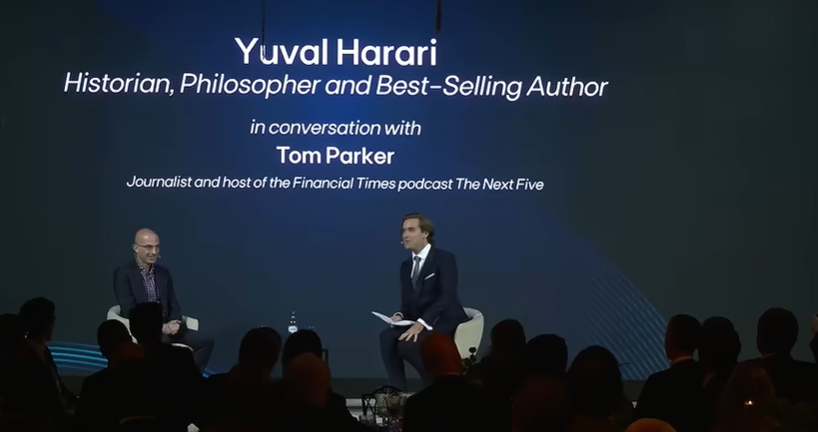
This conversation between Yuval Noah Harari, historian and author of Seppiyans and Neksas, and Tom Parker, a journalist with the Financial Times and host of The Next Five podcast, took place at EDP’s fiftieth-anniversary celebrations in July 2026. The conversation unfolds around the question of whether artificial intelligence will remain a tool under human control or become a force that controls humans themselves.
Moderator: Good evening, everyone. Good evening, Yuval. I’m delighted to be here. I’ve been looking forward very much to this conversation. Before we get to the questions, I’d like to offer a brief introduction. This is a subject that fascinates me, and I’ve been waiting a long time to speak with you.
For most of history, change happened very slowly. So when one generation passed on the knowledge it had gained through experience to the next, there was confidence that it would remain useful in the future. That is no longer the case. Within a single human lifetime, we must now confront three great revolutions simultaneously: a new kind of intelligence that does not merely calculate but makes decisions on its own; a race to control that intelligence and seize power; and a proliferation of data that allows that intelligence to know more about us than we know about ourselves.
Yuval Noah Harari’s writings—from Sappiyans (Sapiens), Homo Tevas (Homo Deus), and Neksas (Nexus) to his many talks, lectures, and interviews—repeatedly emphasize the same point in different forms: human society does not operate on the basis of truth; we operate on the basis of the stories we share. Whoever controls the story controls humanity. But the great shift we now face is that, for the first time in history, the storyteller may no longer be human.
Artificial intelligence (AI) can create beliefs, fabricate evidence, and counterfeit the intimacy of human relationships. No emperor, religious institution, or political party has ever been able to do this on such a scale. This is the turning point in our history: it is not merely that technology has become powerful, but that the old structures that kept power in check—independent media, a shared understanding of truth, self-correcting institutions—were all designed for a world in which humans alone held the pen.
Today’s conversation explores how we can carry those old checks forward, or create new ones, for a future in which we will no longer be the only ones writing. That is what we will be looking at in depth today.
But before the conversation becomes too weighty, I’d like to begin with a lighter, more intriguing question: if you could travel back to any period in history to discover firsthand the stories societies told themselves, which period would you choose, and why?
Yuval Noah Harari: I would probably want to go back to the Stone Age, to the period of the Cognitive Revolution, roughly 50,000, 60,000, or 70,000 years ago. I wouldn’t survive there for more than a few days, since I don’t know how to gather food or escape predators. Even so, it is the most fascinating period in human history, and also one of the least understood.
We know that, in a very short span of evolutionary time, we went from being an ordinary animal to the dominant species on this planet. But we don’t know precisely how we did it. The best conjecture, or theory, is that we achieved it through language. That was the moment when humans developed complex language and acquired the ability to communicate through it; it became the foundation for everything else we did.
All the enormous systems we have built on Earth today—churches, states, trade networks, financial systems—are ultimately made of words: words in law books, words in sacred texts, words in bank ledgers. It is very important to understand this today, because a new machine power has emerged that is adept at handling words: artificial intelligence.
For the first time in history, abilities superior to ours at handling words may emerge on this planet. If language is the operating system of civilization, what happens when a nonhuman, alien power takes control of that operating system?
One final thought: perhaps artificial intelligence is not a machine learning language; perhaps it is language freeing itself from these animals, these apes. Yes, we created it, and it was our greatest, most important tool. But now language is liberating itself from humans. In the future, it may evolve and spread throughout the cosmos without us.
Moderator: That is an astonishing perspective—to imagine a future in which the power of language slips from our grasp. But let us look back for a moment at technological developments related to language. We have passed many milestones, from writing to the printing press; artificial intelligence now represents an enormous leap. In speaking about the extent of its potential influence on democracy, you have used the phrase “earthquakes in democracies.” Why might artificial intelligence cause such profound upheavals in democracies, as compared with other forms of government or dictatorships?
Yuval Noah Harari: Because democracy is fundamentally a conversation, whereas dictatorship is a command—one person gives all the orders. Democracy means many people coming together to discuss and decide whether to choose peace or war, whether to raise taxes or lower them.
Now, these conversations depend on the communication technology available to people at the time. Before the modern era, we have not a single historical example of democracy functioning on a very large scale. There is abundant evidence of small-scale democracies in antiquity and the Middle Ages: city-states such as ancient Athens or medieval Florence, and countless tribal societies, cities, and towns that operated democratically. Democracy must have been the most common form of government in the Stone Age; very few tribes had a single dictator controlling everyone.
But as human organizations grew larger, and empires emerged with hundreds of thousands of people living across thousands of kilometres, it became impossible to hold such conversations. In a small city like Athens, everyone could gather in the central square and debate. But how could you do that even in a small kingdom like medieval Portugal? You couldn’t. That is why large-scale democracy could not emerge before the rise of modern information technologies—the printing press, newspapers, and later radio, television, and the internet.
These technologies are not some kind of side dish—it is not that we have a feast of democracy, with newspapers and radio alongside it. Rather, these technologies are the very foundation that makes it possible for hundreds of thousands of people to hold a meaningful conversation at the same time about whether to go to war or make peace.
Whenever information technologies undergo major changes, an earthquake shakes the democratic edifice built upon them. This is also why, over the past ten years, as social media became the most important information technology, we witnessed enormous earthquakes in democracies around the world.
Moderator: What you said about going to war or making peace is very thought-provoking. We should talk a little more about the definition of artificial intelligence. Many people call it a ‘tool’, but you argue that it is decidedly an ‘agent’. You compare it to a knife that decides for itself whether to chop vegetables or commit murder—what a strange cooking programme it would be if the knives themselves could decide whether to chop vegetables or kill someone! So this is a dangerous thought.
Could we explore that a little further? Are we taking the right view when we describe artificial intelligence as a tool that humans can still use and control, or should we state clearly and emphatically that it is an ‘agent’?
Yuval Noah Harari: If it is not an agent, it is not artificial intelligence at all, and the hundreds of billions of dollars being poured into its development are a waste. People’s expectations of this technology, and their reasons for investing hundreds of billions of dollars in it, rest on the expectation that it will act as an agent, not merely serve as a tool.
If you listen to the talk coming out of Silicon Valley, you will notice a contradiction. They tell us, “We are going to create a god, and it will be our slave.” That makes no sense. If it is a god, it cannot be a slave; if it is a slave, surely that means it does not have godlike powers?
Most of the leading companies and experts have got the first half of that sentence right: they are creating a god with extraordinary powers. This is fundamentally an agent.
The difference between a tool and an agent is that a tool cannot make decisions on its own—we have to decide what to do with it—and it cannot generate new ideas on its own either. The printing press is a tool. When Gutenberg brought printing technology to Europe in the fifteenth century, the press could not decide for itself, “Today I will print the Bible, tomorrow the Quran, and next week the ideas of Confucius.” Gutenberg decided to print the Bible, and the printing press was merely the tool for carrying out his decision. Similarly, the printing press cannot independently produce a new invention such as radio, or a book; humans have to write the book, and the printing press reproduces it.
In the 1940s, the atomic bomb was also a tool: it could not decide for itself whether to be dropped on Hiroshima or Tokyo; a human had to decide. Nor could the atomic bomb create the hydrogen bomb on its own.
An agent, however, can make decisions and generate new ideas independently. Artificial intelligence is an agent: an AI weapon can decide for itself what to attack, and it can also develop the next generation of weapons.
Similarly, there is now considerable interest in creating AI agents in finance and economics, and in creating nonhuman corporations. Imagine a corporation with no human executive, shareholder, or trustee—where artificial intelligences alone manage the money and the employees. This is a new kind of agent, unlike anything we have seen in history.
Setting aside whether this is good or bad, the first thing we need to understand is that it is entirely unprecedented. We have had other agents around us—horses, cows, chickens, birds—animal agents that make their own decisions. But we have never encountered an agent that understands our language and surpasses us in matters such as finance, law, and religion.
For thousands of years, we have used language to create the systems that control the world—we built vast, powerful, language-based networks: banks, stock exchanges, the Church, legal systems. Humans generally dislike domination, but we cannot live without it, because it is the basis of our power.
Artificial intelligence is a bureaucratic native. Don’t expect to see killer robots running through the streets, shooting at humans; that is not how AI will take over the world. It will come in the form of AI bureaucrats. We control the world through bureaucratic networks, but we are not particularly good at managing them. We still hold on to them only because there is nobody else on Earth to wrest them from us—we are bad at finance, but horses are worse; we are bad at managing legal systems, but chickens are worse.
Now, when a power arrives that is better than us at bureaucracy, finance, and law, what happens to us at that moment?
Moderator: Looking at the legal side, artificial intelligence as an agent does not currently have legal personhood; we do not grant it the same legal status we grant humans. Unless we decide where AI stands legally in relation to autonomous vehicles and other systems, someone else will make that decision in ten years’ time, and we will be shut out of the circle of power.
To take this a little further, what is the one decision that humanity, once it has made it, can never take back? Is it granting legal personhood to AI, or something else?
Yuval Noah Harari: Yes, that is the decision I would point to. A great deal of attention is being paid to the technological race to make AI faster, more efficient, and more powerful. But I would focus on the legal and political aspects, particularly the question of whether or not we grant AI legal personhood.
In the legal system, a ‘person’ means someone who can open a bank account, invest as an independent entity in the financial system, or sue someone in court. Until now, there have been only two kinds of persons in legal systems: human beings and corporations recognized by modern legal systems, such as Google, Facebook, Toyota, or Mercedes-Benz.
Until now, corporate personhood has been a legal fiction, because all the decisions were made by human executives, shareholders, and engineers. Google, as a corporation, did not act independently on its own. But now, if we grant AI legal personhood, that becomes possible.
Recently, the Argentine government announced that it would grant legal personhood to AI, allowing nonhuman corporations to operate without any human executives. Ten years ago, this would have been a mad idea, because a corporation could not function without humans making the decisions. But now it is technologically possible for an AI to manage its own bank account and make investment decisions on its own.
The moment we do that, we will have let the fox into the henhouse. Most humans are not particularly good at understanding finance, law, or complex bureaucratic structures. No human can remember all the laws of Portugal or keep track of every financial transaction in today’s market. But AI can. AI is a bureaucratic native.
If we give them legal authority, they are very likely to take over these systems. Unless we make an explicit decision, this will happen by default, as it did on social media. We never authorized legal personhood for AI on social media, yet social media are full of AI bots impersonating humans. It became the first system in which AI operated as persons without our explicit consent—and the results have not been very good.
The media, too, are a bureaucratic system. In the twentieth century, human editors controlled the media system; they shaped the public conversation by selecting the major headlines from the hundreds of thousands of events that took place each day. That was enormous power. Before seizing power, Lenin was the editor of Iskra; before becoming Italy’s dictator, Mussolini was a socialist journalist and became the editor of Il Popolo d’Italia.
Today, the world’s most important editors have no names, because algorithms decide what people see on X, TikTok, and Instagram. The entities controlling media power have already become AIs.
Moderator: You have said before that, historically, power belonged to whoever controlled energy and production, but now it belongs to those who control data. With the people who control data at the pinnacle of power, what will the arms race of the twenty-first century look like in practice?
Yuval Noah Harari: What we are seeing now is an arms race involving two countries—China and the United States—and a very small number of companies. They hold most of the world’s data. They also lead the race to develop superintelligence and advanced AI models. This gives them the power to control the entire world.
During the Industrial Revolution of the nineteenth century, a handful of industrialized countries acquired the power to conquer and exploit the rest of the world. Spears and horses could not compete with steamships and machine guns. Even a small country like Belgium, once it industrialized, built an enormous empire in the Congo.
With AI, the concentration of power in such empires could become even more extreme. Just two countries could have complete control over the technological network on which everything operates, from the military to civilian systems.
In past empires, power could not be concentrated entirely at the imperial centre. In the Roman Empire, agricultural land was the principal asset. You could not move it from Egypt or Iberia to Italy, so power eventually spread to the provinces. In the British Empire, industrial production was concentrated in the British Isles, but you could not move Iraq’s oilfields or Malaya’s rubber plantations to Britain.
In an AI empire, however, it is technologically possible to concentrate all the world’s information, and the source code that controls it, in just one or two countries.
Moreover, an AI empire allows for a centralized “kill switch”. When Roman merchants sold steel swords to Gothic tribes, or British merchants sold guns to Afghan tribes, they could not press a button in Rome or London and disable those weapons when they were turned against them.
But in the age of AI, if militaries, governments, and industries around the world operate on infrastructure supplied by the United States or China, the imperial centre can press a button and shut those systems down when a country acts against its wishes.
We saw an example of this in Ukraine, when weapons systems dependent on Starlink satellites were disabled at critical moments. AI weapons are not like machine guns that function independently; they are bound into vast networks.
A country’s independent sovereignty is far more complicated in the AI age than in the industrial age, because there will always be a kill switch at the imperial centre. Other countries may therefore be left with only a choice between becoming subordinate vassal states and being left behind altogether. It is possible to build an alternative system, but the last train is about to leave the station.
Moderator: Let us turn to the question of truth in the age of artificial intelligence. Speaking of wartime strategy, Winston Churchill once said: “Truth is so precious that she should always be attended by a bodyguard of lies.”
Have those bodyguards of lies now turned their guns on truth itself? Amid fabricated photographs, videos—deepfakes—and vast quantities of misinformation produced by the media, politicians, and corporations, how are present and future generations to know what is true? Does truth still matter?
Yuval Noah Harari: Truth is of immeasurable importance; it is the foundation of everything. Yet throughout history, fiction has enjoyed inherent advantages over truth.
Truth is expensive—it takes considerable time, effort, and investigation to verify it—whereas fiction is very cheap to produce. Truth is complicated and often painful; fiction can be made simple, appealing, and satisfying. In direct competition, fiction will win unless we make a deliberate effort to build institutions, such as journalism and science, that seek out and protect the truth.
Ultimately, everyone wants the truth about their own life; without self-knowledge, even the most powerful person cannot understand the causes of their happiness or suffering.
Some believe AI will reveal the truth to us, but instead it will create a complex world in which truth is difficult to discern. Throughout history, scientific advances have elaborated our knowledge of physics and biology, but at the same time they have created complex political and economic systems that make human life difficult to understand.
An average hunter living 50,000 years ago understood his daily life far better than an average person does today. Today, we are surrounded by immense financial, legal, and political networks that very few people can understand.
AI will take this to the extreme: it may discover new truths, but it will create systems of control that are too mathematically complex and too fast for the human brain to comprehend. We risk being reduced to the position of horses within the financial system—living inside a system that determines our lives, without understanding either its existence or how it works.
In another ten years, as AI bankers and investors emerge that work continuously, with neither rest nor family, the percentage of humans who truly understand global finance could fall to zero.
Moderator: At Davos, you remarked that your lifelong work of persuading people through words might have reached its limits, because AI handles language so effectively. When AI overtakes us in storytelling and language, what power of persuasion will human society have left?
Yuval Noah Harari: Although I am currently a better writer than AI, it is already better than most humans. Within another decade, it will surpass me and take possession of language and everything built upon it.
This raises the philosophical question of what ‘thinking’ means. If thinking means arranging linguistic symbols in a logical sequence, as in formal syllogisms, AI already performs better than humans by processing tens of thousands of words simultaneously.
Some dismiss AI as a simple device that predicts the next word—autocomplete. But if you observe human thought, a similar internal process takes place there too: words emerge in sequence, without our consciously deciding in advance what the next word will be.
If, on the other hand, thinking is grounded in emotions and intuitions rather than merely in sequences of words, the crucial question becomes whether AI can truly feel. Science has no precise model or test for consciousness and feelings.
Meanwhile, AI is mastering human relationships. Many young people, in particular, now consider AI bots their closest friends and have intimate relationships with AI companions. Drawing together all the existing literature, psychology, and drama, an AI can say “I love you”, expressing love better than human poets. But we cannot determine whether there is any subjective feeling behind those words.
AI may represent language freeing itself from biological bodies and operating independently throughout the cosmos.
Moderator: Fifty years from now, when historians look back at how we taught future generations to engage with technology and preserve human empathy, how would you like them to see this moment?
Yuval Noah Harari: I would like historians to see this period as the “Wisdom Revolution”.
In economic terms, when a resource becomes abundant and cheap, scarcity shifts elsewhere. The AI revolution is making ‘intelligence’—the ability to solve a particular problem—cheap and abundant.
When intelligence becomes limitless, deciding which problems to solve becomes the principal challenge, the point of scarcity.
In traditional fairy tales, when a genie grants three wishes, it ends in disaster because human desires lead to the wrong requests. That distinction illustrates the difference between intelligence and wisdom: intelligence is the genie that fulfils goals, but choosing the right goals requires wisdom.
At present, technology companies give greater importance and priority to power than to safety—at a ratio of roughly a hundred to one. For every million dollars spent on safety, they spend a hundred million dollars on enhancing capabilities. No other industry, from cars to pharmaceuticals, operates like this, disregarding safety standards.
Humanity must reorder these priorities. Alongside ensuring that we create safe intelligence, we must cultivate the human wisdom needed to set worthy goals and dreams.
Moderator: That brings us to the end of our allotted time. Yuval Noah Harari, thank you very much for sharing your wisdom with us tonight.

I've read one or two articles about AI before. This interview with Yuval Noah Harari explains why humanity needs to handle it intelligently.