

Lately, whether you step into a modern café or scroll through social media, you can see people travelling back into memory in remarkable ways. Young women and men who were toddlers at the turn of the millennium now wear cargo pants slung below their hips, take pictures with old disposable cameras, and listen to gramophone records. Meanwhile, some leading technology companies are bringing flip phones back onto the market. The film industry, for its part, is deeply invested in reviving the past through reboots and remakes. We might call this a ‘nostalgia economy’. Looking back at the past, and buying it, has become big business today.
Although the desire to recover the past belongs to every age, the economy surrounding it has recently expanded on an unprecedented scale. But why are we so intent on buying back our past? What does this fascination with yesterday tell us about today’s reality? These are questions I find myself considering. The nostalgia I see here is not merely an attraction to old things. It seems to be a meeting place for memory, consumption, technology, and human psychology. What most occupies my thoughts is how our longing for the past is shaped by the market, amplified by social media, and ultimately transformed into data.
I would describe nostalgia, or the stirring of memories of the past, as a powerful psychological tool. This feeling, whose name derives from the Greek words ‘nostos’ (homecoming) and ‘algos’ (pain), acts as a psychological shield. It is a defensive strategy for confronting loneliness, alienation, and anxiety. At the same time, it is a feeling capable of restoring our continuity with the past, our social connections, and our sense that life has meaning.
In this modern age, crowded with global pressures such as economic uncertainty, rapid technological change, and digital fatigue, the present is exhausting and unpredictable. The past, however, is not. Even if that time held some bitter truths, our collective memory polishes its rough edges, presenting it to us as a warm landscape of safety, simplicity, and order. Buying objects or styles from the past is not just about the objects themselves. It is also an attempt to buy emotional security.
With its yearning for a time it never experienced, the younger generation, Gen Z, plays a crucial role in driving the nostalgia economy. Millions of teenagers and people in their twenties imagine and celebrate the late 1990s and early 2000s (Y2K) with a kind of enchantment. There is one principal reason why that earlier era appeals to this generation: the ‘smartphone’. Today’s young people are the first generation to have grown up governed by algorithms, under constant surveillance, and tethered to the digital world. For them, the Y2K aesthetic represents an innocent golden age without algorithms. Wired headsets, button phones, and offline culture signify individual freedom and human relationships not hemmed in by glass screens. So they are not merely dressing as people did in 2003. Through these clothes, they are trying out a way of life free of modern digital fatigue.
At the same time, there is an interesting contradiction here. They rediscover the past through social media itself. In other words, the digital world introduces them to the very aesthetic through which they seek to escape it. What was once a personal memory now becomes a culture recommended by an algorithm. Although the algorithm does not directly determine what we should remember, it has a considerable influence on which parts of the past we repeatedly encounter are brought most prominently to our attention.
Next comes the conversion of feelings into capital. Capitalism has never been slow to monetise human emotions. Businesses understand very well that customer loyalty is stronger when it is bound up with memory and identity. While new inventions proliferate on one side, companies on the other are now employing strategies that evoke old memories.
Streaming platforms and cinemas are overflowing with sequels, prequels, and cinematic universes that recover memories of the 1980s, 1990s, and 2000s. Luxury brands promoting fashion and cosmetics are reintroducing older fashions in cycles at lightning speed. In technology and devices, the return of Polaroid cameras, retro-style gaming consoles, and simple ‘dumbphones’ demonstrates that consumers are willing to pay more for older hardware that offers a human, tactile feel than for hardware with a modern appearance. I would say that commercialisation of this kind turns human longing into a lottery scheme. When we buy an object, we are not buying that object alone. We are buying the memory it awakens in us and the way of life it represents.
This nostalgia economy does not stop at clothes, films, or electronic devices. It has begun to penetrate the spaces we live in as well. The mosaic floor patterns of older homes, terrazzo floors, colourful tiles, wooden doors, iron-barred windows, curved staircases, and old lamps are reappearing in modern homes and cafés. A floor pattern that was once ordinary has now become a vintage aesthetic. The streets of old cities, tram lines, neon signs, low-rise buildings, old shopfronts, and period-specific street furniture are also being rediscovered on social media as the aesthetic of a retro city.
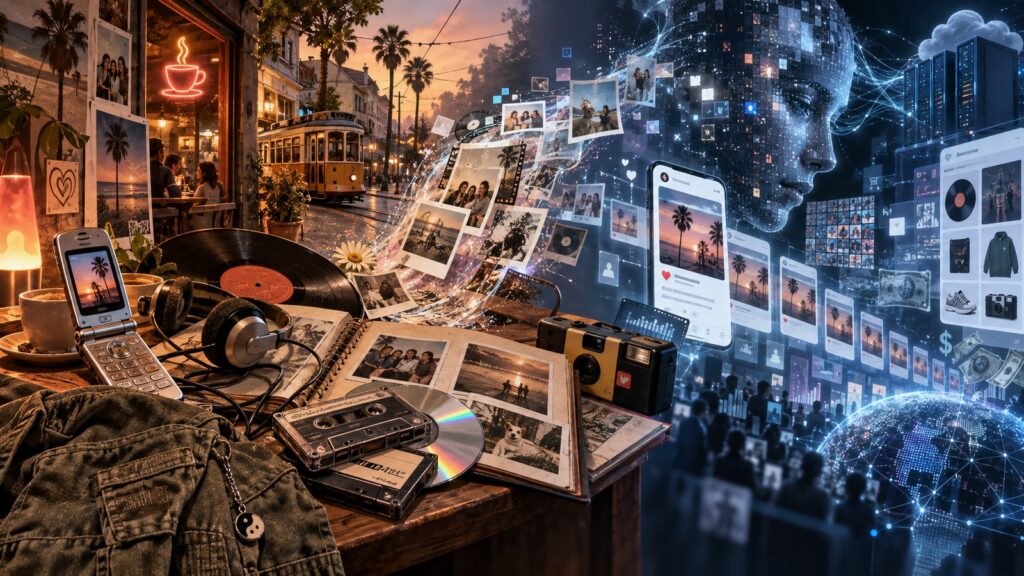
What I find particularly interesting here is that nostalgia no longer sells just an object. It sells an entire environment. Rather than buying an object, we buy the experience of entering an era. Cities, too, are part of this. A new market is emerging between the modern imperative for a city to grow and the human longing to preserve its old face. As a result, even architecture finds itself unable to escape the economy of memory.
Another particularly significant factor I see in this sequence is a deeper aspect that is rarely discussed: the “algorithmic classroom”. Consider how artificial intelligence (AI) learns about our past. It seems to me that this is where a crucial project of AI companies lies. This is not merely a chance occurrence. We cannot make the sweeping claim that AI companies create nostalgia. But we must observe how the algorithms of digital platforms identify this longing that already exists within people, amplify it, and show it to us again and again. We must examine what lies behind it.
Foremost among these processes is the production of digital nourishment (Feeding the AI Data). Training large language models (LLMs) and generative AI systems requires many kinds of human data. But real-time data from the modern world is complicated. There are also various restrictions relating to privacy, copyright, and the use of data. Meanwhile, when people willingly and enthusiastically share memories of the past, old photographs, vintage-style stories, and emotional yearnings online, these become vast digital traces.
Companies are marketing old brands, retro advertisements, and memes from past cultures all over again. People respond emotionally to these on social media, generating tens of thousands of posts. Although we cannot say that all these posts become AI training data through a single, direct route, we can say with certainty that such digital traces become part of an immense data ecosystem concerning human emotions, preferences, habits, and collective memories of the past.
This is the important transformation I see here. Nostalgia begins as a personal memory. Then it becomes a social media post. After that, it becomes a marketable cultural product. Finally, our response to it also becomes a data point. One person posts an old photograph. Another shares a song from the 2000s. Someone else posts about an old camera. The reactions, shares, and views they receive enable that content to reach still more people. In this way, personal memory becomes collective memory, and collective memory becomes a marketable cultural product. This sometimes raises the question of whether we are remembering the past or remembering the past that is shown to us. I would therefore also like to point out a dangerous consequence of this.
“Aestheticised History (Sanitized History)”. That is, a situation may arise in which, rather than reflecting a world encompassing the full, complex, difficult truths of human history, AI systems predominantly encounter selected representations of the past that people have shared, viewed, and enjoyed most online. People remember the past selectively. Social media amplifies those selected memories in turn. Commerce picks out the parts that will sell. Ultimately, those selections may also be reflected in the digital traces from which machines learn.
This is what makes me think about the idea of “aestheticised history”. When even the poverty, inequality, violence, gender discrimination, or social injustices of an era are understood, and go viral, only through its music, clothes, advertisements, films, and games, I begin to wonder whether the emotionally charged aesthetics of history might conceal its complex truths. At that point, the nostalgia economy is no longer merely about remembering the past. It begins to determine which version of the past the future should remember.
Nostalgia, then, is also connected to a struggle rooted in our physical being. As our lives run through the cloud, people experience a hunger for touch. When everything becomes digital, nothing belongs to us. We do not own a music collection. We rent it. Instead of touching photograph albums, we swipe. I would call vinyl records, paper books, and film cameras signs of an instinctive human resistance to this invisible world.
A button phone had fewer functions. With a film camera, each photograph had its limits. A paper book had no infinite scroll. On a record, you could not instantly select the next song. These are all shortcomings in technological terms. Yet those very shortcomings may have given human experience a pace and a boundary. So I even think that, rather than simply reselling objects from the past, the nostalgia economy resells certain experiences we feel we have lost in the present: a slower life, privacy, the sense of touch, the experience of waiting, and undistracted human connection.
The nostalgia economy, therefore, is not merely a short-lived advertising strategy. It is the expression of a culture struggling to breathe as it absorbs modernity. Whether through an old telephone, vintage clothing/accessories, or an old film, we seek from yesterday the security that the present fails to provide. Businesses and digital platforms turn this very longing of ours into capital that serves their interests. At the same time, all the memories, posts, reactions, and preferences we generate accumulate into a vast digital memory. From that memory, the machines of the future will learn about human beings, our culture, and our past.
In that sense, the nostalgia economy is not just the story of how we sell the past. It is also the story of which past we choose to remember, which parts we forget, who amplifies those memories, how they become data, how they will evolve into collective intelligence, and what kind of society that intelligence will create tomorrow. My view is that our digital behaviour today may play a much greater role than we imagine in determining how the future will remember human history and our emotions.