
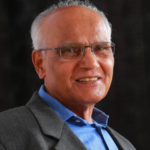
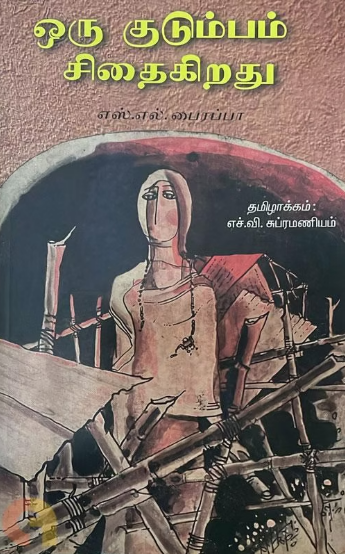
S. L. Bhyrappa (20 August 1931 – 24 September 2025), one of the foremost novelists in modern Kannada literature, was a writer with a wide readership across Indian languages. His novels continually explored philosophy, history, religion, family relationships, caste, and the complexities of the human mind. Vamshavriksha, Daatu, Parva, and Grihabhanga are among his notable works. Grihabhanga, published in Tamil as Kudumbam Sithaigirathu, is one of his major novels. It is an extraordinary work that delicately portrays human suffering and resilience through the disintegration of a family.
We present here two interviews that offer insights into Bhyrappa’s literary outlook and creative process. The first is a conversation conducted by Deshakulkarni at Bhyrappa’s home in Mysore on 6 and 7 July 1997. It appeared in the November–December 1998 issue of the Sahitya Akademi’s journal Indian Literature. The second, an interview titled My Life, My Work, was conducted by R. Surendran (Arsu). It was published in the November–December 2010 issue of the same journal.
Bhyrappa says that he turned to literature to confront the fundamental questions of life for which he could find no answers through philosophy. In these conversations, he speaks at length about how the seed of a novel takes shape, how experience becomes fiction, how characters acquire inner lives of their own, and how he revises and restructures a novel after writing the first draft. His reflections on Parva, which reimagined the Mahabharata as the lives of human beings, are also noteworthy.
At the same time, Bhyrappa’s views on literary movements, Marxism, feminism, caste, and India’s cultural unity are open to debate. In particular, his argument that literary creation must be free of ideologies itself raises a counter-question: to what extent can a writer free himself from his cultural beliefs and social outlook?
These interviews offer room not only to agree with Bhyrappa’s views but also to disagree with them. Through his beliefs about literature, his creative experiences, and his responses to criticism, these two conversations may help us understand a novelist’s world of thought and broaden our own questions about literature.
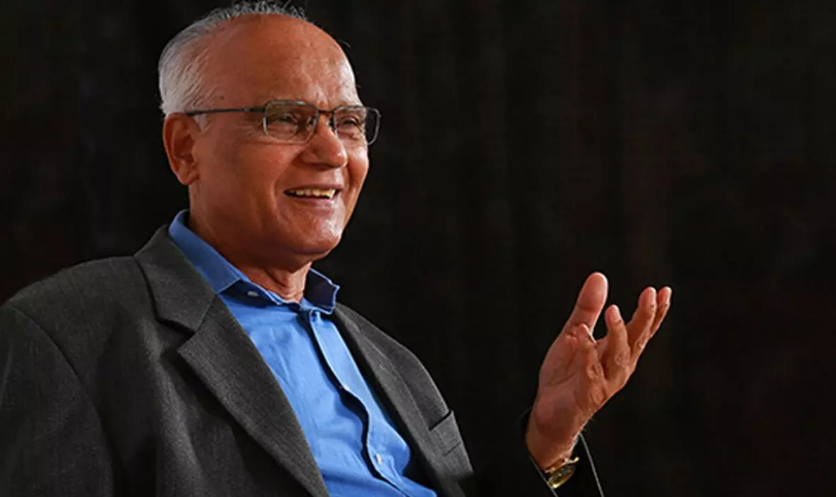
1
Literature Is My Way of Addressing Life’s Questions
On creativity, philosophy, and literary freedom..
Interview by Deshakulkarni
Deshakulkarni: Let us begin with writing. What, in fact, is the act of ‘writing’, on the abstract and concrete (subtle and material) planes?
S. L. Bhyrappa: Aestheticians, as well as those who have not written books on poetics (the theory of poetry), have written extensively on this subject; every student of literature will have read them. But every writer must discover the purpose of his writing for himself. I studied philosophy seriously in order to understand fundamental problems such as the many contradictions of life, death, and the justice we uphold for ourselves. After studying it for nearly ten years, I found that it had not fulfilled my quest. It was during this period that I wrote my first novel, Vamshavriksha (Vamshavriksha). Literary creation helps me find an emotional resolution to many of the problems that trouble me. I realised this while writing it.
Deshakulkarni: Did your academic environment not finally resolve the problems described in your autobiography?
Bhyrappa: No. That is why I took literature seriously. For me, literature is a means of discovering the reality of life on its emotional and ideal planes. It is as serious as physics, mathematics, or philosophy.
Deshakulkarni: In that case, can literature advocate a particular cause? Does it require some form of commitment?
Bhyrappa: In modern times, India has seen various literary trends: the Progressive movement, the Modernist movement, the Dalit movement, the Marxist movement, and the Rebel movement. Fundamentally, I believe that a movement is always a collective activity. Literature, however, is entirely individual in its creation. Any ideology formulated by a group and imposed on the creative mind inhibits the full and free expression of one’s creativity. That is why I have not belonged to any of these movements. This does not mean that I have no sympathy for the ethical concerns they advance. Yet these movements do not stop at drawing attention to their concerns; they construct a socio-political doctrine with a philosophy of its own. This prevents their followers from seeing other dimensions of reality and human experience; it blinds them.
Deshakulkarni: How does this work?
Bhyrappa: Take, for example, a committed Marxist writer. Can he honestly approach, explore, or portray the character of a rich man outside the context of class struggle? Similarly, in the context of gender, can a feminist writer portray a male character sympathetically? One cannot become a great writer without stepping outside these ideological frameworks.
Deshakulkarni: Could you explain this a little further?
Bhyrappa: Many feminist readers, thinkers, and critics told me that my portrayal of Kunti and Draupadi in Parva (Parva) was more powerful, in its treatment of the story’s cultural conflicts and the realisation of ideals, than the efforts of self-proclaimed feminist writers. But I did not portray those characters from a feminist perspective at all; I sought to explore and create them purely as an artist.
Deshakulkarni: Let us return to writing. Is there really such a thing as ‘Indian literature’? How do we recognise it as something shared?
Bhyrappa: I do believe there is a distinct identity called ‘Indian literature’. The cultural dilemmas and attitudes of characters portrayed in literature (written in any Indian language) are generally very similar. That is why a work in one Indian language lends itself readily to translation into another: the cultural concepts are largely alike.
But try translating from any Indian language into Chinese, Spanish, Arabic, English, or another language. It is very difficult, because the cultural concepts are entirely different. Our gods, rituals, and traditional customs, such as marriage, are not like those of other cultures. After all, literature is nothing other than an expression of a society’s culture and way of life.
Deshakulkarni: Even here, there is the problem of publication.
Bhyrappa: Yes. The unfortunate thing is that we are obliged to read a Bengali novel in English translation. Even translators rely on the English translation. (At this point, Prabhu observed that the very difficulties of translating an Indian work into a foreign language point to the ‘Indianness’ of Indian literature.)
Deshakulkarni: You were a young man when you turned from philosophy to literature in search of answers to life’s troubling problems. Now that you are past sixty, do you feel that literature has fulfilled all your quests?
Bhyrappa: Let me go back a little. Philosophy is certainly capable of analysing life’s fundamental problems and values, but it did not give me emotional fulfilment. Perhaps that might have been possible had I followed the path of ‘sadhana’ (spiritual practice). I was not temperamentally prepared for it. I also realised that I could not work creatively in philosophy—that is, I could not contribute any new ideas to the field. In literature, however, I could be original, and that gave me emotional fulfilment.
But even literature does not offer complete fulfilment. Various branches of science, including theoretical physics, attempt to unravel the mystery of existence. Then there is the great reality of death: however hard you try to understand it, however closely you approach it, it does not reveal its nature. Neither intellectual philosophy nor literature provides an answer to this predicament. Our philosophical tradition says that the study of philosophy helps us understand it. But, as I have already made clear, that does not suit my temperament. Literature has remained my only creative path.
Deshakulkarni: Can you give a concrete example of this distinction?
Bhyrappa: For example, I have read about the concept of ‘truth’ in various Eastern and Western philosophical traditions. But when I wrote my novel Sakshi (Sakshi), I explored the idea of truth and falsehood, and its relationship to other values in life, far more intensely than in anything I had read elsewhere. I began writing a story out of feeling, without any philosophical objective. But it developed into a work rich in philosophical undertones.
Deshakulkarni: How would you describe your choice of literary form? Most fiction writers write both novels and short stories. But you have never written even a single short story, have you?
Bhyrappa: Whenever a theme occurs to me, it comes with a broad background; it then grows still larger in scope and becomes a novel rather than a short story. I believe it is this disposition of mind that determines whether one writes poetry or prose. I tried writing a few poems, but soon realised that it did not suit my temperament. I also tried learning Hindustani classical music for nearly four years. But I reached a point beyond which I could not progress unless I devoted myself to it full-time; that would have meant abandoning my literary pursuits and my interest in other fields, such as history, philosophy, and psychology. My interest in the fine arts—painting, music, sculpture—has, in fact, enriched my imagination as a writer.
Deshakulkarni: There seem to have been some early impulses to give written form to autobiographical experiences.
Bhyrappa: Autobiographical elements predominated in my early novels, Dharmashree (Dharmashree) and Doora Saridaru (Doora Saridaru). Moreover, the creative imagination had not risen to the necessary height. It was in Vamshavriksha that my imagination first created entirely new situations and characters that had no correspondence with any autobiographical element. Through this, I discovered that a writer becomes accomplished only when he creates something entirely new without using his own experience as its direct basis. Later, however, when I wrote Grihabhanga and Anveshana (Anveshana), I had acquired the ability to transform even autobiographical elements in a wholly creative way.
Deshakulkarni: But later, as the novels accumulated, did you feel the need to advocate anything in particular through them?
Bhyrappa: No. I have not tried to advocate any ideology, nor are my characters subordinate to any doctrine. There are some Kannada writers and critics bound by ideologies such as Marxism, Lohiaism, Lawrenceism, Freudianism, and socialism. My novels do not give them what they want to find. Yet, for some reason, they call my novels ‘ideological’ because they differ from their own views. Fundamentally, I do not approve of a writer being ideologically bound.
Deshakulkarni: In particular, Vamshavriksha and Tabbaliyu Neenade Magane (Tabbaliyu Neenade Magane) have been criticised as conservative, rather than offering the progressive outlook our times require.
Bhyrappa: The writer who wrote Vamshavriksha and Tabbaliyu also wrote Grihabhanga, Parva, Sakshi, and Anchu (Anchu). But critics with ulterior motives remain silent about these later novels. They cling to those two novels alone and accuse them of being fundamentalist. Their claim about Vamshavriksha is that Bhyrappa disapproves of widow remarriage and has deliberately tormented the widow by making her suffer three miscarriages after she remarries. My reply is this: the theme of that novel is not widow remarriage but family lineage. The young widow who remarries experiences inner conflict because her father-in-law is a strong personality shaped by traditional values. Even experienced psychiatrists, after reading the novel, told me that her inner conflicts and miscarriages were quite natural. I think these psychiatrists—some of them women—understand her inner conflicts better than my critics do.
Let us turn to Tabbaliyu. Its underlying premise concerns the bond between human beings and other living creatures. The traditional Indian conception is that, since we drink the cow’s milk and live on its nourishment, this is a natural mother–child relationship. A human being must therefore be as grateful to the cow as he ought to be to his mother. The Semitic religions, however, say that God created all animals for human benefit. The Indian tradition, by contrast, recognises that all animals have lives as valuable as human life. Those who oppose this philosophy may accuse Tabbaliyu of being conservative, but I pity their ignorance of Indian philosophical traditions.
Deshakulkarni: But there is also the question of ‘progress’…
Bhyrappa: Progress does not mean exercising unlimited human dominion over all life on earth. Modern Western environmentalists who advocate ecological balance nevertheless value animals and trees only for a healthy environment and for human food needs. This anthropocentric attitude springs from the ethical values of Semitic culture. According to Indian culture, human beings have no rights over other animals.
॥ सुप्रभातं वदार्याणां सर्वेषां प्राणिनामपि ॥ [May there be a good morning / well-being for the virtuous and for all living beings.]
The Indian ‘tapovana’ has been described as a place where a cobra spreads its hood to shade a frog panting in the summer heat, even though the frog is its prey. Jainism truly represents this ethical ideal of India. Human beings can progress, can travel to Mars and beyond, without taking an anthropocentric view of the world.
Thus, Tabbaliyu is not conservative; rather, it portrays the conflict between traditional ideals and modern ‘progress’.
Deshakulkarni: While your novels have a vast readership, the so-called ‘intellectuals’ remain indifferent.
Bhyrappa: Supreme Court and High Court judges, leading lawyers, scientists at TIFR (TIFR) and IISC (IISC), professors, doctors, army generals, and technical experts are among my readers and admirers. Are they not part of the intelligentsia?
Deshakulkarni: Some of your critics are openly hostile, but more generally there is something one might call ‘literary untouchability’ towards your writing.
Bhyrappa: Not all critics are silent about my work. There is a group of critics who deliberately maintain silence about my books. I have explained elsewhere why some are hostile towards me. Some of these critics are professors of English. They are loyal to a man who wields influence over academic appointments, promotions, and examinerships, and dominates prizes and awards. Fundamentally, these critics are cowards. So they conduct a kind of covert smear campaign (whispering campaign) against my work. Ideologically motivated groups, such as Marxists and ‘Bandayagars’ (Bandayagars), join this clique. I actually find it amusing, since it is a subject for sociological study. But my real strength is the immense affection of my readers, including highly educated people and lovers of literature, both in Kannada and in translation into other languages. I also find it amusing that many of these critics are among the first to read my books as soon as they appear and enjoy them in private, while concealing that enjoyment from others.
Deshakulkarni: How have readers responded to your books in translation?
Bhyrappa: They are appreciated as usual. In fact, there is a joke in circulation in Maharashtra: “Bhyrappa is the most popular Marathi writer writing in Kannada.”
Recently, at a conference abroad, I met some Nepali writers. They recognised me as the author of books they had read in Hindi. Our conversation revealed that they had read those books closely.
Deshakulkarni: What about the English translations?
Bhyrappa: Serious readers and intellectuals in Britain appreciate Vamshavriksha. They feel that, at a deeper level, these are the problems of their own society too. Sakshi will be published in Canada in September ’97; the publisher expects it to reach a larger readership in the English-speaking world.
Deshakulkarni: With Anveshana and the novels that followed, there was a change in the content and form of your fiction. Was this a conscious effort on your part? Was it due to the influence of the ‘Modernist’ trend you had long kept at a distance?
Bhyrappa: In fact, when I wrote the first draft of Anveshana, I wrote it in an entirely narrative manner, just as I had Grihabhanga (of which it was a continuation). But the story in Anveshana takes place in various locations: Arsikere, Ranebennur, Byadagi, Bombay, Hubli, and Mysore. The central character, Vishwanath, meets many people in each place, so that when he moves on to the next, the previous characters disappear altogether. This happens repeatedly. The first draft was as large as Thanthu (Thanthu), running to nearly 900 printed pages. I found the manuscript tedious when I read it. I felt I had to give the central theme a new dimension and rework the entire novel. In Grihabhanga, all the characters interact with one another and contribute to its unity. This did not happen in Anveshana because there was no continuity of place at all. After I had thought about it for nearly a year, a new technique occurred to me. I began to seek out Vishwanath through the experiences of four or five people he knew, and this was how the novel acquired its new form. In fact, I used this technique fully and effectively when writing Parva. In Parva, different characters reflect on their lives, and through this the other characters also emerge. This turn in my writing style was part of my development. My experimentation with technique was not new to this novel. It certainly did not begin with Anveshana. Even earlier, in Jalapatha (Jalapatha), I had used the technique of two people taking turns to recount their experiences. Daatu (Daatu) combines techniques that interweave narration and drama. I have used the protagonist’s delirious ravings as a device for juxtaposing (comparing) myth and the present.
Deshakulkarni: This brings us to the question of the craft of fiction. How do you go about writing fiction?
Bhyrappa: I cannot say when the seed of a novel sprouts in my mind. A flash of a character or situation feeds my imagination for two or three days. Then it vanishes. After many days, perhaps a month, another flash appears, seemingly unrelated to the first. After remaining in my mind for a while, this too disappears. This may happen once or twice more. After some time, I discover that all these flashes are different dimensions of a single coherent theme. It takes its own time to take full shape—weeks, perhaps months. I begin to feel confident that a theme could become a novel. It takes a year or more for it to become clear.
If it is a historical theme, I begin the necessary research, which supplies the details the novel requires. So far, I have written only one novel based on the Mahabharata. All my other novels have contemporary themes. The theme frequently occupies my mind, and then I begin to think about technique and characterisation.
A few months later, I sit down to write. When I was a professor, I would wait until I could add leave to either end of the vacation—sometimes unpaid leave. This was because I habitually wrote from early morning until evening, without any distractions. I write for two hours at a stretch, then rest. A short nap. A walk outside. Then I begin writing again. Five or six such sessions in a day. After six days of writing, I take a day or two off. Even during this break, I remain alone with myself, without any distractions.
Depending on its length, I finish a novel in two or three months. Parva took fourteen months to write, and Thanthu a year.
After writing the first draft, I put it aside for at least a year. Then I give it to two close friends to read and ask them to take it apart in a constructive critique. One is the writer M. S. K. Prabhu, who examines the text from a creative standpoint. The other is Professor N. Balasubramanya, an authority on English, Kannada, and Sanskrit literature, Indian philosophical traditions, and Western thought. His analysis is from an academic standpoint. Both give me detailed written notes. I then sit down with them separately and listen to their views.
Before that, I read the manuscript over at least three times. After absorbing their views, it is always my decision whether to incorporate their suggestions or alter the text in my own way. I may not accept some of their views.
After another six months, I take up the manuscript and read it again. By then, I have a clear idea of the changes I am going to make. Sometimes I rearrange certain sections, rewrite some chapters, or discard the manuscript and write a new novel on the same theme using an entirely different technique.
Deshakulkarni: Have you ever abandoned unsatisfactory manuscripts altogether?
Bhyrappa: Yes. I have set aside two of them.
Deshakulkarni: On other occasions, do you reread the first draft while reworking the manuscript?
Bhyrappa: No. When reworking it, I do not incorporate anything from the earlier draft. In terms of technique, the second draft is generally better than the first. Sometimes I write a third draft, which becomes the novel’s final form.
At this stage, Prabhu compares it with the first draft of the novel and comments again.
Deshakulkarni: Have you followed this same process for all your novels?
Bhyrappa: I have not written drafts like this for all of them. I have followed this process for five novels. Some of my major novels reached their final form in the first draft itself. It is a matter of chance. It cannot be explained.
Deshakulkarni: In other words, professional discipline plays its part.
Bhyrappa: Writing a novel means forgoing many of life’s comforts and opportunities. It is a taxing experience that demands discipline, patience, and dedication. It is not like writing a short story or a poem. Joy and fulfilment come only when the final draft is ready and sent to the publisher. By then, however, I am confident of its quality. Still, I have some anxieties until the novel is published and I hear from a few reliable, honest readers.
Deshakulkarni: Well, which work gave you the greatest fulfilment while writing it?
S. L. Bhyrappa: Vamshavriksha, Grihabhanga, Daatu, Parva, Sakshi, Saartha. These brought out the deepest layers of my quest, my emotions, and my imagination.
But if you ask me to name a single work that drew out not only my emotions but also the enigmatic complexities within me, I would name Parva. Parva overwhelmed me. It wrung me dry. It took so much out of me. For nearly four years afterwards, I felt I had nothing left to write.
Deshakulkarni: Two of your novels have been made into films. Did you have any part in making them?
Bhyrappa: No. Once I gave permission for them to be filmed, they became the directors’ responsibility; the results and everything else were outside my concern.
Deshakulkarni: Tell us about your forthcoming novel.
Bhyrappa: Saartha (Saartha), expected to appear in December 1997, is actually my first fully historical novel. Although I wrote Parva from a historical perspective, I used the external framework of Vyasa’s story. The story of Saartha is my own creation. I spent three years researching its subject. It deals with India in the eighth century CE, encompassing Nalanda, architecture, Vedic myths, political and economic conditions, Buddhist works, the north-western frontiers, and religious thought, including Vamamarga. I have portrayed, briefly but through my imagination, four historic figures: Shankaracharya, Mandana Mishra, Ubhaya Bharati, and Kumarila Bhatta.
Deshakulkarni: Now that there are no identifying frameworks (labels) in literature, how do you view the work of your contemporary novelists?
Bhyrappa: All the well-known novelists—Vyas araya Ballal, Yashwant Chittal, U. R. Ananthamurthy, and Poornachandra Tejaswi—are in their sixties, like me. I do not see any notable novelists under sixty. It is difficult to explain the reasons for this.
The flowering of creativity is not governed by any artistic rule or social condition. But certain factors can be observed. Many contemporary writers are swept along by movements, isms, and doctrines such as Bandaya (the Rebel movement), Dalit, and Marxism. Most of our women writers are involved in the feminist movement. Art demands complete attention, patience, and dedication. It requires preparation in terms of time and priorities. Various isms and doctrines stand in their way.
Deshakulkarni: Do you feel fulfilled by your work? Or do you have any regrets?
Bhyrappa: I turned from philosophy to literature thirty-five years ago. I am happy with that decision; I do not regret it. But now, in my sixties, when I consider the meaning of life as a whole, I am still bewildered. That is to say, my literary works have not resolved life’s philosophical questions.
2
From Myth towards the Human..
On experience, characters, and the inner truth of the novel
Interview by R. Surendran
R. Surendran (Arsu): Philosophy, which was part of your education, seems to have helped your creative writing. What do you think about the relationship between philosophy and literature?
Bhyrappa: Every profound literary work has an outlook that is philosophical in nature. Take any great work of literature: it will stir deep interest, possess a great vision, and offer a new ethical awareness. In our tradition, poets, playwrights, and storytellers were well versed in the Vedas (Vedas), the Upanishads (Upanishads), Vedanta (Vedanta), and other philosophies.
Arsu: Your first novel, Dharmashree, centres on love between people of different religions. In that novel, love and religion were set against each other. How was it received by readers?
Bhyrappa: Dharmashree was very well received; it continues to sell well even now. Its ninth edition has appeared. Its theme of religious conversion and cultural anguish remains relevant today, not only to India but to the whole world, where missionaries operate ruthlessly in the belief that their religion alone offers salvation.
Arsu: Vamshavriksha is a novel about family lineage. Where did you find its seed? Also, which of the two main characters, Shrotriya and Katyayani, is closer to you? The novel is at once traditional and modern; was it not difficult to reconcile the two?
Bhyrappa: As a student of philosophy, I was reading the Dharma Shastras. While reading P. V. Kane’s seven-volume History of Dharma Shastras, I was deeply drawn to concepts such as lineage, marriage, ancestral rites, property rights, kinship and inheritance, naming ceremonies, gotra, and renunciation, and to their interrelationships. The character of Shrotriya took shape in my mind as the embodiment of all these concepts. Shrotriya is a dignified, noble character, while Katyayani is tender. As a writer, I stood apart and maintained my detachment.
Arsu: When the father, lover, teacher, and father-in-law of Katyayani, the heroine of Vamshavriksha, all express different opinions about remarriage, the confusion this creates within her does not seem entirely convincing.
Bhyrappa: Katyayani represents the early twentieth century, when traditional roots remained strong despite the gradual entry of modern Western ideas. That is why she falters and suffers. To a twenty-first-century reader she may seem inconsistent, but in her own time that experience was real.
Arsu: Godhuli explores the problem of the generation gap and the differences between Eastern and Western outlooks on life. What idea or incident prompted you to write this novel?
Bhyrappa: I was working as a lecturer in philosophy at Sardar Patel University, near Anand in Gujarat, where the Amul dairy is located. At the time, five veterinary doctors worked with the dairy. One of them was a friend of mine; he showed me in detail the processes of artificial insemination, methods of increasing milk production, and mechanical milking using the principle of a vacuum in the suction tube. In short, they had reduced the animal (the buffalo) to a mere milk-producing machine. This made me think about the cow’s changing place in our society, and that developed into this novel.
Arsu: Grihabhanga is distinctive in many ways. There are no scholars or thinkers in the novel. The virtues cherished by uneducated people are also wonderfully brought out through its characters. Nanjamma, who cannot read or write, is a woman of extraordinary idealism, worthy of respect and courageous. Where did you find the inspiration to write this novel and create this ideal character?
Bhyrappa: Grihabhanga contains many of the experiences of my parents and grandparents. My autobiography, Bhitti, published in Kannada and Hindi, recounts these experiences in detail. In fact, to a large extent, Nanjamma is my mother.
Arsu: Daatu caused some controversy. In it, you focus on the evils of the caste system and show that even educated people are complicit in this evil. But the heroine Satya’s fate is painful. Yet she does not overcome the barriers. This is strange. Was this due to a limitation of yours as a novelist?
Bhyrappa: Satya did cross the caste barrier, but she refuses to marry Mohandas. This is because Mohandas harbours thoughts of revenge against the upper castes, including sexually exploiting upper-caste women, just as upper-caste men exploited Dalit women in the past. She feels that living with a man so full of hatred and vengeance that he could commit rape would make her life miserable. This is not a limitation of the novelist; rather, it points to the fact that Satya is evolving to a higher level.
Arsu: Parva is your masterpiece. After writing novels that unfolded love stories, social realities, and family narratives, you turned to mythological material. What was the fundamental impulse behind this novel? When writing mythological novels, a novelist has to concentrate on certain specific aspects. In this genre, the writer does not have complete freedom. What was it like to reread and reimagine an epic such as the Mahabharata?
Bhyrappa: The story of the Mahabharata has fascinated me since childhood. Poets and playwrights in almost every Indian language have written parts of the Mahabharata, or the whole of it, accepting and using its mythological dimensions and events. I wanted to tear through the covering of myth and explore the inner truths of the story, its characters, and its events. What was Draupadi’s emotional experience of married life? What were the mental torments and sorrows of Kunti and the other characters? By placing the superhuman heroes of myth within a human framework, I was able to bring out many, many new perspectives that earlier writers had missed.
Arsu: The Mahabharata is a story of war. But your Parva ultimately becomes an anti-war narrative. Even the victors are troubled by the devastation.
Bhyrappa: War is glorified in the traditional Mahabharata. When you look at it in practical terms, you realise that it is a catastrophe. But we cannot run away from that truth.
Arsu: The final moments of Gandhari and Kunti in Parva provoke reflection. Did they not become neighbours within your soul? The women seem to be the most powerful figures in Parva.
Bhyrappa: I found greater possibilities in those women for exploration and development. They are exceptionally rich emotionally.
Arsu: Do you see a fundamental unity in Indian literatures?
Bhyrappa: I lived in various parts of North India for more than ten years. I have travelled extensively through every region of India, including its rural areas. I have stayed in remote villages. I know the whole of Karnataka intimately. I have travelled through every part of Kerala, Tamil Nadu, and Andhra. Apart from local differences, the fundamental ethical principles and way of life are the same throughout India. This is because the stories of the Ramayana and the Mahabharata have taken deep root in every corner of the country. The Vedas, the Upanishads, yoga, Vedanta, the classical traditions of literature, music, and dance, and temple-building—all these brought India together. Any serious modern literary writer working in any Indian language can perceive this unity and strengthen it further.

An in-depth conversation. Ideas that resonate with writers. An interview to read and absorb. Excellent 👌