
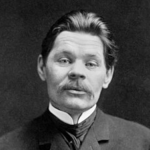
A letter written by Maxim Gorky to the writer Vladimir Korolenko in November 1910, on the occasion of Tolstoy’s death, but never sent.
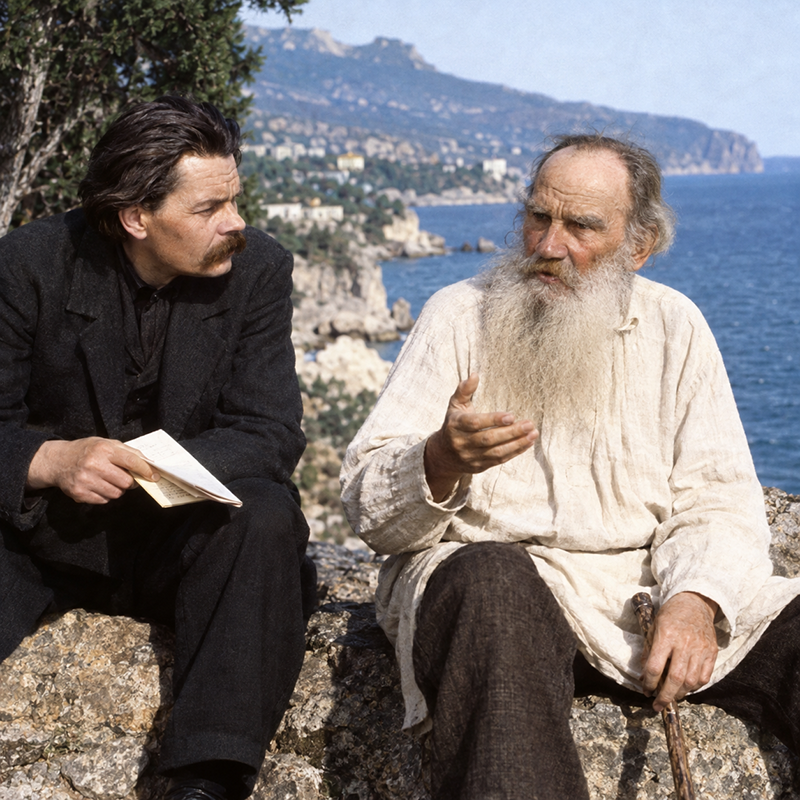
I had only just posted a letter to you when telegrams arrived: “Tolstoy has left home.” And here I am writing this letter, once again speaking to you in my mind.
Everything I am about to say about this news may strike you as confused. Harsh, too. You may even think I am speaking out of irritation. Forgive me. I feel as though someone has seized me by the throat and is choking me.
I have had many long conversations with him. When he was staying at Gaspra in Crimea, I often went to see him. He, too, liked having me visit. I have read his books lovingly, eagerly, with deep absorption. So I have the right to say everything I think about him, however bold my views may be, however far they may depart from the opinions generally held by others.
Who is more worthy than he of being acclaimed a ‘genius’? I, too, know that there is no one. Who is more complex than he? Who is more full of contradictions? He is great in everything. Yes, yes, in everything! That greatness is strange, vast, beyond the reach of words. One longs to cry out to everyone: “Look, what a wonderful man lives on this earth!” There was something of that kind in him. Above all, he was a human being. A great human being for all humanity.
Yet there was a quality in him that always made me draw away. It was his stubborn determination to turn the life of Count Leo Nikolayevich Tolstoy into ‘The Pure Life of Our Holy Father Leo’. There was a kind of lust for power in it, too.
You know this yourself. For a long time he had wanted to suffer. He had lamented to A. Solovyov and Suler that he had not yet been able to suffer in that way. He did not seek suffering to test how much his will could endure; he wanted to suffer in order to increase the influence of his religious ideas. His teachings must gain still greater strength; through his suffering they must appear sacred to people; no one must be able to refute them. People must be compelled to accept them. Yes, I repeat: his purpose was to force them.
He himself had realized that people had not accepted his teachings sufficiently. If you ever read his diaries, you will find ample evidence that he doubted both his teachings and his own personality. He also knows that “with rare exceptions, martyrs and sufferers are tyrants.” He knows everything! And yet he thinks, “If I suffer for my ideas, their influence will grow.”
This is precisely what I could not bear. It seemed to me an attempt to do violence to my conscience. I felt that he wanted to beguile my conscience with the glory of blood shed for justice, and slip the yoke of a religious doctrine around my neck.
He always extolled the immortality to be attained in the next world. But what he desired more was to endure without perishing here, in this world. He was a national writer. In the fullest sense of those words. All Russia’s failings were present in his great soul. The ravages wrought in us by the sorrows of our history had affected him too.
All his nebulous teachings about “inaction” and “non-resistance to evil” belong to a state of passivity. They are the unhealthy fever of old Russian blood poisoned by Mongolian fatalism. They stand wholly opposed to Western thought, which encourages ceaseless labour, creativity, and an indomitable struggle against the evils of life. What others call Tolstoy’s ‘anarchism’ is also, at bottom, an expression of our Slav aversion to the state. The desire to wander like nomads rather than settle has been ingrained in us since ancient times. It has become a national trait. You and others know how eagerly we have indulged that desire to this day.
We Russians know this. Yet we always drift along the path of least resistance. Though we know it is harmful, we draw further and further apart from one another. We have named those dismal cockroach wanderings ‘the history of Russia’. It is the history of a state created almost by accident, mechanically, through the force of Varangians, Tatars, Baltic Germans, and petty police officers. Many honest citizens have been astonished that such a state came into being at all. For we were forever scattering. Only when we reached a place worse than any other, with nowhere further to go, did we stop and settle. It became our fate to settle amid snow and swamps, beside tribes such as the Erzya, Chud, Merya, Ves, and Muroma.
But there also arose men who understood that light must come to us not from the East but from the West. Now Tolstoy, standing at the summit of our ancient history, wishes, knowingly or unknowingly, to lie like a vast mountain across Russia’s road to Europe. That road leads towards an active life. It demands that man devote the whole of his vital energy to it.
The Russian national character is evident in his attitude towards science too. The suspicion born of ignorance in the old Russian village is clearly reflected in him. Everything about him bears the stamp of Russian nationality. His teachings, too, are attempts to return to the past. They are a resurgence of old traits we had already begun to cast off and leave behind.
Think of the letter he wrote in 1905, ‘Arivaaligal, Arasu, Makkal’. What a harmful, poisonous piece of writing! In it rings the voice of a religious zealot snarling, “I told you so!” I too wrote a letter in reply to him then. In it I said that he had long since forfeited the right to speak about the Russian people or on their behalf. I have seen for myself how he made no effort to listen to or understand those who came to speak openly with him. My reply was harsh. In the end, I did not send it to him.
Now he may be mounting a final assault to lend his ideas the greatest possible worth. Like Vasily Buslayev. He is fond of such assaults. But through them he wishes to establish his sanctity and acquire a halo around his head. That is a despotic impulse. It is also true that Russia’s ancient history and the sufferings he endured as a genius provide a background for his teachings.
He seeks to attain sanctity by suppressing the desire to live and play with sin. Yet people want to live. He tries to persuade them that “All life on this earth is futile.” It is easy to persuade a Russian of this. He is lazy; if he finds a reason to do nothing, what more could he want?
It is true that not all Russians are the Karatayevs, Akims, Bezonkhis, or Nekhlyudovs he created. History and nature made those men. They were not wholly formed in the mould Tolstoy desired. He refined them further to lend strength to his teachings. Nevertheless, the whole of Russia is a combination of Tyulin above and Oblomov below. To see the Tyulin above, look at the year 1905. To see the Oblomov below, look at Count A. N. Tolstoy and I. Bunin, and at everything around you.
Let us leave beasts and swindlers aside for now. The beasts of our land, too, have a distinctively Russian character. However cruel the beast may be, what a loathsome coward it is! Those who live by swindling, on the other hand, know no national boundaries.
There were traits in Leo that aroused nothing but hatred in me. At times that hatred weighed so heavily that it crushed my heart. His overgrown individuality had an almost repulsive immensity. He resembled the Russian hero Svyatogor, whom the earth itself could not bear. Yes, he was great.
I believe he concealed more than he said. There are things he left unsaid even in his diary. Perhaps he will never tell them to anyone. That unspoken something would occasionally reveal itself obliquely in his conversation. There were traces of it in the two notebooks of his diary that he gave Suler and me to read.
It was something that ‘denies all certainties’. A powerful, cruel nihilism born of immense, unrelenting despair. At its root was a loneliness that he alone could have felt with such clarity. I have often wondered whether, deep in his heart, a stubborn indifference to human beings persists.
He is so far above other people. He stands at an immense height, an immense distance. Human beings are like mosquitoes to him; their actions seem ridiculous and pitiful. He has left them and gone far away into some desert. There, alone, bringing all the strength of his soul to bear, he examines ‘something most fundamental’: death.
All his life he feared death; he hated it. ‘The Arzamas terror’ throbbed ceaselessly in his heart. Must he die? The whole world looks towards him. Living threads of connection stretch towards him from China, India, and America. His soul belongs to everyone; it belongs to them for ever. Why, then, should nature not make an exception to its law? Why should it not grant this one man bodily immortality? Why not?
He is too logical and rational to believe in miracles. Yet he is also a great hero, a seeker of the unknown. Like a young warrior confronted by an unfamiliar enemy formation, he is uncontrollably agitated by fear and despair.
At Gaspra he read Shestov’s book Nietzsche, Tolstoyin Bothanaigalil Nanmaiyum Theemaiyum. When Anton Chekhov said he did not like the book, Tolstoy said, “I found it amusing. He writes with an exaggerated sense of his own importance. Still, it is interesting. I like cynics who speak honestly. He says, ‘There is no need for truth.’ Quite right. What does he need truth for? He is going to die anyway.”
As though realizing that no one had understood what he meant, he suddenly smiled and added:
“Once a man has learned to think, whatever he thinks about, his death is there in the background of his thoughts. It is so with all philosophers. What truth can there be when there is death?”
He went on to say that truth was the same for everyone: to love God. But as he spoke of this, his voice grew faint and weary. After lunch, on the veranda, he took up Shestov’s book again. He laughed on hearing this passage read aloud: “Tolstoy, Dostoevsky, and Nietzsche cannot live without answers to their questions; any sort of answer will do. Whatever answer they receive is better for them than no answer at all.”
“What a bold hairdresser! He says outright that I have deceived myself. Surely that means I have deceived others too!”
“Why is he a hairdresser?” Suler asked.
“That was what came to mind,” he said thoughtfully. “He is fashionable; he is ornamental. I thought of a hairdresser who had come from Moscow to a village for his peasant uncle’s wedding. What exquisite manners! How elegantly he dances! And so he looks down on everyone.”
I believe I have recalled this conversation almost word for word. It is deeply etched in my memory. Like many other things that struck me, I wrote it down at the time.
Suler and I often made notes of what Tolstoy said. But when Suler came to see me in Arzamas, he had lost his notes. He was careless by nature. He loved Leo with a woman’s tenderness. Yet at times he behaved as though he were superior to him. I too put my notes away somewhere. They were lost. Perhaps someone in Russia has found them.
There was a reason why I watched Tolstoy so closely. I was looking for a living human being who expressed his faith in action. I am still looking. I shall go on looking until I die. There was another reason too. Once, speaking of our lack of cultural awareness, Chekhov said regretfully:
“In Germany, everything Goethe said has been recorded. But what Tolstoy says is carried away on the wind. My friend, there is no Russian habit more unbearable than this. Only after he dies will everyone bustle about. They will write memoirs. They will tell lies too.”
I return to Shestov. “He says, ‘One cannot live looking at terrible spirits.’ How does he know they are terrible? If he had really seen them, he would not write this nonsense. He would have done something important, as the Buddha did all his life,” Tolstoy said.
“Shestov is a Jew,” someone said then.
“That is unlikely,” Tolstoy said doubtfully. “No. He is not like a Jew. There is no such thing as a Jew without faith. Can you name even one? You cannot.”
At times this old magician seemed to be playing with death. He seemed to be trying to charm the goddess of death, to deceive her somehow. As though he were saying to her, “I am not afraid of you. I love you. I long for you.”
At the same time, he seemed to be staring at death with his keen little eyes and asking: “What are you like? What lies behind you? Will you destroy me utterly? Will something in me live on?”
It gave one a strange feeling to hear him say, “I am happy. Very happy. I am steeped in happiness beyond measure.” The very next moment he would say, “One must suffer.” His desire to suffer was genuine too. I have no doubt that, had he been imprisoned or exiled while still not fully recovered from his illness, he would gladly have accepted a martyr’s crown.
Would dying a martyr’s death lend death some justification? Would it help one understand and accept death, at least when viewed from outside? But he had never truly been happy. Nowhere, at any time. I am firmly convinced of this. Neither in books of wisdom, nor in riding, nor in the embrace of women had he ever fully known heavenly bliss in this earthly life. Rather, he was a rationalist who knew life and human beings all too well. I remember something else he said:
“The Caliph Abdur Rahman is said to have had fourteen happy days in his life. I can say with certainty that I have not had even that many. For I have never lived for myself. I cannot live for myself. I live only to be seen by others; I live for people.”
When we came out, Chekhov said to me, “I do not believe he has never been happy.” But I do. He had never been happy. At the same time, it was not true that he lived only to be seen by others.
He gave people what he himself did not need, as one gives alms to beggars. He also liked to insist that they do things. They must read; they must walk; they must eat only vegetables; they must love the peasants; they must believe that Leo Tolstoy’s ideas, with their blend of reason and religion, were flawless—these were the things he insisted on. People had to be given something to satisfy or please them, and then sent away. A man had to be left alone before the bottomless abyss of that great, fundamental question. He had to be allowed to rest in the solitude he knew so well, painful and, at moments, comforting.
Except for Avvakum, and perhaps Zadonsky, all Russia’s religious preachers have been accommodating men. They have no living faith that finds expression in action. When I wrote Luka in my play Adiyaazhathil, I wanted to create just such an old man. He takes an interest in every solution, but none in people. When he cannot avoid meeting them, he offers them comfort. But only so that they will leave him alone.
The philosophy and teachings of such men are merely alms they dispense, concealing a kind of hatred. Behind their blessings sounds a voice full of poverty and sorrow: “Go away! Love God; love your neighbour; now go away! Curse God if you will; love the stranger if you wish; only leave me alone! I am a man. I must die. Leave me alone!”
Alas, that is how it is; that is how it will be. It cannot be otherwise; nor will it ever be. People are weary. They have drifted far apart from one another. Each struggles in a solitude that drains the very soul.
I would not have been surprised even if Leo had reconciled himself with the Orthodox Church. There would have been a logic to that, too. All men are equally petty, even if they are archbishops, are they not? In truth, it would not have been a reconciliation at all. It would have been an act in keeping with his attitude: “I forgive those who hate me.” A Christian act. The mockery of the small, sharp smile concealed behind it would have been understood as the genius’s retort to fools.
None of what I am writing here conveys what I mean. I cannot put it properly. A wolf howls within me. A dread that some harm is about to befall us. The newspapers have just arrived. I see that there, in Russia, you have already begun to weave a saintly legend about him. Idlers and good-for-nothings have made a saint without stirring from their seats!
Think how much harm this will do the country at such a time. Disillusioned people stand with bowed heads. Most have emptiness in their hearts. The hearts of the intelligent are filled with sorrow. Sick and starving people yearn for a saintly legend. They long for it so eagerly because they want their pain eased, their suffering consoled.
They will create precisely what Tolstoy wanted. But it is something we do not need: the life of a saint. Yet he is great because he is human; that is why he is holy. A man so full of sorrow and beauty that he almost drives us mad. A great man for all humanity. I seem to be contradicting myself here. No matter.
He seeks God. Not for himself, but for mankind. Perhaps so that, in the stillness of his chosen desert, God himself will leave him alone! He gave us the Gospels so that we might forget the contradictions in Christ. He simplified the figure of Christ. He removed the elements of struggle and brought to the fore the submissive aspect: “the will of Him who sent me.”
Tolstoy’s gospel is readily accepted because it soothes the sickness of the Russian people. There is no doubt about that. He has to give people something. They lament; they groan; they disturb the earth itself. In doing so, they distract him from ‘something important’.
But works such as Porum Amaithiyum will not soothe the sorrow and despair that fill Russia’s snow-covered land. Of Porum Amaithiyum, he himself said, “I say this without false modesty: it is like the Iliyat.” Tchaikovsky heard him make the same assessment of Kuzhanthaip Paruvam and Ilamaip Paruvam.
Reporters have come from Naples. One has hurried all the way from Rome. They ask what I think of Tolstoy’s ‘escape’. That is the word they use: “escape.” I have refused to speak. You can understand how troubled I am. I do not want to see Tolstoy as a saint. Let him remain a sinner, close to this sinful world and to every one of us who sins. Pushkin! Tolstoy! There is no one greater than they are, no one dearer to us.
Leo Tolstoy is dead.
A telegram arrived. Two utterly ordinary words: “Is dead.”
Those words struck my heart. I wept in pain and anger.
Now, almost like a madman, I keep calling to mind the Tolstoy I knew and saw with my own eyes. The longing to speak to him again torments me. I imagine him lying in his coffin. He is like a smooth pebble lying in the lap of a stream. I firmly believe that within his grey beard that mysterious little smile lies quietly hidden, distant as a star. At last his hands are folded, peacefully at rest. They have finished their arduous, almost impossible work.
I remember his keen eyes, which pierced through everything. His fingers, moving as though endlessly sculpting something out of the air, his speech, his mockery, the rustic words he loved, his elusive tone of voice—all come back to me. What an immense life was contained in that one man! His wisdom exceeded what was humanly possible. The very thought of it is frightening.
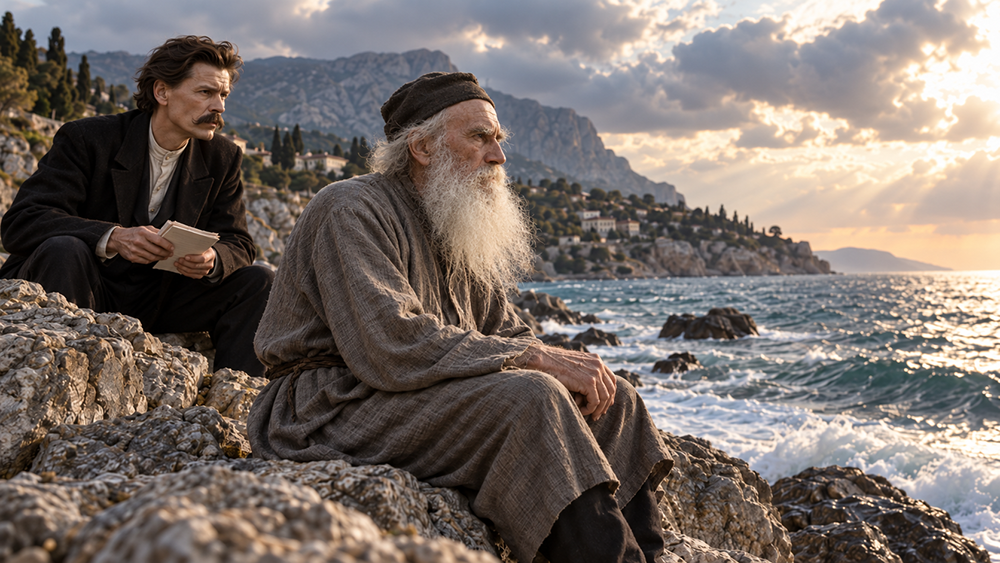
I think no one else can have seen him as I once did. I was walking along the shore at Gaspra to visit him. Behind Yusupov’s garden, he was sitting among the rocks. A tattered grey garment; a crumpled hat on his head. A small, crooked figure.
His head resting on his hand, he gazed out at the distant sea. The sea breeze played with the silver strands of his beard. Little blue-green waves came humbly to embrace his feet. They stroked his feet and passed on, as though telling the old magician about themselves.
There was both sunshine and cloud that day. The shadows of clouds moved over the rocks. With them, the old man too was steeped by turns in light and darkness. Great rocks lay split apart. The tide had risen over them, leaving them coated in foul-smelling seaweed.
He too seemed to me like an ancient rock come to life. A rock that knew the beginning and end of all things. A rock pondering when and how the stones, the grass, the sea, and the vast universe, from a pebble to the sun, would come to an end. The sea was a part of his soul. Everything around him seemed to have come from him, from within him.
In that motionless old man, deep in thought, I sensed something like fate, like magic. It descended into the darkness beneath him. In the other direction, like the beam of a searchlight, it rose towards the blue expanse above the earth. Was it his concentrated will that drew the waves towards him and thrust them back again? That moved the clouds and shadows? That gave life to the rocks?
In a moment of madness, I wondered what would happen if he suddenly rose and waved his hand. The sea would freeze into glass. The rocks would leap up and cry out. Everything around him would come alive. Each thing would find a voice of its own and lament about itself and about him. They would speak for him and against him.
At that moment I felt more than I thought. Words could not reach that feeling. Joy and fear rose together in my heart. In the end they all became one joyous thought: “As long as this man is alive on earth, I am not an orphan.”
I did not want to disturb his thoughts. I tiptoed away so that the pebbles would not shift and rattle beneath my feet.
Now I feel that I am an orphan. I weep as I write this. Never before have I wept with such inconsolable grief and bitter despair. I do not even know whether I loved him. Whether I loved him or rejected him—what does it matter? Every feeling he aroused in me was immense, beyond imagining. Even the discord and anger he stirred in me did not constrict my heart. On the contrary, they broke it open. They made it capable of feeling more, made it more spacious.
He would appear suddenly from somewhere. From behind a door or out of a corner of the room, he would come towards you. He stepped with authority, as though wearing down and levelling the uneven floor with his shoes. It was the light, swift gait of a man accustomed to walking far upon the earth. At such moments there was an extraordinary majesty about him. He would pause for a moment with his thumbs tucked into his belt. His gaze would sweep the room. Nothing new escaped that gaze. In the same instant, he would grasp the meaning of what he saw.
“How are you?” he would ask.
I would sense another meaning beneath that question: “How are you? It gives me pleasure to ask you this. What good will it do you? Still, tell me, how are you?”
He was small in stature. But the instant he arrived, everyone around him seemed smaller still. His peasant beard, his rough yet extraordinary hands, his simple clothes—all these made him seem readily approachable to everyone. That outward simplicity deceived many.
Judging a man by his clothes is an old, servile habit among Russians. I have seen such people pour out their loathsome ‘frank talk’ to him. It was not frankness at all, but an overbearing familiarity, as though they were in a cattle shed.
“Ah! You are one of us! At last, by the grace of God, I see the great son of our motherland in person. May you live for ever! I bow before you!”
This is a sample of the simple, affectionate speech of a Moscow Russian.
Here is another kind, a man who considers himself a freethinker:
“Leo Nikolayevich, I do not agree with your religious and philosophical views. But I have the highest regard for you as a very great artist.”
That was all it took: the old Russian landed aristocrat concealed beneath the peasant beard and the plain, crumpled shirt would emerge at once. Then these simple souls and educated men would shrivel, their noses turning blue in the blast of an unbearable, bitterly cold wind. How elegant his aristocratic gestures were! What proud restraint in his speech! What an edge to those words that cut through life itself! I liked to witness it.
He would reveal the landowner in him only as much as these servile souls required. It was they themselves who called that aristocrat forth from him. Once he emerged, his weight crushed them. They would shrink into themselves and begin to whimper.
Once, on my way back to Moscow from Yasnaya Polyana, I travelled with just such a Muscovite. For a long time he could not recover from the shock. Smiling pitifully, he kept repeating: “Good heavens! What a bath in ice water! What a stern man… Good heavens!”
Between times he said ruefully, “I really thought he was an anarchist. Everyone said so. And I believed it.”
He owned a large factory. A rich man. A pampered little paunch. A face the colour of flayed flesh. Why did he want Tolstoy to be an anarchist? This, too, is one of the ‘deep mysteries’ of the Russian soul!
When Leo Nikolayevich wanted to please someone, he could do it more easily than a beautiful, intelligent woman. Imagine the variety of people who would sit together in his room: Grand Duke Nikolai Mikhailovich, Ilya the house-painter, a Social Democrat from Yalta, Patsuk the Stundist, a musician, a German, the manager of Countess Kleinmichel’s estate, the poet Bulgakov… and so many others. All would gaze at him with the same affection.
He would be explaining the teachings of Lao Tzu to them. At such moments he seemed to me like a one-man band, capable of playing several instruments at once. A pipe, a drum, a piano, a flute… as though he were playing them all at the same time. I, too, would watch him, like the others.
How I long to see him once more now! I shall never see him again.
Reporters come running to tell me that a telegram received in Rome says, “The news of Tolstoy’s death is false.” They talk excitedly. Imagining that they are offering consolation to Russia, they pour out needless words. But the Russian newspapers leave no room for doubt.
One could not lie to him, even out of compassion. Even when he was gravely ill, one could not pity him. To pity a man like him is a paltry act. Such men must be protected, cherished. They must not be burdened with the dust of lifeless, worn-out words.
“Don’t you like me?” he would ask. One had to answer, “No, I don’t.”
“Don’t you love me?”
“Today I do not love you.”
He showed no mercy in his questions. Only when answering did he exercise a sage’s restraint.
He spoke of the past with extraordinary beauty, especially when speaking of Turgenev. When he spoke of Fet, there were affectionate smiles and flashes of humour. When he spoke of Nekrasov, his voice grew low and full of doubt. But whichever writer he spoke of, he spoke as though they were all his children, and he, their father, knew all their faults.
He pointed out their faults before mentioning their virtues. Whenever he found fault with someone, it seemed to me that he was giving alms out of consideration for his listeners’ poverty. It was uncomfortable to hear. Then came his sharp little smile. We would lower our eyes. Once we had seen that smile, nothing he had said remained in our minds.
Once he declared harshly that G. I. Uspensky wrote in the Tula dialect and had no talent at all. On another occasion I was present when Leo was speaking to Chekhov. “Uspensky? He is a true writer! The strength of his honesty reminds one of Dostoevsky. It was Dostoevsky who went into politics and played to the gallery. Uspensky is simple, and still more honest. Had he believed in God, he would have become a religious zealot.”
“But didn’t you say that Uspensky had no talent, that he was a writer of the Tula dialect?”
Lowering his thick eyebrows, he said, “His way of writing is bad. What sort of language is that? More punctuation marks than words! Talent is love. A man who knows how to love has talent. Look at lovers. They are all talented!”
Only when speaking of Dostoevsky did he hesitate. He spoke as though concealing something, holding something back within himself. “He ought to have read Confucius or the Buddhists. Then he might have found a little peace. Those are important things everyone ought to know. His very body was excitable. When he grew angry, knotted veins stood out on his bald head; his ears moved. He felt a great deal, but did not know how to think. He learned to think from Fourier’s disciples, from Butashevich and the others. Then he hated them all his life.
There was something Jewish in his blood. A man suspicious without reason, full of greed, burdens and misfortune. It is astonishing that so many people read him. I don’t understand it. It is all anguish and futility. Those idiots, adolescents, Raskolnikovs… None of his people are real. Life is simpler than that, more comprehensible. What saddens me is that people do not read Leskov. He is a true writer. Have you read him?”
“Yes. I like him very much. Especially his language.”
“What a wonderful knowledge of the language he had! He knew all its subtleties too. It is surprising that you like him. Somehow you don’t seem Russian at all. Your thoughts are not Russian either. You’re not angry with me for saying so, are you? I have grown old. Perhaps I no longer understand modern literature. But none of it seems like Russian literature. They write strange poems. What sort of poems are they? What do they mean? I don’t know. It is from Pushkin, Tyutchev and Fet that one ought to learn to write poetry.
“But you”—he turned to Chekhov—“you are Russian. Yes, truly Russian.”
He smiled affectionately and laid his hand on Chekhov’s shoulder. Chekhov grew embarrassed. He murmured something softly about his little house and the Tatars.
He loved Chekhov dearly. Whenever he looked at him, there was tenderness in his eyes. His gaze seemed to caress Chekhov’s face. Once Chekhov was walking across the lawn with Alexandra Lvovna. Tolstoy was still ill then, sitting in a chair on the veranda. Leaning towards them, he said softly: “Ah! What a beautiful, wonderful man! Modest and quiet as a woman. He even walks like a woman. What a lovely man!”
One evening at dusk he read the continuation of a scene from his story Thanthai Sergius. In this scene a woman comes to tempt the monk. He read it all with his eyes half closed, his eyebrows moving. When he had finished, he raised his head and closed his eyes. “The old man has written that well. Well!” he said distinctly. The simplicity with which he said it was wonderful. His delight in the beauty of his own writing was genuine. I can never forget the rapture I felt on hearing him. I could not express it; I did not know how. Only with a great effort did I contain myself. For a moment my heart seemed to stop beating. Everything around me seemed to come alive, renewed.
Only those who heard Tolstoy speak could understand the beauty of his speech. It cannot be explained in words. His speech was not always grammatically correct. He would use the same word over and over. It had the simplicity of country people. Beyond the words and the voice, his expression and the light flashing in his eyes gave life to his speech. They were the most eloquent eyes I have ever seen. Within Leo’s two eyes there were a thousand eyes.
Once Suler, Sergei Lvovich, Chekhov and someone else were sitting in the park, talking about women. For a long time he listened without saying a word. Then suddenly he said:
“Do you know when I shall tell the truth about women? When I have one foot in the grave! Then I shall tell everything. And at once I shall jump into the coffin, pull the lid shut and say, ‘Now do whatever you like!’”
There was such wildness in the startled look he gave us then. For a while we were all struck dumb.
I think he had within him the unbridled spirit of Vasily Buslayev, with its blend of ardour and mischief. He also had the obstinacy of the Archpriest Avvakum. Beside these, or above them, lurked Chaadayev’s sceptical mind. Avvakum’s nature tormented the artist within him with its teachings. That Novgorodian roughness assailed and unsettled Shakespeare and Dante. Chaadayev’s scepticism mocked the play of his inner life—indeed, even its agonies. The old Russian within him, driven to the inaction of anarchism by his futile attempts to better human life, attacked science and the state.
Strangely enough, Olaf Gulbransson, the caricaturist of Simplicissimus, has discerned this Buslayev quality in Tolstoy by some instinct. Look closely at his drawing. How precisely it captures the likeness of the real Tolstoy! What audacity in that face with its half-hidden eyes! What intelligence! Nothing is sacred to it. Those eyes put no faith in ‘a sneeze, a dream or the cry of a bird’.
The old magician stands before me. A stranger to everyone. A man who wandered alone through all the deserts of thought in search of an all-embracing truth. But he did not find that truth. I carry within me the grief of losing him. At the same time, I am proud to have seen that man in person. That pride eases my grief a little.
It is an astonishing experience to see Tolstoy standing among the ‘Tolstoy devotees’. A bell tower stands in its majesty; its church bell rings unceasingly throughout the world. Small, frightened dogs prowl around it. They howl at the pealing bell. Then they look at one another suspiciously and quarrel, asking, “Which of us howled best?”
I think those people spread hypocrisy and cowardice through the house at Yasnaya Polyana and Countess Panin’s mansion. Self-interest, petty greed, waiting for an inheritance—they filled those houses with all these things. They reminded me of certain sham monks who wander through the dark corners of Russia, carrying dogs’ bones and selling them as saints’ relics; selling false sacred objects under such names as “The Darkness of Egypt” and “A Tear of the Virgin Mary”.
One of the Tolstoy devotees at Yasnaya Polyana refused to eat eggs, saying that he did not wish to harm the hens. But when I saw him at Tula railway station, he was greedily chewing meat. “The old man takes everything too far,” he said.
Most of them liked lamenting and kissing one another. Sweaty hands that seemed boneless; deceitful eyes. Yet they knew how to manage practical affairs deftly to their own advantage. Leo, too, knew the true worth of these Tolstoy devotees. So did Suler, whom he loved tenderly, with a youthful ardour.
Once, a disciple was holding forth at great length about how happy his life had become, how pure his soul, since he had embraced Tolstoy’s teachings. Tolstoy leaned towards me and said softly: “The scoundrel keeps lying. He thinks he is pleasing me.” Many people tried to please him. But I never saw anyone do it skilfully. He rarely spoke to me of his customary themes—forgiving everyone, loving others, the Gospels, Buddhism. He understood at once that those teachings would have no effect on me. I respected him greatly for that.
When he wished, he could be extraordinarily charming, kind and gracious. His speech had an astonishing simplicity and beauty. Yet sometimes it was painful even to listen to him. The way he spoke about women always disgusted me. It would be unbearably coarse. There was something artificial and insincere about it. At the same time, the pus of a deeply personal wound seeped through. Some woman must have struck and wounded him at some time. He seemed unable either to forget or to forgive it. That was how it struck me.
I remember the evening I first met him. It was at his house in Khamovniki, Moscow. He took me into his study, seated me opposite him, and began talking about my works Varyenka Olesova and Irupathaaru Perum Oruthiyum. His tone disconcerted me. In fact, I was quite at a loss. Without the slightest hesitation, he argued vehemently that chastity was unnatural in a girl in the full bloom of youth.
“If a girl over fifteen has a flourishing body, she wants someone to touch and embrace her. But her mind is still afraid of what it does not know or understand. That is what people call chastity and purity. Her ripe body already knows that this obscure longing is natural, that it has a right to exist. Even if the mind refuses, the body demands that this law of nature be fulfilled. You portray Varyenka Olesova as a healthy woman. But there is no life in her feelings. That is not true to life.”
Then he spoke about the girl in Irupathaaru Perum Oruthiyum. He kept uttering coarse words. The way he said them seemed merciless and mocking to me. I felt hurt, too. Only later did I understand that he had hurled those words merely because he thought them the most precise, the sharpest. But that day I found them revolting to hear. I said nothing.
His manner changed at once. With kindness and concern, he asked about my life. He enquired what I was studying, what I was reading.
“They say you have read a great deal. Is that true? Is Korolenko a musician?”
“I don’t think so. But I don’t know for certain.”
“You don’t know? Do you like his stories?”
“Very much.”
“That is the difference. He has poetry in him; you do not. Have you read Veltman?”
“I have.”
“A good writer, isn’t he? An intelligent man. He writes precisely; he does not exaggerate. Sometimes he is better than Gogol. He knew Balzac. It was Gogol who followed Marlinsky.”
I said that Hoffmann, Sterne, and perhaps Dickens might have influenced Gogol. Looking at me, he said: “Did you read that somewhere? No? Then let me tell you—it is not true. Gogol did not know Dickens very well. But I can see that you have read a great deal. Be careful! It is dangerous. That was how Koltsov ruined himself.”
He came to the door, embraced me and kissed me. “You are a true Russian peasant. You will find it hard to live among writers. Never mind, don’t be afraid. Always say what you think. It does not matter if it is rough. Intelligent people will understand,” he said.
After our first meeting, I had two conflicting feelings. I was happy and proud to have seen Tolstoy. Yet our conversation had felt like sitting an examination. I had not seen the author of Kasakkugal, Kholstomer, and Porum Amaithiyum there. I had seen only a landowner who thought he must condescend to my level. He seemed to think it appropriate to speak to me in the ordinary language of the street and the marketplace. The image of him I had nurtured for so long and lovingly cherished had been shattered.
I next met him at Yasnaya Polyana. It was an overcast autumn day. A light rain was falling. Wearing a heavy overcoat and high boots, he took me for a walk in a birch wood. He leapt over hollows and water-filled ruts like a boy. He shook the branches, scattering raindrops. He gave a wonderful account of how Fet had explained Schopenhauer to him in that very wood. Affectionately stroking the wet, silky-smooth trunks of the birches, he said, “I read a poem recently”:
“The mushrooms have vanished; but on the slopes
The heavy scent of the damp earth where they grew still lingers…”
“That is good. How true!” he said.
Suddenly a hare sprang up at our feet. Tolstoy straightened in excitement. His face lit up. He shouted like an old huntsman. Then he looked at me with a mischievous smile and immediately burst into hearty laughter. At that moment he was infinitely charming.
Another time, he was watching a hawk in the park. It circled high above the cowshed in wide sweeps, floating on the air with barely a movement of its wings. It seemed unable to decide whether the moment had come to swoop. Tolstoy stood up and watched, shading his eyes with his hand. “The rogue! He is coming to snatch our chicks. There… now… he will come down… Oh, he is afraid! Is the groom over there? I will call him,” he muttered excitedly.
He called out to the groom. Frightened by the sound, the hawk rose higher, flew away, and vanished. Tolstoy sighed. As though reproaching himself, he said, “I should not have shouted. It would have swooped anyway.”
Once, while talking about Tiflis, I mentioned V. V. Flerovsky-Bervi. “Do you know him? What sort of man is he? Tell me!” Tolstoy asked eagerly.
I described Flerovsky. He was tall and thin, with a long beard and large eyes. He wore a long shirt of coarse sacking. At his waist he carried a bundle of food cooked in red wine. He also carried a large cloth umbrella. With that umbrella he had wandered with me along the mountain paths of Transcaucasia. Once, on a narrow mountain path, a wild buffalo came towards us. We opened the umbrella to frighten it off and cautiously backed away. At every step we risked falling into the ravine.
As I was telling him this, I suddenly noticed tears in Tolstoy’s eyes. Bewildered, I stopped speaking.
“Never mind. Tell me, go on,” he said. “It is a joy simply to hear about a good man. He is just as I imagined him: an original. Of all the radical thinkers, he is the one with maturity and wisdom. In his Agaravarisai, he clearly establishes how barbarous our civilization is. He says it is not powerful nations that create culture, but weak and peaceful ones. He also argues that the ‘struggle for existence’ is a lie invented to justify evil. You will not agree with that, will you? But Daudet does. Do you remember his Pol Astiyar?”
“How would you reconcile the role the Normans played in European history with Flerovsky’s theory?” I asked.
“The Normans? That is another matter.”
Whenever he did not wish to answer, that was what he said: “That is another matter.”
I sometimes felt that he had little interest in talking about literature. I believe I was not mistaken. But he was deeply interested in a writer’s personality. He would often ask, “Do you know him? What is he like? Where was he born?” Almost every remark of his offered some fresh insight into the writer.
Reflecting on V. K., he said, “He is not a Great Russian. That is why he can see Russian life better and more truthfully than we can.” Of Chekhov, whom he loved dearly, he said, “His medical practice gets in his way. If he were not a doctor, he would be an even better writer.” Of a young writer he said, “He is playing the Englishman. That role will never quite suit a Muscovite.”
One day he said to me, “You are an inventor. All those Kuvaldas of yours are people you have made up.”
I told him that Kuvalda was based on a man I had seen in real life. “Where did you see him?” he asked.
I described the episode involving Konovalov that I had witnessed in the Kazan city court. It was the man I met there whom I had written about under the name Kuvalda. At this, Tolstoy shook with laughter. Wiping his tears, he said, “Blue blood! That’s it… blue blood! An aristocrat! How splendid! How funny! You tell stories better than you write them. Yes, you are a fantasist, a romantic. Admit it!”
I replied that all writers invented stories to some extent. We wrote people as we wished them to be in life, I said. I also told him that I loved active people who wished to fight the evils of life by every means available, even violence.
“But violence is the chief evil!” he cried, seizing my hand. “How will you escape that contradiction, you inventor? Your story En Payanath Thozhan is not something you made up. That is why it is good. But once you begin thinking things up for yourself, you create heroes like Amadis and Siegfried!”
I said that as long as we lived within the narrow world of those inescapable ‘travelling companions’, the people who surrounded us, everything we built would stand on shifting sand, amid conditions hostile to us.
Laughing, he nudged me gently with his elbow. “That can lead to very, very dangerous conclusions. You are a dubious socialist. You are a romantic. Romantics ought to be monarchists. They always have been.”
“What about Victor Hugo, then?”
“Hugo? That is another matter. I don’t like him. All noise!”
He often asked what I was reading. If, in his opinion, I had chosen a bad book, he would scold me at once.
“Gibbon is worse than Kostomarov. You ought to read Mommsen. He is terribly tedious to read, but it is all sound scholarship.”
He was angry when he heard that the first book I had ever read was Semkano Sagotharargal.
“You see? A foolish novel! That is what ruined you. The French have only three writers: Stendhal, Balzac, Flaubert. Well, we can include Maupassant. But Chekhov is better than he is. The Goncourt brothers? Mere clowns. They pretended to be serious writers. They learned about life from books written by fantasists like themselves. They thought it a great undertaking. But it did no one any good.”
I did not agree with him. This irritated him a little. He found it difficult to tolerate disagreement. His opinions, too, were sometimes peculiar. They would change abruptly.
“There is no such thing as hereditary degeneration,” he said one day. “The Italian Lombroso invented it. Then Nordau, the Jew, came squawking after him like a parrot. Italy is a country full of swindlers and adventurers. It breeds nothing but Aretinos, Casanovas and Cagliostros!”
“Garibaldi?” I asked.
“That is politics. That is another matter.”
I recounted several true incidents from the lives of Russian merchant families. “None of that is true. That is the sort of clever thing they write in books,” he said.
I told him the true history of three generations of a merchant family I knew. It was a family to which the notion of hereditary degeneration applied with terrible force. He immediately grew excited, seized my hand and tugged at it. “Now what you are telling me is true! I know two families like that in Tula. This must be written. A long novel told in brief. Do you understand? You must write it!” His eyes shone.
“But then heroes would creep in too!” I said perversely.
“No, no heroes. This really is an important story. The man who becomes a monk to pray for the whole family—wonderful! That is the truth. ‘Go on sinning; I will pray for you and wash away your sins,’ he says. And the other one, weary and money-hungry, who stays with the family—he too is a real human being. A drunkard, a depraved beast; he loves everyone; then suddenly he commits murder! Ah, splendid! You must write this. Do not look for heroes among thieves and beggars. Never look for them. Heroes are all lies and inventions. There are human beings, only human beings.”
He would often point out the exaggerations in my stories. But once, when speaking of Irantha Aanmaakkal, he said with an affectionate smile:
“We are all terrible fabricators. When I am writing, I too suddenly feel pity for a character. At once I give him a good quality. Or I snatch a good quality away from someone else. Only then does this fellow not look quite so black beside the others.”
The next moment he continued in the stern voice of a merciless judge: “That is why I say art is a lie. A counterfeit fashioned to suit our wishes; something that harms people. We do not write about life as it really is. We write only what we think about life. We write how I see that tower, how I see the sea or a Tatar. Why should anyone else need that? What interest or use is it to them?”
[At times it seemed to me that his thoughts and feelings veered off without reason, that they were deliberately contradictory. But what fascinated and troubled people was the merciless directness of his thought. It was the directness of Job, who fearlessly questioned a cruel God. Once he said:
“At the end of May I was walking along the road to Kyiv. The earth was paradise. Joy everywhere. Birds sang; bees hummed; the sun shone. Everything was beautiful, loving, happy. Sheer bliss! I could not hold back my tears. I felt like a bee for whom all the flowers had bloomed. I felt God close to my soul.
“Then I saw a man and a woman lying by the roadside. Pilgrims. Both were old; they were grey and dirty. They writhed like worms; they groaned; they muttered. The merciless sun scorched their bare, discoloured legs and their withered bodies. The sight struck at my heart and shattered it. I wanted to cry out, ‘God, who created beauty, are you not ashamed?’ I was utterly broken.
“You see what things happen! The devout called nature the devil’s creation. How mockingly, how cruelly she torments man! She takes away the body’s strength and leaves desire intact. Everyone with a living heart feels this. But it is man who must experience this shame and anguish in full, in his own body. We carry it within us as an inescapable punishment. For what sin is this punishment?”
As he said this, his eyes changed strangely. One moment they were pitiful as a child’s; the next they gleamed sternly, sharply. His lips trembled; his grey moustache bristled. When he had finished speaking, he took a handkerchief from his shirt pocket and wiped his face, pressing hard. There was no moisture on his face. Then he stroked his beard with his strong, veined fingers, like a peasant’s. “Yes, for what sin?” he asked again softly.]
Once I was walking with him along the lower road from Dulber to Ai-Todor. He walked swiftly and lightly, like a young man. But suddenly, in a voice more agitated than usual, he said
“The body should be a dog that obeys the soul’s commands. It should run to do whatever the soul tells it. But how do we live? The body leaps and bounds in a frenzy, while the soul runs sorrowfully after it, powerless to do anything.”
He placed his hand over his heart and rubbed his chest hard. He raised his eyebrows. Then, as though something had come back to him, he continued:
“Once, in autumn, I turned into an alley near the Sukharev Gate in Moscow. A drunken woman was lying there beside a gutter. Wastewater was running out of a courtyard and beneath her back. She lay in that cold, filthy water, muttering. She shivered. She writhed. But she could not get up.”
He shuddered at the memory. Half closing his eyes, he shook his head. Then he said softly
“Let us sit here a little… There is no sight more horrible, more repulsive, than a woman helplessly drunk. I wanted to lift her to her feet. But I could not. It was so revolting! Her whole body was caked in filth. I felt that if I touched her, I could wash my hand for a month and still not get it clean. Horrible!
“A little boy was sitting beside her at the edge of the pavement. Bright cat’s eyes. Tears streaming down his cheeks. Helpless. In a weary, tearful voice, he pleaded over and over: ‘Mum… my… Mummy… get up, Mummy…’
“She would move her arms. Groan. Try to raise her head. The next moment her neck would flop back into the filthy water.”
He fell silent. Looking about him, he went on in a whisper:
“Yes, yes. Utter degradation. Have you seen many women helpless with drink? Many? God! You must not write about this. No, do not write about it.”
“Why?” I asked.
He looked straight into my eyes. “Why?” he repeated with a smile. Then, slowly and thoughtfully, he said:
“I do not know. It just slipped out. There is something shameful about writing of degradation. But why should one not write about it? Yes, one must write about it, too. One must write about everything. Everything.”
Tears welled in his eyes. He smiled as he looked at the handkerchief with which he had wiped them. But tears were flowing down the wrinkles of his face again.
“I am crying,” he said. “I have grown old. The mere thought of something horrible makes my heart ache.”
Then he touched me very gently with his elbow.
“One day you too will have lived out your life. And everything will still be just as it is now. You too will weep. You will weep more than I do. You will weep rivers—as our village women say. One must write about everything, everything. Otherwise that young boy with the bright eyes may be hurt. He may accuse us. ‘That is not the truth; that is not the whole truth,’ he will say. He is a very exacting judge of truth.”
Suddenly he shook himself and said in a kindly voice:
“Well, now tell me a story. You know how to tell a story well. About a child… Tell me about your childhood. It is hard to believe that you too were once a child! You are a strange creature. You seem to have been born a grown man. There is much that is childish and immature in your thoughts. Yet you know far too much about life. What else is there for a man to listen to but life? Well, tell me a story…”
He settled back comfortably against the exposed roots of a nearby pine tree. He watched the ants bustling among the fallen, faded needles.
To a man from the frozen wastes of the north, the lush nature of the south seems strange. Luxuriant plants and creepers proclaiming their beauty at the tops of their voices; unbridled, brilliant greenery. Among them Tolstoy looked a tiny man. Yet he had the solidity of someone bound fast by strong roots running deep into the earth, intertwined and knotted together. Even his name seemed to resound with his inner strength.
He was both out of place and perfectly at home in the lush landscape of Crimea. He was a man of ancient times. Master of everything around him. Like a great master builder who had built a palace centuries ago and now returned to it. He had forgotten much of what was inside the palace; much seemed new to him. Everything was where it ought to be. Yet something was not quite right. He had to discover at once what was wrong, and why.
He walked the paths with the swift, sure steps of an explorer who knew the earth well. Not a pebble or a tiny creature escaped his keen eyes; not a thought escaped him. He looked, measured, tested, compared. As he went, he scattered all around him the living, inexhaustible seeds of unruly thoughts.
Once he said to Suler:
“Lyovushka, your vanity keeps you from reading any book that is not weighty enough. Gorky, on the other hand, reads a great many bad books because he does not trust himself. I too write a good deal that is bad. It is an old man’s greed—the desire to have everyone think as I do. Of course, what I write seems good to me. To Gorky it seems bad. As for you, you do not think at all. You just sit there blinking, looking about for something to snatch.
“One day you will snatch something that is not yours. You have done it before. You will sink your claws into it and hold on for a while. When it slips from your claws, you will not even try to keep it. You know that wonderful story of Chekhov’s, Chellakkanne, don’t you? You are just like the woman in it.”
“In what way?” Suler asked, laughing.
“You know very well how to love. But you do not know how to choose. You waste your strength on petty troubles.”
“Is everyone like that?”
“Everyone?” Leo repeated.
“No. Not everyone.”
Then, as though suddenly seized by pain, he hurled a question at me like a blow:
“Why don’t you believe in God?”
“I have no faith in God, Leo Nikolayevich.”
“That is not true. You are a believer by nature. You cannot live without God. One day you will understand that. It is only your stubbornness that keeps you from believing. You have been beaten and wounded. The world is not as you would like it to be. That is why you refuse to believe.
Some people fail to believe even out of shyness. This happens with young men. They love a woman deeply. But they are afraid she will not understand their love. Nor do they have the courage to declare it. Faith, like love, needs courage. It also needs initiative.
“A man must say firmly to himself, ‘I believe.’ Then everything will come right. The world will appear as he wishes it to be. He will come to understand of his own accord: the world draws him to it too.
“You know how to love passionately. Faith is simply a still greater love. Love more. Then your love will turn into faith. When a man loves a woman, she seems to him the finest woman in the world. Every man thinks he loves the finest woman in the world. That is faith.
“A man without faith cannot love. Today he loves one woman. Then another. Such fellows are wanderers; their lives are barren. That is not good. But you were born a believer. There is no use standing in your own way.
“Well, what do you say about beauty? What is beauty? The highest, most perfect beauty is God.”
He almost never spoke to me about this subject. His sudden fervour that day astonished me. I remained silent.
He sat on the sofa with his legs tucked under him. A small, triumphant smile blossomed on his face. Wagging a finger at me, he said:
“Don’t think you can get out of this by keeping quiet. You can’t!”
I, who did not believe in God, looked at him for some reason with great caution and a little fear. As I looked, I thought:
“This man is like God.”
Translated into Tamil by A. Rajendran