
The black kite prepared to descend from the sky. Across the open heavens in which it had flown all day in delight, the sun’s red light sank westward. Boundless space. An inexhaustible radiance.
Beneath its wings, the earth seemed gathered into itself. The sky cradled the earth in the hollow of its palm. By afternoon, the cold north wind sweeping through the distant mountains had grown strong enough to rob the bird of control. As the hours passed, dark clouds assembled like a herd of elephants. A small movement of its spread wingtips was enough to change course, to wheel and circle; it wished it could remain afloat forever.
For some reason, that evening the kite had no desire to touch the ground. Its mind was as desolate as the empty sky. The fork of its white tail opened and closed as it climbed and dipped. When exhilarated, it cried out in flight. To human ears, the cry was music; to small creatures, a herald of destruction.
As daylight ebbed into gathering dusk, it longed to remain aloft, almost motionless, until the last instant its sharp eyes could still see. It wanted to keep flying, oblivious to itself, over the earth that waited with open arms, unconditionally and for all time, ready to hold it to its breast. Before darkness fell, it would have to choose a branch concealed among the leaves of some tree in its familiar forest. When it could no longer endure the strain of flight, it tipped forward into the wind, releasing the weight it had held suspended. It plunged towards the crown of a great tree it had chosen, cleaving the air in a swift, precise descent.
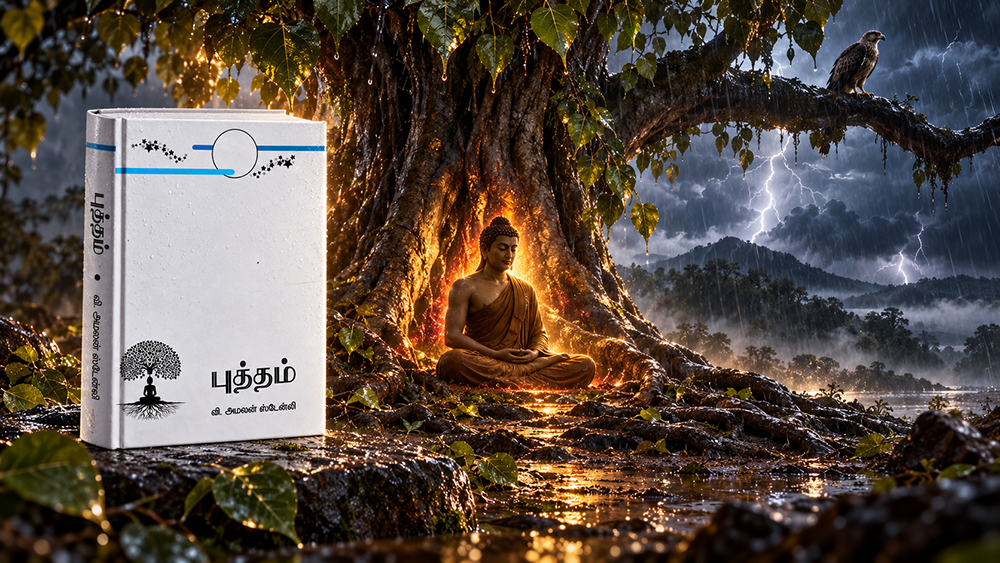
It was a peepal tree. Only recently it had shed its dry, ageing leaves, stood naked for a time, and slowly put forth tender green shoots. Now its broad, close-set leaves trembled in the wind, and its spreading branches made it a vast presence in the forest. Beneath that generous canopy it sheltered an abundance of creatures, great and small, offering shade and care. Like the earth, it was complete in itself: a sanctuary for the lives that came to dwell within it.
As the descending kite approached the treetop, it drew in its body and gathered its attention as though entering meditation. It slipped through an opening in the branches and settled with soundless precision on a bough deep among the leaves, where the shadows were thick. The branch did not tremble. Only the wind stirred the foliage. The bird became still, attentive to its own breathing.
Only from the earth could it marvel at the moon, the stars and the planets of the night; it could never come close to them. The air was as pathless by night as by day, yet darkness enclosed it, preventing any further ascent. By the gentle light of a waxing moon, it might swim a little higher through the layers of air. But the cold—the terrible cold—would weigh upon its wings, and it could not remain in the sky as long as it wished. This was a full-moon night. The moon would soon rise, but banks of rain-heavy cloud were gathering, darkening the northeast.
The kite lowered its head. Someone was sitting motionless beneath the tree. Who could be there at this hour? Startled and curious, it tilted its head, shifted its feet and peered between the moving leaves. It was the same man. The one who wandered through this part of the forest by day and by night. The one who sat alone for hours without stirring.
Only days before, the kite had seen him near death. Wasted to skin and bone, scarcely able to walk, he had struggled along a path before collapsing in a faint beside it. Vultures from the surrounding woods had followed him in secret, awaiting his death and the flesh that would remain upon his bones.
Sometimes a few companions walked with him. Sometimes women gathering firewood at the edge of the forest talked to him as they went. Most often, village children kept him company, talking and playing with him, nibbling fruits and other things gathered to eat. Small animals came close to him as well—even the birds and little creatures the kite might otherwise hunt. There was tenderness in the sight, a quiet fellowship that left no room for fear or hesitation. From its circles high above the trees, and from its resting places beneath their green canopies, the kite had often watched this solitary man.
It had begun to feel a certain concern for him. He, too, seemed to wander alone, inwardly absorbed, overflowing with his own solitude. Perhaps the forest was to this man what the open sky was to the kite. It recognised in him another living being immersed in the inexhaustible depths of solitude. At last the bird closed its eyes. Nestled among the leaves in the cool air of the dark forest, it drifted into sleep and, with the other creatures of the earth, into the enchantment of dreams.
• • •
Beneath the centuries-old peepal tree, the man folded his legs and sat cross-legged. Rain gathered and began to fall as a fine drizzle, while a chill wind pierced his body. He moved farther into a recess formed by the inward folds of the enormous trunk and settled there. A premonition seemed to hang over the night: through the discipline of many years of meditation, this human being was about to receive a vision of profound understanding. He adjusted his legs on his mat of kusa grass, straightened his back and entered the stillness of meditation. Beneath the cosmic canopy of the peepal tree, he turned inward for the deliverance of all living beings, himself among them.
He observed his breath entering and leaving his body, his chest rising and falling, his belly expanding and subsiding. It took time to bring his awareness of the whole body into harmony with the breath and gather his mind into a single focus. Then, as he followed the breath to its deepest roots, a surge of vital energy welled up inside him, gathered in his skull and seemed to descend again, dense and concentrated, into his breathing.
A flash of cold lightning ran through his spine. His body shuddered. He felt as though a great python had wound itself around him, binding and twisting him from head to foot. The force of his meditation moved through him, gentle yet powerful: a serpent within the body, a body within the serpent, the two becoming one and swelling with each successive movement. Before long, both serpent and body seemed to vanish. Only heightened awareness remained—like air, like a low hum, like sensation unfolding on every side.
The weight of his body dissolved into the pull of the earth, leaving an impression of utter emptiness. Near the tailbone, at the base of his spine, an inward impulse stirred, urging his body to lift and sway. The living magnetic force of the ground seemed to shake him. His body felt as light as cork.
Above him, the clouds grew darker, billowing and gathering. Thunder rolled without pause, reverberating deep into the forest.
The rain that night was unusually heavy. Lightning streaked repeatedly across the sky, and thunderbolts struck the forest trees. Amid the roar and the fierce agitation of wind and fire, the woodland seemed caught in an age-ending cataclysm. A starless sky, wind sweeping through the trees, a churning storm, rain pouring down and water rushing over the ground: heaven and earth appeared to be colliding in some vast dissolution of the world.
Although he sat in the shelter of the tree’s wide, hollowed trunk, he was soaked through. His body bore the cold, prickling and trembling at intervals. His chest tightened and his breath seemed to stop. As though the roots beneath him were parting to receive him ever more deeply into the soil, he merged with the earth in full awareness and lost the sense of having a body.
Through his breathing, a centre of fundamental energy seemed to form within him. Its whirling focus moved from place to place: the spine, the tailbone, the throat, the point between the brows, the eye sockets, the crown of the head. His lower belly drew inward towards his back; his diaphragm was taut as a bowstring. The vital breath held still, while the rising current of respiration gathered above his head.
At his nostrils, his breath mingled with the surrounding air and ceased to seem his own. His breathing held him like a mast secured by taut ropes. The deep movement of air heightened his alertness until awareness appeared to flow through every opening, every minute pore of his body.
The breath came to rest in the hollow of his chest, immersed in a white energy that seemed to engulf the body with astonishing speed. Its vortex gathered in his head, spread slowly outward, mingled with the air and disappeared. What remained within him was awareness of that very disappearance. His skin tingled, while bone and flesh seemed to rise as vapour, dissolve and settle into an insubstantial form.
The night passed like a breeze that moved over him, touching and embracing him. It was suffused with fulfilment and perfect peace. Awareness of the self opened into an awareness beyond the self and spread into the air. Strange manifestations of true understanding moved through his body.
With the rain came a crimson outpouring, as though a cool spring of flame were flowing from a river of fire. In a luminous fluid without heat, his body burned; then the forest of his body slowly cooled. At the edge of that fiery energy, there remained nothing to call one’s own, nothing to call another’s.
He bowed, seeking refuge, only to discover that there was nothing within him to surrender. Nor was there anything from which refuge could be granted. The vessel had lost both its capacity and its contents.
What was there to surrender?
A spring of sublime gentleness.
Energy gathered in a dense mass.
Desires stilled,
without faltering,
within a radiance
beyond understanding;
tasting the vastness within,
immersed in it, then bowing;
revealed as inward awareness,
with neither inside nor outside,
neither self nor other;
the essential truth aglow,
a vision of pure grace—
immersed without immersion,
this living presence in that world.
In a moment of the first watch of the night, the fear of death gathered like darkness and flared into light. He shifted slowly to one side, leaning as he sat. A desolate instant overtook him: bereft of the means to live, without hope or support, as though everything had come to an end. Every possible cause of mortal fear seemed pressed into that single, unfamiliar moment. Startled, he planted his right hand on the ground. His body leaned, then recovered its balance and settled firmly once more.
The movement bound him more deeply to the earth. As if the earth itself offered his body refuge, immense energy surged through the point of contact between him and the ground. It climbed his spine, took possession of his head, pressed through the centre of his forehead and rose to the crown. His body quivered and shook. The earth trembled. The sky roared. The waters swelled. The wind lashed and whirled.
Here and there, lightning set the forest alight. The body’s boundaries gave way; the mind grew loose, and the elements within him rose with enormous force, gathering into a cosmic energy. Within the solid, liquid and gaseous substance he had called himself, an immeasurable truth, beyond knowing, made itself felt. In the rain-filled darkness, the place beneath the tree where he sat appeared as a cool, rising crimson flame. It was the expanse of awakening: a vast awareness in which there was no inner and outer, no self and other, only the indivisible whole. A profound knowing.
One who has truly entered that state can never again be what he was before. Henceforth, his identity lies in possessing nothing as his own. For one who has followed this path, to live upon the earth is merely to continue in time. He has, in a sense, become time itself.
The minerals of the earth shone within his living cells. This fleshly body, made of the earth’s elements, was luminous in its own awareness. It belonged not to Māra, but to the earth. Māra, too, belonged to the earth. The liberation of the mind was grounded in this embodied existence; only through the body could its freedom be realised.
Siddhattha understood that day that the highest purpose of this birth was to enter ever more deeply into the unity of mind and body through meditation, to reach the innermost source of life, and to cultivate the power of true insight already present at the core of being. To delight in that insight, to help others discover it for themselves, and to share the joy of awakening: this was the highest fulfilment of human life.
In the second watch of the night, numberless births rose and danced before him—births within each day, each passing instant of his life. The great dance of birth and death. Names and forms arose as living beings, danced briefly, then vanished. Everywhere a cry went up, the lament of countless ages, the grief of mortality. The salt of ceaseless tears flowed into rivers and gathered in the sea.
Everything came into being and passed away. Beings struggled and writhed, collided, separated, grew quiet, then rose once more. The illusory turning of the world’s living multitude.
It seemed that the land shook and the earth cracked open. Form after form appeared, moved and vanished. Seasons changed. Cold yielded to heat, and heat to cold. The land altered; so did the heavens. Within the universe’s great turning, the limits of existence and what lay beyond them extended together.
Events revolved in fleeting instants; to discern them was to know. Through the senses he glimpsed a mode of being beyond their reach, a richness that could not be exhausted. In the third watch of the night, a further vision arose from his meditation, leading towards that inexhaustible understanding.
Release beyond the pleasures of virtue, material well-being and delight. A disembodied inward light, in which knowing itself danced as knowledge, bright as a steady flame.
Beneath the rain-soaked peepal tree, the energy of the heavens seemed to dissolve into every cell of his body. It flowed through the particles and minerals of the earth like magnetism, entered the meditating man and held him in its power. In his consciousness, the wisdom of the vast universe shone.
He had glimpsed something of it already through awareness, yet this immediate encounter with experiential truth filled him with wonder and rapture. How long the search had been. Nearly seven years. Seven years of living in the forest.
For a moment he saw it clearly: the universe in its ordered movement; a vast process that seemed merely to arise and subside, yet transcended the opposites of beginning and end. To enter it deeply and know it as it was—that was the boundless release called nirvana. Nothing more.
Whatever arose within him did not stay. It came and went, whether pain, grief, happiness or fulfilment, whether in body or mind. Moment by moment, here and there, in fragments, he watched these occurrences within the field of his awareness.
Dependent arising lay at the root of the opposites of life: birth and death, sickness and mortality, grief and joy. The very cycle of nature was dependent arising. In each present moment, the arising of conditions was birth; their cessation was death. When the roots of those conditions fell away, there was neither arising nor passing. He found a way of meditation that rested in timeless awareness, in the open space beyond both.
He saw that the appearance, continuance and disappearance of all worlds were mirrored in the lives of all beings: in their coming into existence, their activity, and their passing away. Freedom from attachment was the rare and difficult liberation. Non-self lay at the heart of inward freedom. Non-self did not mean absolute nothingness. There was what we call a ‘self’, but it changed from instant to instant: insubstantial, impermanent, without any fixed essence.
Pleasure and pain alike arose through dependence upon conditions. Such was the nature of life.
Yet there was a boundless dimension of being dependent upon nothing, where every attachment had fallen away. That was nirvana, the revelation of inward freedom. This completeness of non-self, free from clinging, was the true path open to humanity, the path of well-being. Those who travelled it would encounter no death. For birth and death belonged to the conditioned union of mind and body. Where attachment had fallen away, in the clear expanse of non-self, there was nothing left to die: only empty space. Where had the fire gone when a tree was entirely consumed? No direction could be assigned to it. Nor could one trace the path of an owl’s cry through the midnight air.
The path of inward liberation opened before him. As the defilements quietened and subsided, only lucid witnessing remained. Ideas about the separate components of living activity dissolved. Existence revealed itself as a current, flowing and changing like a river. By examining the conditions of mind and body with steady awareness, he understood, the afflictions of life could be relinquished.
To recognise the current of freedom running through existence was to loosen the grip of suffering. If one understood the conditions that gave rise to distress, and learned attentively to remove their causes, move beyond them, or choose another way, freedom and well-being could be found here and now.
Within living beings, one strand of nature’s interdependent activity appeared as an innate capacity to act. It was also the freedom of each person to choose—to decide on behalf of oneself, of others, and of the world.
Now Māra stood before Siddhattha as ill intent, seeking to turn him from those choices. He tried to unsettle him. He could not. There was no work left for him here. Nothing, he realised, could now prevent Siddhattha from going forward. He would have to wait. And Māra knew how to wait. He could remain patient through aeons for the slightest opening.
At the most exalted moment, at the height of human drama, a person might suddenly lose hold of himself without knowing it. Even at the final breath of death, a person might falter. Māra could enter through the smallest fraction of an instant and bring down human resolve, devouring the values by which a life was lived. So he would wait—for that one moment in Siddhattha’s life.
Even when his balance wavered, Siddhattha touched the heart of the earth and steadied himself. He settled once more into the vastness of meditation, at peace, his attention flowing without effort.
The particles of earth within his cells shimmered and stirred, and the energy of the cosmos swept through his body. The five aggregates came into view, one by one: material form, feeling, perception, mental formations and consciousness. Interwoven, they gave rise to countless appearances. They mingled, combined, formed new patterns, developed and disappeared. Nothing existed in isolation; life continued through mutual dependence, element within element.
Within this ceaseless turning he perceived his own birth, continuity and death, and the arising and passing of every living being. Pleasure and suffering, ease and pain, day and night, moved through the same cycle. Amid it all, awareness held its centre. As he examined each aggregate in turn, he found deliverance and a clear stillness welling continually in the depths of being.
There is a dimension beyond earth, water, fire and air; a dimension that abides in the boundlessness of space, the boundlessness of consciousness, the boundlessness of emptiness, within and beyond the senses. There is a dimension beyond this world, beyond sun, moon and sky: no coming, no going, no enduring; no arising, no disappearance, no settling into place, no assumption of form or measure. There is that which rests upon no support. He remained immersed in this immediate knowing.
Awareness probed farther and farther, as though tunnelling through the body, the mind, the earth, the heavens, and the whole universe. It penetrated ever more deeply until the opening of wisdom trembled into fullness and spread as immensity, as light—eternal, complete, nirvana.
In the dark vortex
of desire and illusion,
within this world of seeming truth,
none escapes being caught,
none escapes perishing.
Through the unfinished suffering of life,
in bewildered wandering,
the particles of countless aeons
had endured their unbearable dance.
Now the dance was ended.
Liberation, that rarest attainment,
had been won.
A clear and stainless inward light
shone in the awakened one;
recognising him,
the defilements fled in terror.
The morning star came down into the dawn sky and shone, suspended in the air, resting on nothing. He gazed at it as though he had never seen it before. Everything that had passed was finished; his mind shone clear. Birds began to sing, one after another. Deep compassion and genuine tenderness arose in him for every living creature in that land. In the emptiness beyond self and other, there was immeasurable joy.
Until then,
however much was poured in,
the inward quest of life
had continued to receive it.
Now it was fulfilled.
With nothing held back,
all poured out,
beyond the very rim of living,
the fullness of inner space
overflowed.
Though it enters and becomes one
with every manifestation
of the interwoven universe,
it holds not even a trace,
not a drop that can cling.
So shines, distinct and boundless,
the vast expanse of emptiness.
On the path by which a single being discovers wisdom, insight, self-awareness and mindful attention can become the instruments of release. Set aside every notion of a higher divine presence beyond the individual: through thought and sustained endeavour, a person can open a way towards the well-being of all creatures. A life grounded in equality and justice is possible.
Let those who can ascend the stages of meditation attain their fruits and find liberation. Those who live ordinary lives can be taught the nature of conditioned existence, suffering, its relief, and ethical conduct, and so be guided towards a wholesome path. Human beings can know a lucid peace that depends on nothing and clings to nothing: clarity of thought, breadth of vision, and a rare fulfilment. In that extraordinary moment, he understood that a bodhisattva’s life—a life of profound awareness nourished by love and compassion—was possible.
The first red rays of dawn cut through the mist into a clearing in the forest. He rose, clear in understanding. Complete awakening—sambodhi—shone forth. The birds sang as though announcing that the world would never again be as it had been.