
The American writer Ernest Hemingway (1899–1961), who holds an important place in twentieth-century world literature, is known for his economical prose and distinctive storytelling. This extensive interview offers a way of coming to know, in his own words, a writer who had a considerable influence on the language and form of modern literary fiction.
Conducted by George Plimpton, a writer and one of the founding editors of The Paris Review, this interview appeared in the magazine’s eighteenth issue, in the spring of 1958, under the title The Art of Fiction No. 21.
How does one begin writing a story? When should one stop writing? Why does it become necessary to revise the last page of a novel thirty-nine times? Of what one has learned in life, what should be written and what left unsaid? Hemingway’s answers to such questions point to the techniques of creation and the discipline and labour behind writing.
Particularly important is his explanation that, just as most of an iceberg lies hidden beneath the water, much of what a writer knows may remain unstated in a work of fiction. But he draws a clear distinction between leaving something out through ignorance and deliberately leaving it unsaid despite knowing it well.
The conversation touches on many areas: the writer’s experience, imagination, literary predecessors, politics, the creation of characters, and the reader’s role. Hemingway answers Plimpton’s questions sometimes patiently, sometimes with irritation or mockery. He does not believe that everything about writing can be explained.
This can be read not merely as a discussion of literary theories, but also as an account of how a writer understands his own experience of creation.
Hemingway believes that fiction is not a matter of writing down events just as they happened; it is a matter of using the imagination to create from them a new portrayal of life.
Hemingway: Do you ever go to the races?
Plimpton: Yes, occasionally.
Hemingway: Then you read the Racing Form… That is where the real art of fiction is.
A conversation in a Madrid café, May 1954.
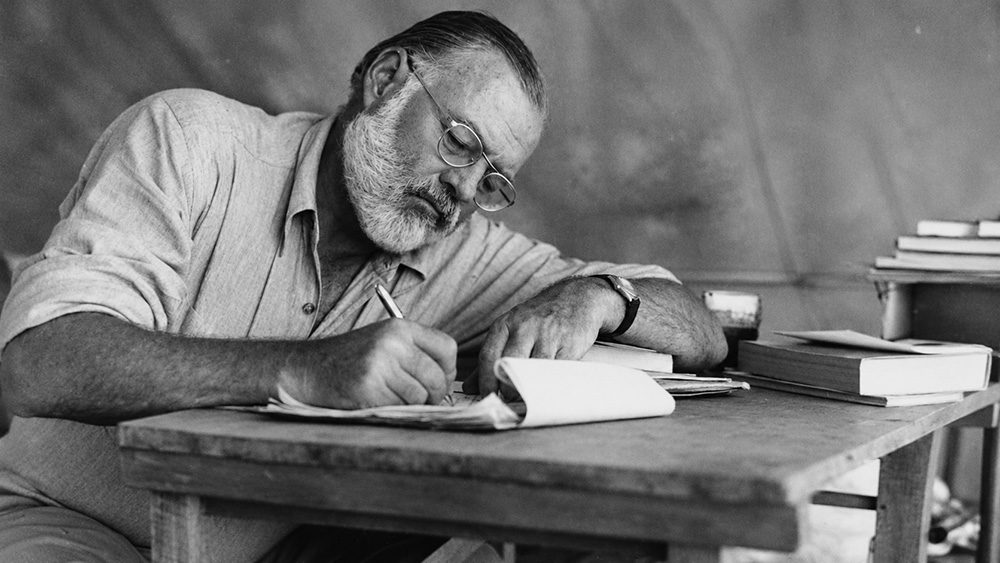
Ernest Hemingway writes in the bedroom of his home in San Francisco de Paula, a suburb of Havana. He has a room set aside for writing in the square tower at the southwest corner of the house. Yet he prefers to write in the bedroom. He goes to the tower room only when ‘characters’ (characters) drive him there.
The ground-floor bedroom adjoins the main room of the house. The door between them is propped slightly open with a heavy volume, The World’s Aircraft Engines. It is a book that catalogues and describes the world’s aircraft engines. The bedroom is large. White walls. Pale yellow tile floor. Windows facing east and south let in the daylight. Plenty of light.
Two chest-high bookcases extending into the room from opposite walls divide it into two separate areas. One is dominated by a large, low double bed. At its foot, large slippers and loafers are neatly arranged. A few books are stacked on each of the two small bedside tables. In the other area stands a large table, with a chair on either side. Its surface is heaped with papers and mementoes. In a corner of the room, a leopard skin is spread over a bureau. White bookcases stand along the other walls. There is not enough space in them, and books lie on the floor as well. Books are also piled on top of the bookcases, among old newspapers, bullfighting magazines, and bundles of letters bound tightly with rubber bands.
Hemingway’s ‘writing desk’ is beside one of these crowded bookcases. It stands against the wall near the east window, three feet from his bed. Its capacity is limited. Books, newspapers, papers, manuscripts, and pamphlets are crammed into it. On top there is room only for a typewriter, a wooden reading board, a few pencils, and a lump of copper. The metal serves to keep the papers from blowing away when a breeze comes through the east window.
From the beginning, Hemingway has been accustomed to writing standing up. Wearing large loafers, he stands on a worn deerskin. The typewriter and reading board are before him at chest height.
When beginning a new work, he always uses a pencil. He writes on onionskin typing paper laid on the reading board. A sheaf of blank sheets is held on a clipboard to the left of the typewriter. “These cost money,” he says, drawing them out one at a time from beneath the metal clip. He lays the sheet at an angle on the board, rests his left forearm on it, and holds the paper with his hand as he writes. Over the years his handwriting has grown larger and more boyish. There is little punctuation and very little capitalization. In place of a full stop, he usually puts an ‘X’. When he has finished a page, he turns it face down and clips it to another board to the right of the typewriter.
Only when the writing is going quickly and well, or when he is writing passages that come easily to him, such as dialogue, does he move from the writing board to the typewriter.
“So as not to kid myself,” he records the number of words he writes each day. This tally is kept on a large piece of cardboard cut from the side of a box. The cardboard is propped beneath the elk’s head that decorates the wall. Below the animal’s nose, the daily figures vary: 450, 575, 462, 1250, then 512. If he plans to go fishing in the Gulf Stream the next day, he writes more that day so that he will not feel guilty. On those days the word count rises.
A man who does not alter his habits, Hemingway does not use the comfortable table in the room. Though it offers more space for writing, it too holds an assortment of objects: bundles of letters; a stuffed toy lion; a small jute bag containing the teeth of carnivorous animals; shotgun shells; wooden carvings of a lion, a rhinoceros, two zebras, and a tusked wild boar. These carvings stand in a neat row on the table. Along with them, as always, are books. Novels, histories, volumes of poetry, plays, and essays lie piled on the table and beside the small tables, or are crammed into the shelves without any attempt at classification.
A glance at the titles reveals their variety. On the shelf opposite his knees as he stands at his ‘writing desk’ are Virginia Woolf’s The Common Reader, Ben Ames Williams’s House Divided, The Partisan Reader, Charles A. Beard’s The Republic, Tarle’s Napoleon’s Invasion of Russia, Peggy Wood’s How Young You Look, Alden Brooks’s Shakespeare and the Dyer’s Hand, Baldwin’s African Hunting, T. S. Eliot’s Collected Poems, two books on General Custer’s defeat at the Battle of the Little Bighorn…
At first glance the room may seem untidy. A closer look reveals that its owner is essentially orderly, but cannot bring himself to throw anything away, especially anything bound up with memories. An assortment of mementoes is heaped on top of one bookcase: a giraffe made of wooden beads, a small cast-iron turtle, model locomotives, two jeeps, a Venetian gondola, a toy bear with a key in its back, a monkey holding two cymbals, a small guitar. A tin toy resembling a U.S. Navy biplane lies tilted on a round straw mat. It is missing a wheel. The collection recalls the odds and ends one might find on opening a shoebox at the back of a boy’s cupboard.
Yet these things are valuable to him. The three buffalo horns he keeps in his bedroom are dear to him in much the same way. Not because they are large, but because things went badly during the effort to secure them in the wild, and turned out well in the end. “Looking at them cheers me up,” he says.
Hemingway may admit to such superstitions, but he does not like to discuss them. He feels that talking about them will rob them of their value. His attitude toward writing is much the same. Several times during this interview he stressed that the art of writing must not be damaged by excessive scrutiny:
“There is a solid part of writing that you can talk about without doing any harm. But another part is fragile. If you talk about it, the structure will crack, and you will have nothing left.”
Hemingway is a gifted storyteller with a rich sense of humor. His knowledge of the things that interest him is astonishing. Yet he finds it difficult to talk about writing. This is not because he has few ideas about it. He firmly believes that they should not be expressed. Questions about them leave him “spooked”—one of his favorite words. He becomes almost unable to speak. He preferred to write out many of the answers to this interview at his board. He feels strongly that writing is a private task undertaken in solitude, needing no witnesses until the work is finished. The occasional sharpness of his answers is an expression of this feeling.
This dedication to his art may seem at odds with the image of Hemingway lodged in the reader’s mind: a carefree man roaming the world in pursuit of pleasure. In fact, Hemingway, who so openly enjoys life, brings the same dedication to everything he does. It is an attitude that takes everything seriously and despises fraud, deceit, halfhearted effort, and shoddy work.
It is in this bedroom with its pale-yellow tiles that his dedication to his art is most clearly apparent. Rising early, he stands at the writing board in complete concentration. His only movement is to shift his weight from one foot to the other. When the writing goes quickly, he sweats profusely and grows as excited as a boy. If his command of the art eludes him even for a moment, he becomes anxious. He feels inadequate. He stands until noon within the fence of his self-imposed discipline. Then he takes up his wooden walking stick, scarred with knots, and leaves the house, heading for the swimming pool where he swims half a mile every day.
Plimpton: Do you find the time you spend writing enjoyable?
Hemingway: Very much.
Could you say a little about how you write? When do you write? Do you keep strictly to set hours?
When I am working on a book or a story, I begin writing every day as soon after dawn as I can. There is no one to disturb you. It is cool or cold. As you write, you grow warm. I read what I have already written. Since I always stop at a place where I know what will happen next, I go on from there.
While I still have some energy left to write, I stop at a place where I know what will happen next. Then I try to get through the time until I begin again the next day. Suppose I start at six in the morning. I may write until noon, or finish even earlier. When you stop, you feel empty. At the same time, you feel not empty at all, but overflowing. Like the feeling after making love with someone you love. Nothing can trouble you. Nothing can happen to you. Nothing else means anything until you write again the next day. Waiting until the next day is the hard part.
When you are away from the typewriter, can you put the work you are writing out of your mind?
Certainly. But it takes self-discipline. You have to acquire that discipline through practice. You simply have to.
Do you rewrite as you read up to the point where you stopped the day before? Or do you do that only after the whole work is finished?
Every day I rewrite up to the point where I stopped the day before. When it is all finished, naturally I go over the whole thing again. Looking at a clean copy typed by someone else gives me another chance to correct and rewrite. The last chance comes when I correct the proofs. I am grateful for every such opportunity.
How much do you rewrite?
It depends on the work. I rewrote the ending of Farewell to Arms, its last page, thirty-nine times before I was satisfied.
Was there some technical problem with the writing there? What was giving you trouble?
Getting the words right.
Is rereading what gives you that “energy to write”?
When I reread, I can see that I have written as well as I could up to that point. It brings me to the point where I simply have to go on writing. The urge to write is always there.
Are there times when you have no creative inspiration at all?
Certainly there are. But if you have stopped at a point where you know what will happen next, you can go on. Once you have started, there is no problem. The energy comes.
Thornton Wilder speaks of mnemonic devices that help a writer begin the day’s work. Apparently you once told him that you sharpen twenty pencils.
I don’t remember ever having twenty pencils. If you wear down seven number-two pencils writing, you can say you have done a good day’s work.
What places have you found best suited to writing? Judging by the number of books you wrote there, the Ambos Mundos Hotel must be one of them. Or do surroundings not have much influence on the writing?
The Ambos Mundos in Havana is a very good place to write. The Finca farmhouse is a wonderful place. Or it used to be. But I have written well everywhere. That is, I have been able to write as well as I could in different surroundings. The telephone and visitors are what ruin the work.
Is an even state of mind essential to writing well? You once told me that you could write well only when you were in love. Could you explain that a little further?
What a question. Still, full marks for trying. You can write at any time if people leave you alone. More precisely, you can write if you can be ruthless enough to keep anyone from interrupting you.
But the very best writing certainly comes when you are in love. If you don’t mind, I would rather not explain that any further.
What do you think about financial security? Can it be detrimental to good writing?
If you have financial security early in life, you may love living as much as you love writing. You will want the tempting comforts it offers. Once writing has become your chief habit and your greatest pleasure, only death can stop it. Then financial security is a great help; it keeps you from day-to-day worry. Worry blunts the ability to write. Ill health harms your writing as much as it causes you distress. Sorrow strikes at the depths of the mind and destroys the energy that wells up within.
Do you remember a particular moment when you decided to become a writer?
No. I had always wanted to be a writer.
In his book about you, Philip Young says that the shock of the severe wound you received from a mortar shell in 1918 profoundly affected you as a writer. I remember your speaking briefly about this view of his in Madrid. You said there was not much to it, and that you considered an artist’s ability to be inherited, along Mendelian lines, rather than a quality developed later in life.
I cannot say that my state of mind was very sound in Madrid that year. I spoke only briefly about Young’s book and his theory of explaining literature through trauma. The two concussions and the fractured skull I suffered that year may have made me talk irresponsibly. I remember telling you that imagination might arise from the inherited experience of a race. That may sound fine when you are joking around after a concussion. But I think it is best left there. So let us leave it there until the ‘next liberating trauma’ comes along. All right!
Thank you for removing the names of the relatives I dragged into this. Exploring ideas is what makes conversation interesting. But much of that sort of talk should not be put into writing. Nothing said irresponsibly should be written down. Once you have written it, you have to take responsibility for it. You may have said it merely to find out whether you believed it yourself.
To return to your question. The effects of wounds vary. Ordinary wounds without broken bones do not matter very much. Sometimes they can even give you confidence. Wounds that do great damage to bones and nerves are not good for writers or for anyone else.
What do you think is the best intellectual training for someone who wants to be a writer?
Suppose he is going to hang himself because he cannot write well and realizes how difficult it is. Then, without mercy, he must cut himself down and escape. For the rest of his life he must try to write as well as he can. He must discipline himself. At least he will have the story of his attempt to hang himself to begin with.
What do you think of those who have gone into academic work? Have the many writers who teach compromised their literary lives?
It depends on what you mean by ‘compromise.’ Do you mean it in the sense in which a woman’s reputation is compromised? The compromise a politician makes? Or the compromise you make with your grocer or tailor, agreeing to pay a little more, but later?
A writer who has the ability both to write and to teach can do both. Many able writers have done so. I know I could not. I respect those who can. Still, I think academic life may put an end to experience of the outside world and so keep one’s knowledge of the world from expanding. But as knowledge deepens, the writer’s responsibility increases too; writing becomes more difficult.
Trying to write something of lasting value is a full-time job, even if only a few hours are spent on the actual writing. A writer can be compared to a well. There are as many kinds of wells as there are kinds of writers. What matters is that there should be good water in the well. It is better to draw enough water than to pump it dry and wait for it to fill again. I have strayed from the question. But the question is not very interesting.
Would you recommend newspaper work to a young writer? Kansas City Star —how much did your training there help you?
At the Star, you had to learn to write a simple sentence that said something directly. That is useful to anyone. Newspaper work will not harm a young writer and can help him if he gets out of it in time. This is one of those pieces of advice that have grown stale with repetition. I apologize for it. But if you ask old, worn-out questions, you will get dull answers.
You once wrote that the only reason to engage in journalism was to be well paid, in the Transatlantic Review . You said, “When you write about what is valuable within you, and so get it out of you, you want to be paid a great deal for it.” Do you regard writing as a kind of self-destruction?
I do not remember writing that. I may have said something like it to avoid the trouble of giving a sensible answer. The statement is that foolish and reckless. I certainly do not regard writing as self-destruction. Still, beyond a certain point, journalism can become a daily act of self-destruction for a serious creative writer.
Does the intellectual stimulation of friendship with other writers help a writer?
Certainly.
When you associated with other writers and artists in Paris in the 1920s, was there a ‘group feeling’?
No. There was no group feeling. We respected one another. I respected many painters. Gris, Picasso, Braque, Monet—some were my age; some were older. Monet was still alive then. I also respected certain writers, such as Joyce and Ezra Pound, and what was good in Gertrude Stein.
When you are writing, is your work influenced by what you are reading at the time?
Not since the time when Joyce was writing Ulysses. Even his influence was not direct. There was difficulty in using the words we knew; we had to fight for every word. It was the influence of his work that changed everything at that time. It showed us how to break free of the restrictions.
Have you been able to learn anything about writing from other writers? Yesterday, for example, you said that Joyce did not like to talk about writing.
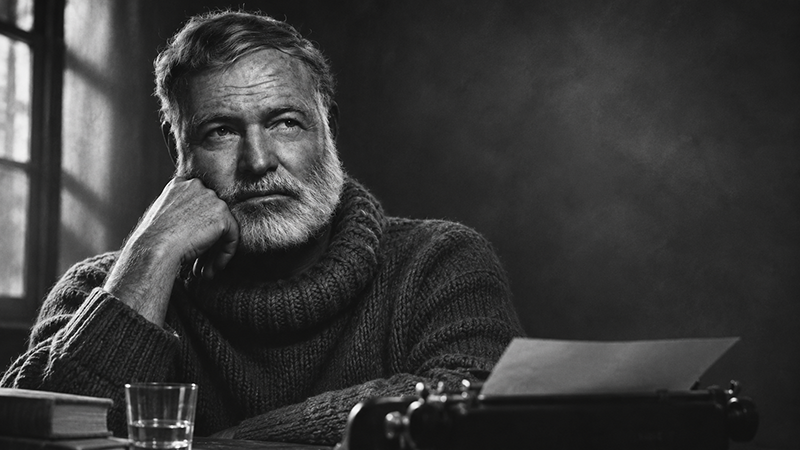
When you are among writers, the talk is generally about other writers’ books. The better a writer is, the less he talks about what he has written. Joyce was a great writer. He explained what he was doing only to fools. He expected other writers he respected to understand what he had written by reading it.
You seem to have withdrawn from the company of other writers in recent years. Why?
The reason is rather complicated. As you go further in writing, you grow more solitary. Most of your old friends are dead. Others move far away. You seldom get to see them. But you write letters. The friendship continues just as it did when you sat together in the cafés in the old days. We exchange funny letters; sometimes they are high-spirited, sometimes a mixture of obscenity and irresponsible talk. It is almost like talking face to face.
Still, you grow more solitary. Because you have to write alone. And the time you have keeps growing shorter. If you waste it, you feel you have committed an unforgivable sin.
How have some of these contemporaries influenced your work? What was Gertrude Stein’s influence, if any? Ezra Pound’s? Max Perkins’s?
I am sorry. I am no good at these post-mortems. There are coroners in literary circles and outside them to attend to all that. Stein has written at length, and with considerable inaccuracy, about her influence on my writing. She says this after my book The Sun Also Rises came out, after she learned to write dialogue. I was very fond of her. I thought it was wonderful to have learned to write dialogue from her. It was nothing new for me to learn from anyone I could, living or dead. I did not know it would affect Gertrude so badly. Apart from that, she had already written well. Ezra was extremely intelligent about the things he really knew.
Doesn’t this talk bore you? It is as distasteful as washing dirty linen from thirty-five years ago and gossiping in the backyard. It would be different if we tried to tell the whole truth. There would be some value in that.
Instead, I can give thanks for everything I learned from Gertrude about the abstract relationship between words; I can say how much I loved her. I can reaffirm my loyalty to Ezra, a great poet and a faithful friend. I can say that because of my love for Max Perkins, I still cannot accept that he is dead. It is simple to say it this way here. And it is better.
Perkins never asked me to change anything I wrote, except to remove a few words that could not be printed at the time. Those spaces were left blank. Anyone who knew the words would know what had been there. To me he was not an editor; he was a wise friend, a wonderful companion. I like the way he wore his hat and the peculiar way his lips moved.
Whom would you name as your literary forebears? From whom have you learned the most?
Mark Twain, Flaubert, Stendhal, Bach, Turgenev, Tolstoy, Dostoevsky, Chekhov, Andrew Marvell, John Donne, Maupassant, Kipling’s good work, Thoreau, Captain Marryat, Shakespeare, Mozart, Quevedo, Dante, Virgil, Tintoretto, Hieronymus Bosch, Bruegel, Patinir, Goya, Giotto, Cézanne, Van Gogh, Gauguin, San Juan de la Cruz, Góngora… It would take a day to remember them all. A list like that would not seem like a recollection of those who have influenced my life and work; it would look as though I were showing off an erudition I do not possess.
This is not an old, tired question. It is a very good question, but a serious one. A question that calls for an examination of conscience. I included painters—or began to include them—because I have learned as much about how to write from painters as from writers. Are you asking how? It would take another day to explain. I think it is obvious how learning from composers, and studying harmony and counterpoint, can help one’s writing.
Have you ever played a musical instrument?
I used to play the cello. My mother kept me out of school for a whole year so that I could study music and counterpoint. She thought I had musical talent. But I had none at all. We used to play chamber music. Someone would come to play the violin; my older sister played the viola and my mother the piano. There cannot have been anyone in the world who played that cello worse than I did. That year I was also going out and doing other things.
Do you reread the writers on your list? Twain, for instance?
I have to wait two or three years before rereading Twain. I remember what he wrote so clearly. I read a little Shakespeare every year. I never miss reading Lear. Reading it cheers me up.
Then reading is both a constant occupation and a pleasure for you.
I am always reading books. I will read as many as I can get. I ration my reading so that there will always be something left to read.
Do you read manuscripts?
Unless you know the writer personally, you can get into trouble doing that. A few years ago a man sued me for plagiarism. He claimed I had stolen For Whom the Bell Tolls from an unpublished screenplay he had written. He said he had read the screenplay at a Hollywood party. He said I had been there. Someone called ‘Ernie’ had been there listening. That was enough for him to sue for a million dollars.
At the same time he sued the producers of Northwest Mounted Police and Cisco Kid. Those films, too, had supposedly been stolen from the same unpublished screenplay. We went to court. We won the case. It turned out that the man could not even afford to pay his debts.
Shall we go back to that list and take one of the painters? Hieronymus Bosch, for instance. The nightmarish symbolism of his paintings seems very far removed from your work.
I have nightmares. I know about other people’s nightmares too. But you do not have to write them all. If you leave out something you know well, it will still be there in your writing, and its quality will come through. But if a writer leaves out things he does not know that the story needs, they will show up as holes in his writing.
Then does an intimate knowledge of the work of those on your list help fill the ‘well’ you mentioned earlier? Or did you deliberately use their work to develop your writing techniques?
They were part of learning to see and hear and think and feel and not feel and write. The well is where your ‘strength to write’ is. Nobody knows what it is made of, and you know least of all. All you know is whether you have it now or must wait for it to come back.
Would you acknowledge that there are symbols in your novels?
I suppose there may be, since critics keep finding them. Please do not misunderstand me; I do not like talking about them or being questioned about them. Writing books and stories is difficult enough. It would be good not to be asked to explain them as well. If I explained them myself, I would also be taking work away from the interpreters. If five or six good interpreters, or even more, can keep on interpreting, why should I interfere? Read everything I write for the pleasure of reading. If you find anything else in it, that only shows how much you yourself bring to the reading.
Just one more question along these lines. One of the editors on our advisory board believes he sees a parallel between the characters in The Sun Also Rises and the participants in a bullfight. He points out that the very first sentence of the novel tells us Robert Cohn is a boxer. Later, when the bulls are released from their pens, a bull is described as hooking and jabbing with its horns like a boxer. Just as a fighting bull is drawn to the presence of a steer and quieted by it, Robert Cohn submits to Jake, who is castrated like the steer. He sees Mike, who repeatedly taunts Cohn, as the picador who attacks the bull with a lance from horseback. His interpretation goes on at greater length. His question is whether you wrote the novel with the intention of giving it the tragic drama of the bullfighting ritual.
That advisory editor seems to have a screw loose. Who said Jake was ‘castrated like a steer’? His wound was actually of an entirely different kind. His testicles were whole and undamaged. So he had all the normal feelings of a man, but could not fulfil them through sexual intercourse. The important distinction is that his wound was physical, not psychological, and that he had not been castrated.
These questions probing into writing techniques really are irritating.
An intelligent question gives neither pleasure nor irritation. Still, I continue to believe that it is very harmful for a writer to talk about how he writes. He writes to be read by the eye. It should need no explanations or dissertations. You can be sure there is more in it than appears on a first reading. Once he has created it, it is not the writer’s job to explain it or to take the reader by the hand and lead him through the difficult parts of his work.
I remember your warning that it is dangerous to talk about a work in progress, that you can ‘talk it out.’ Why is that? I ask because many writers—Twain, Wilde, Thurber, Steffens—seem to have refined their material by trying it out on listeners.
I cannot believe that Twain ‘tried out’ Huckleberry Finn on listeners. If he had, they would have made him cut the good things and put in the bad parts. People who knew Wilde said he talked better than he wrote. Steffens talked better than he wrote. At times it was hard to believe either his writing or his talk. I have heard many of his stories change as he grew older. If Thurber can talk as well as he writes, he must be one of the finest and least boring talkers. The man I know who can talk best about his profession, and whose talk has the most charm and mischief, is the bullfighter Juan Belmonte.
How much conscious, deliberate effort did you put into developing a distinctive style of your own?
That is a long, tiring question. If you spent two days answering it, you would become so self-conscious that you could no longer write naturally. When you try to create something for the first time that has never been created before, certain distortions are inevitable. Usually these are what the inexperienced call ‘style.’ Almost no new classics resemble the classics that came before them. At first people see only the distortions. Later they become less noticeable. In the beginning, when the distortions are conspicuous, many people mistake them for style and imitate them. That is unfortunate.
You once wrote to me that more could be learned simply by knowing the circumstances in which different works were written. Could you illustrate this with The Killers? You said you wrote it, Ten Indians, and Today Is Friday all in one day. Could you also tell us about your first novel, The Sun Also Rises ?
Let us see. I began The Sun Also Rises in Valencia on my birthday, July 21. My wife Hadley and I had gone to Valencia early to get good tickets for the feria, which began on July 24. Everyone my age had written a novel. I had trouble writing even a paragraph. So I began the book on my birthday. Throughout the fiesta I wrote in bed in the mornings. I continued when we went to Madrid. There was no fiesta there. We got a room with a table. I wrote comfortably at that table. I also sat and wrote in the beer hall in the Pasaje Alvarez, just around the corner from the hotel. It was cool there.
Finally it became too hot to write, so we went to Hendaye. There was a small, inexpensive hotel on the long, beautiful beach. I wrote well there too. Then I went to Paris. I finished the first draft in the apartment above the sawmill at 113 rue Notre-Dame-des-Champs. It had been six weeks since I began. I showed the first draft to the novelist Nathan Asch. He spoke English with a strong foreign accent then. “Hem, you say you have written a novel. What do you mean? A novel, Hem? What you are writing is a travel book,” he said. I was not too discouraged by what Nathan said. I rewrote the book at the Hotel Taube in Schruns, in the Vorarlberg. I kept the travel passages—the fishing trip and the parts about Pamplona.
I wrote the stories you mentioned in a single day in Madrid, on May 16. It was the day the San Isidro bullfights were cancelled because of snow. First I wrote The Killers. It was a story I had tried to write before and failed. After lunch I lay in bed to keep warm and wrote Today Is Friday. The urge to write was so strong that I thought I might be going crazy. I had six more stories to write. So I dressed and walked to Fornos, the old bullfighters’ café, and had coffee. Then I came back and wrote Ten Indians. It made me very sad. I drank a little brandy and went to sleep. I had forgotten to eat. A waiter brought some bacalao, a small piece of meat, fried potatoes, and a bottle of Valdepeñas.
The woman who ran the boarding house was worried that I was not eating enough. She had sent the waiter. I remember sitting up in bed, drinking the Valdepeñas and eating. The waiter said he would bring another bottle. He also said the woman had asked whether I was going to write all night. I said no, I thought I would rest a little. He asked why I did not try writing another story. I said I could only write one. He said that was nonsense. He said I could write six. I said I would try tomorrow. “Try tonight. What do you think the old woman sent the food for?” he said.
I said I was tired. He said that was nonsense. No, nonsense was not the word he used. “Tired from writing these three miserable little stories? Translate one of them for me,” he said.
“Leave me alone. How can I write if you don’t leave me alone?” I said. Then I sat in bed drinking Valdepeñas and thinking what a writer I was, since the first story was as good as I had hoped.
How clearly do you have the complete shape of a short story in mind? Do its theme, plot, or characters change as you write?
Sometimes I know the story beforehand. Sometimes I make it up as I go along and do not know how it will end. Everything changes as the story moves. In those changes is the movement that makes the story. Sometimes it is so slow that you cannot see it moving. But there is always change and movement.
Is it the same with a novel? Or do you work out the whole plan before you begin and write without departing from it?
I treated For Whom the Bell Tolls as a problem to be solved each day. I knew basically what was going to happen. But I invented what happened in it each day as I wrote.
The Green Hills of Africa, To Have and Have Not, Across the River and Into the Trees —did these begin as short stories and grow into novels? If so, are the two forms alike enough for you to move from a short story to a novel without completely changing your approach?
No. That is not true. The Green Hills of Africa is not a novel. It was an attempt to write a book based entirely on fact. I wanted to see whether a country’s landscape and the course of a month’s events, if presented truthfully, could compete with a work of the imagination.
After writing it, I wrote two short stories, The Snows of Kilimanjaro and The Short Happy Life of Francis Macomber. They were stories I invented from the knowledge and experience gained on that same long hunting trip. It was one month of that trip that I had tried to recount truthfully in The Green Hills. Both To Have and Have Not and Across the River and Into the Trees did begin as short stories.
Do you move easily from one work to another? Or do you keep at what you have begun until it is finished?
I have stopped work I was seriously engaged in to answer these questions. That alone shows that I am a fool who deserves severe punishment. I will be punished. Don’t worry.
Do you think of yourself as competing with other writers?
Never. There are a few dead writers whose worth I have no doubts about. I used to try to write better than they did. For a long time now, I have only tried to write as well as I can. Sometimes I have the luck to write better than I can.
Does a writer’s power diminish with age? The Green Hills of Africa is where you say that American writers become ‘Old Mother Hubbards’ at a certain age, isn’t it?
I don’t know about that. Those who know what they are doing must keep writing as long as their brains work. If you look at the book you mentioned, you will see: I was talking off the top of my head about American literature to a humorless Austrian who had forced me to talk when I wanted to do something else. I wrote down that conversation accurately. I was not trying to pronounce judgments that would stand forever. Still, quite a few of them are pretty good.
We haven’t yet talked about characters. Are all the people in your work taken from real life?
Certainly not. Some come from real life. Mostly I create people out of my knowledge, understanding, and experience of human beings.
Can you tell us how you turn a real person into a fictional one?
Explaining how it is done in some cases would amount to a handbook for lawyers handling libel suits.
Do you distinguish, as E. M. Forster does, between one-dimensional and multidimensional characters—flat and round characters?
If you describe someone, the result will be flat, like a photograph. To my mind, that is a failure. If you create that person in your imagination out of what you know, they will have all the dimensions.
Which of your characters do you remember with particular affection?
That would be a very long list.
Then do you enjoy rereading your own books without feeling the urge to revise them?
When writing is difficult, I sometimes read them for encouragement. Then I remember that it was always difficult, and that sometimes it was almost impossible.
How do you name your characters?
As well as I can.
Does the title come to you while you are writing the story?
No. I make a list of titles after finishing the story or book. Sometimes there are as many as a hundred. Then I begin eliminating them one by one. Sometimes I eliminate them all.
Do you do this even when the title comes out of the story itself? Hills Like White Elephants, for example?
Yes. The title comes afterward. I met a woman when I had gone to Prunier to have oysters before lunch. I knew she had had an abortion. I went over and spoke to her. That was not what we talked about. But on the way home the story came to me. I skipped lunch and spent the whole afternoon writing it.
Even when you are not writing, you are constantly observing, looking for things that might be useful, aren’t you?
Certainly. If a writer stops observing, he is finished. But he need not observe deliberately or think about how something might be useful. Perhaps he does in the beginning. Later, everything he knows and has seen forms a great store within him. Everything new he sees is added to it. If it is any use to know this, I will tell you: I always try to write according to the iceberg principle. Seven-eighths of it is underwater. You can leave out anything you know. It will remain as the unseen part and only strengthen your iceberg. But if you leave something out because you do not know it, there will be a hole in the story.
The Old Man and the Sea could have run to more than a thousand pages. I could have brought in every person in the village. I could have written about how they are born, make their living, get an education, and have children. Other writers have done those things wonderfully. What has already been done well in writing also sets limits on what new things you can do. So I tried to learn to do something else. First, I tried to leave out everything that was unnecessary for the reader to feel an experience. When he has finished reading, it should have become part of his experience; it should seem to have really happened. That is very difficult to do. I have worked hard at it.
Let us leave aside how I did it. This time I was unbelievably lucky. I was able to convey the experience fully to the reader, and an experience no one had ever given in writing before. My luck was in having a good man and a good boy. Recent writers have forgotten that such people still exist. The sea is as worthy of being written about as man. I was lucky there too.
I have seen marlin mating; I know about it. So I leave it out. In those same waters I have seen a school of more than fifty sperm whales. Once I harpooned a whale nearly sixty feet long and lost it without being able to bring it in. So I left that out too. I left out all the stories I knew about the fishing village. But that knowledge is what makes up the underwater part of the iceberg.
Archibald MacLeish has spoken about your method of conveying an experience to the reader. Kansas City Star was where you developed it, he said, while reporting on baseball games. The method involves recording small details precisely and conveying the experience through them. By making the reader clearly aware of something he had until then sensed only subconsciously, those small details suggest the whole…
That story is not true. I never wrote about baseball for the Star. Archie was trying to recall the way I was trying to learn to write in Chicago around 1920. I looked for the little things that people overlook but that stir the emotions. The way an outfielder throws his glove away without looking back to see where it has fallen; the squeak of resin on canvas under a boxer’s flat-soled training shoes; the gray color of Jack Blackburn’s skin when he had come out of prison—I noted these and other such things as a painter might sketch them. Before you knew Blackburn’s history, you saw his strange color, the old razor scars, and the way he swung his punches at an opponent. These were what stirred your emotions before you knew his story.
Have you ever written about situations you had no direct or personal knowledge of?
A strange question. When you say personal knowledge—do you mean sexual experience? If so, yes. A good writer does not merely describe. He creates in his imagination out of knowledge gained directly and in other ways; he makes something new. At times he seems to possess knowledge whose source cannot be explained. It may have come from the forgotten experience of his race or his family. Who teaches a homing pigeon to fly that way? Where does a fighting bull get its courage? Where does a hunting dog get its nose? This is an expansion—or a condensation—of the things we talked about in Madrid at that time when my brain was not working properly.
How much distance do you need from an experience before you can write it as fiction? For example, the plane crashes you were in in Africa?
It depends on the experience. One part of you stands completely apart from the beginning and watches it. Another part is deeply caught up in it. There is no rule about how soon you should write about it. It depends on the person’s mental balance and powers of recovery.
Being in a plane that crashes and catches fire is certainly a valuable experience for a trained writer. He learns many important things very quickly. For them to be of use to him, he must first survive. Surviving with dignity is as difficult as ever. ‘Dignity’ may be an outmoded word, but it is very important. For a writer, too, surviving with dignity is very important.
It is always those who do not last who are loved more. Some people wage a long, tedious, unrelenting struggle to get something done, before they die, in the way they believe is right. In those who do not last, no one has to witness that struggle, fought without giving or receiving pity. Those who die or give up quickly and easily, and for good reasons, are more loved. They can be understood; they are human. Failure and concealed cowardice are still more human, still more loved.
How much concern do you think a writer should have for the social and political problems of his time?
Everyone has a conscience of their own. There should be no rules about how a conscience must function. There is only one thing you can say with certainty about a politically committed writer: if his work endures, you will have to skip the political passages when you read it. Many so-called politically committed writers change their politics frequently. This creates a great deal of excitement for them and for their political and literary journals. Sometimes they have to rewrite their positions, too… and in a hurry. Perhaps it deserves respect as a way of pursuing happiness.
Has Ezra Pound’s political influence on the segregationist Kasper affected your belief that the poet should be released from St. Elizabeths Hospital?
No. Not at all. I believe Ezra should be released and allowed to write poetry in Italy, provided he promises not to engage in politics in any way.[1] I would be happy to see Kasper jailed as soon as possible. Great poets do not have to be Girl Scouts or scoutmasters; nor do they have to be exemplary models for the young. Let me give you a few names: Verlaine, Rimbaud, Shelley, Byron, Baudelaire, Proust, Gide. They should not have been locked up for fear that local Kaspers might imitate their thinking, conduct, or morals. I firmly believe that ten years from now this paragraph will need a footnote to explain who Kasper was.
Would you say there is a didactic purpose in your work?
‘Didactic’ is a word that has been spoiled by misuse. Death in the Afternoon is a book of instruction.
It is said that a writer deals with only one or two ideas throughout his work. Would you say your work, too, reflects one or two ideas?
Who said that? It is an oversimplification. Perhaps whoever said it had only one or two ideas.
Perhaps this would be a better way to put it. Graham Greene said that a writer’s deep preoccupation provides a thread connecting a shelf full of his novels. I think you, too, have said that great writing springs from a sense of injustice. Is it important for a novelist to be possessed by some such strong feeling?
Greene has a knack for pronouncements; I do not. Whether it is a row of novels on a shelf, a flock of snipe, or a flock of ducks, I cannot make a sweeping pronouncement about it. Still, I will try one. A writer without a sense of justice and injustice would be better off editing the yearbook of a school for ‘exceptional children’ than writing a novel. Another generalization. You see, they are not so difficult if you stick to the obvious.
The most essential equipment for a good writer is a built-in, shockproof ‘crap detector.’ That is the writer’s radar. All great writers have had it.
Finally, a fundamental question: as a creative writer, what do you think is the function of your art? When the actual event exists, why do we need a work that depicts it?
What is there to be confused about? Out of what has happened and what exists now, out of everything you know and even everything you cannot know, you create something through imagination. It is not merely a depiction. It becomes something entirely new, truer than anything real and alive. You give it life. If you can make it well, you give it immortal life too. That is why you write, and for no other reason you know of. But then there are all the other reasons that no one knows!