
Selected pages in the book “The Impersonal Personhood – an Alternative Buddhist Perspective, written by V Amalan Stanley, published by Thamizhini, 2023
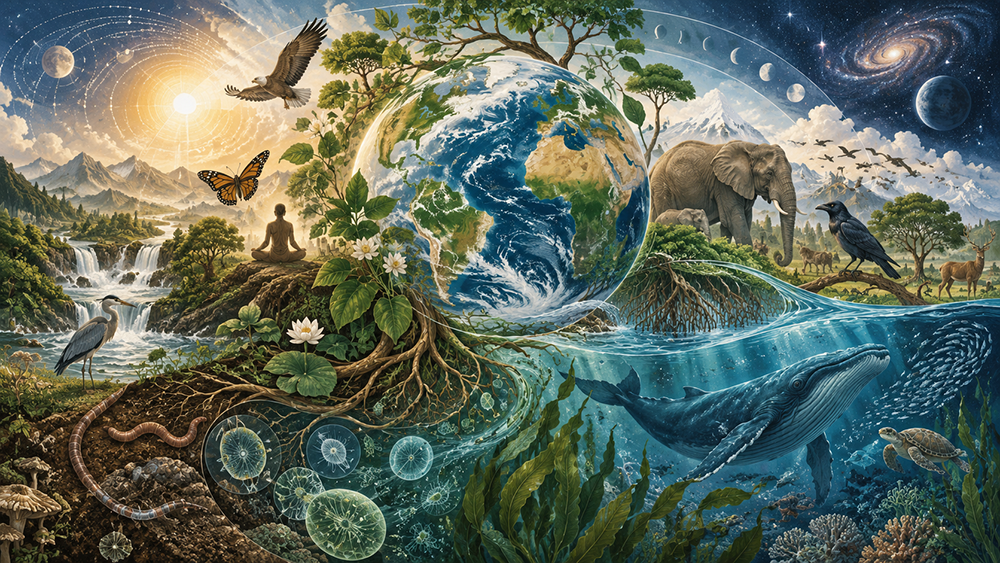
Considering the whole planet earth as a single living biosphere, every life form is an
equally inevitable member of its ecosystem, be it a microorganism or an exaggerated
body of entity, such as an elephant or a huge whale.
Looking at human life with an ecological perspective based on its own principles and
functionality is, in a way, a spiritual journey of enrichment and meaning by itself.
Understanding and abiding by the specific roles enshrined under the umbrella of
global functioning within the different ecosystems of this planet’s biosphere can itself
provide a spiritually fulfilling experience in one’s lifetime.
In living and functioning within the given gamut of an ecosystem, there’s a huge
meaning that could be attributed to each one’s existence. This is because each
member of an ecosystem naturally contributes to its ecosystem at both the micro and
macro levels, the same way it draws up its resources; micro means the immediate
ecosystem, which the human species belongs to. Macro includes the planet as a
whole. And it could be poignantly stated that ecological functionality does not stop
willy-nilly with the operations of the planet, but beyond it, interconnects with the
planets and abiotic factors of the solar system, which includes the milky way and the
entire cosmos. This is due to the main reason that solar energy is the only life energy
as an individual and whole in this life supporting biosphere.
With the principles of ecological sustainability and balance, including the carrying
capacity of an ecosystem, the birth and death of every single member of organism is
merely an eternal dance of interaction; an ananda thandavam, with the related biotic
and abiotic factors within its ecosystem as a member of its species, generation after
generation. The process of independent assortment, one of the three laws of
genetics promulgated by Sir Gregor Mandel itself reflects the reality of impersonation
in the DNA replication of an organism in its early developmental stages. There’s
impersonation with details in the Mendelian laws of genetics – law of dominance, law
of independent assortment and law of segregation.
The genetic recombination happening through crossing over of chromosomes
determines what genetic feature is to be inherited, dominated or made to be
dormant. The exchange of different genetic features obey the law of Mendelian
principles and get manifested in an organism in a way that could be related to the
ancient idea of karma and rebirth as proposed in the Vedic, Buddhist and Sramanic
disciplines and schools. Prarabdha, sanchita and agami; prarabdha experienced
through the actions of the present life as an individual tendency influenced by one’s
unique personality, sanchita being the sum of past actions as an evolutionary and
genetic process, and agami being the impact on our future based on our current
actions; a combination of the first two as well as the proactive, anti-active efforts or
the kinetics and dynamics of an individual in relation to the ecosystem.
Shohaku Okumura Roshi, a famous Japanese Zen master, presents this ecological
perspective in Zen parlance: ‘’Our own life itself is universal and also unique. It
pervades the whole universe, and yet my life is just myself. We cannot share our
lives with others. So this universality and individuality is completely present at this
moment, and we should create our own way of life, our own way of practice based
on that universal reality. That is the wondrous dharma. That is what all buddha-
tathagatas are transmitting, and that is what we are following and trying to practice
each moment, day after day, year after year, until the end of our lives. And through
our practice, the buddha-dharma manifests and influences other people. This is like
a circle. That is what Dogen Zenji calls Jijuyu Zanmai’’.
There’s an order and discipline in the operations of this cosmos as well as an ethical
dimension in the ecological interaction among different species of animals and
plants. Remember that only humans are capable of considering the ethical aspects
of an action. So what is meant to be ecological ethics is the sheer compliance with
the ecological principles as an entity in an ecosystem. Every aspect of the
ecosystem is interdependently woven into the sustainable global ecosystem. The
primary premise of altruism of any ecosystem is that every member of different
species of plants, animals and microorganism as an entity of its member lives
simultaneously, benefiting itself as well as for its ecosystem that it represents. The
definitive and unique aspect of every ecosystem is that none of its members can
afford to be truly selfish. Any kind of selfish act will eventuate into a benefit to other
members of the ecosystem. A simple example is when a member dies. It’s
immediately consumed by other smaller organisms, microbes and non-living forms
such as scavengers, omnivores and detritivores. So there’s nothing that could be
rendered as wasteful unlike this modern human society’s standard of worth or non-
worthiness in terms of materialistic and consumerist attitude.
There’s meaning and purpose in every mundane act of various members of an
ecosystem all the time. When a fly catcher picks up a worm in the air tactfully, it
checks the count of its routine staple plant leaf, thereby protecting the plant from
dying due to much of it being eaten up by the so ‘’pests’’ that will eventually check
the number of its population to maintain the balance; when a butterfly tastes the
honey in an inflorescence, cross pollination happens; when a crow shits, there is a
seed digestively treated for easy germination; when a mature female gets attracted
to a colourfully vibrant, gracefully dancing male fowl, a robust progeny of the next
generation of its species is ensured, and this continues endlessly and relentlessly.
Birth, death, a mere balance of numbers to maintain the carrying capacity of a
particular ecosystem. Again, this clear-cut demarcation of two different ecosystems
is not absolute because no ecosystem can operate as an island, it is
interdependently sustaining itself and extending its support to its neighbourhood
ecosystems. And, interestingly, there’s an ecotone of edge effect confluence of the
two systems with its unique adaptive biological features, an example is an estuary
where a freshwater river meets up and mingles with a salty ocean.
When I say birth and death are related to the carrying capacity of an ecosystem, I
wish to emphasise how birth and marriage are celebrated and how death is regretted
and mourned among the human societies around the globe, which is unique and
completely not observed among any other animal species. Human beings are the
only species that builds a memorial for the dead, as big as an Egyptian pyramid and
mourning year after year as a remembrance, especially of the great spiritual
masters.
And there’s no value judgment like demeaning a particular species as a pest or a
pathogen or something useless (there is no pest in an ecosystem and is therefore
humane). Every form of organism is ecologically useful in its lifetime, even before its
birth, by providing conjugal pleasure to its parents of higher order in the phylum till
death, and after death by means of being a source of food to other organisms.
On a particular sense the whole ecological system is communistic in its core design,
a sense of comradery in its core construct and approach, each of its member
species interdependently coexist and cooperate with each of its other members,
living one’s own life while letting or extending support to other members, perfectly
sustainable and self-fulfilling, moments by moments, seasons by seasons, cycles
after cycles, with intermittent natural disasters and catastrophes. But even those
disasters and catastrophes contribute to ecological sustainability and in balancing
the carrying capacity or preparing the grounds for new ages and eras.
But it’s intriguing to note that this simple natural ecological system has continued to
be sustainable since ancient times, while human-constructed communism couldn’t
survive more than a century. Of course, there’s an obvious cue from the principles of
nature that could be rendered useful for the revival of neo-communism to dawn once
again with assured sustainability and altruism if imbibed deeply into human brains
with the help realizing the flimsiness or transience of this existence, glaringly made
obvious under the pangs of the COVID-19 pandemic.
Fundamentally, in terms of ecological hierarchy, the roles of primary, secondary and
tertiary producers or consumers are mere roles and nothing more than those defined
roles. It is the human mind that attributes a lion as a king of a jungle and other small
creatures living in the jungle as helpless. Yes, it is true that they are vulnerable, but
the predators too are so without any exceptions or specialness. Further, those roles
too are arbitrary in nature as the primary producers by themselves depend on other
biotic and abiotic factors like solar energy, minerals, gaseous exchanges, heat,
humidity and essential elements, collectively the Maha Boothas.
Considering these ecological facts though, one could say that it’s a biologically
spiritual life if one mindfully realizes and lives such a simple way of abiding with the
species’ role in an ecological sense, there is one particular humane aspect that will
be lacking in this dynamic ecological system of sustainability.
Being human and exercising humane qualities of higher levels of conscious living
that involves the human ability to love, show kindness, care and compassion, being
empathetic and willingness to share the life resources with others. This includes
plants and animals or even for the well-being of the environment.
So, finally coming to what’s lacking in the ecological principles is fundamentally the
humane elements, the Buddha’s preferred four sublime planes: Lovingkindness,
compassion, appreciative joy and the broad base of the pyramid, equanimity. By
simply fitting these four jigsaw puzzle pieces of sublime humane aspects to the
almost complete picture of ecologically existential and sustainable framework of all
life forms, as a rational being sitting at the top of the pyramid verily completes the
whole puzzle of meaningful and spiritually fulfilling and contented life. The moment
the puzzle is complete, it’s not merely a survival, but a truly purpose-filled fully
humane life of celebrations, care and joy. This is going to ensure the enlightenment
of whole humanity, not just pieces of instances here and there, a rare happening in a
century, but a true Thathagatha in each household. In such a condition, there’s
happiness, despite the impersonality of happenings. In such cases, there’s suffering,
there’s pain, but there’s also joy, happiness and contentment because there, birth is
comprehended, death too is comprehended, and the whole process of eternity is
also comprehended. So there’s no hole in the bucket as a metaphor of existence, but
the story of human life as a whole.